


Natural language processing in clinical neuroscience and psychiatry: A review
- PMID: 36186874
- PMCID: PMC9515453
- DOI: 10.3389/fpsyt.2022.946387
Natural language processing in clinical neuroscience and psychiatry: A review
Abstract
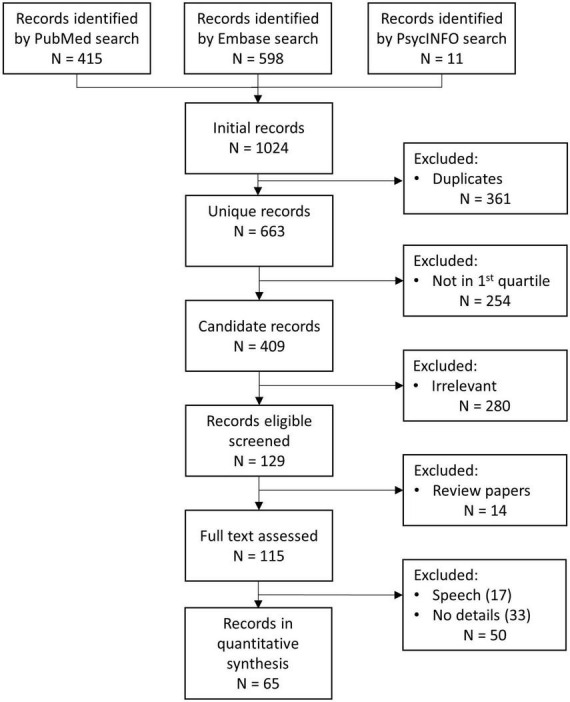
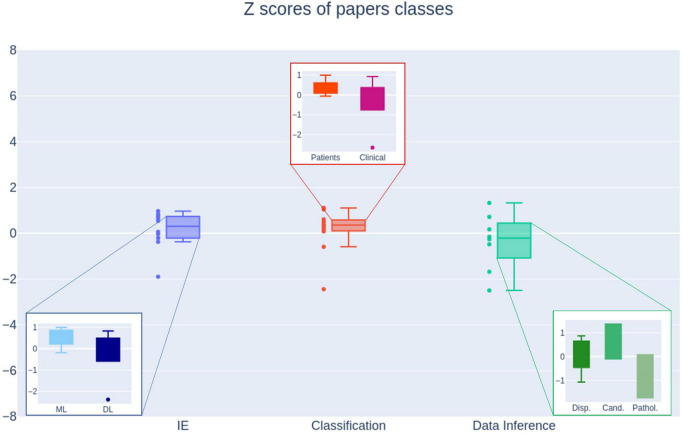
Natural language processing (NLP) is rapidly becoming an important topic in the medical community. The ability to automatically analyze any type of medical document could be the key factor to fully exploit the data it contains. Cutting-edge artificial intelligence (AI) architectures, particularly machine learning and deep learning, have begun to be applied to this topic and have yielded promising results. We conducted a literature search for 1,024 papers that used NLP technology in neuroscience and psychiatry from 2010 to early 2022. After a selection process, 115 papers were evaluated. Each publication was classified into one of three categories: information extraction, classification, and data inference. Automated understanding of clinical reports in electronic health records has the potential to improve healthcare delivery. Overall, the performance of NLP applications is high, with an average F1-score and AUC above 85%. We also derived a composite measure in the form of Z-scores to better compare the performance of NLP models and their different classes as a whole. No statistical differences were found in the unbiased comparison. Strong asymmetry between English and non-English models, difficulty in obtaining high-quality annotated data, and train biases causing low generalizability are the main limitations. This review suggests that NLP could be an effective tool to help clinicians gain insights from medical reports, clinical research forms, and more, making NLP an effective tool to improve the quality of healthcare services.
Keywords: deep learning; electronic health record; information extraction; natural language processing; neuroscience; psychiatry.
Copyright © 2022 Crema, Attardi, Sartiano and Redolfi.
Conflict of interest statement
The authors declare that the research was conducted in the absence of any commercial or financial relationships that could be construed as a potential conflict of interest.
Figures
References
-
- Devlin J, Chang M, Lee K, Toutanova K. BERT: pre-training of deep bidirectional transformers for language understanding. Proceedings of the 2019 Conference of the North American Chapter of the Association for Computational Linguistics: Human Language Technol–gies. Minneapolis, MN: Association for Computational Linguistics; (2019). 10.48550/arXiv.1810.04805 - DOI
-
- Musaev A, Wang D, Pu C. Litmus: a multi-service composition system for landslide detection. IEEE Trans Serv Comput. (2015) 8:715–26.
-
- Vaswani A, Shazeer N, Parmar N, Uszkoreit J, Jones L, Gomez A, et al. Attention. is all you need. In: Leen TK, Tesauro G, Touretzky DS. editors. Red Hook, NY: Curran Associates, Inc. Advances in Neural Information Processing Systems. (2017).
-
- Collobert R, Weston J, Bottou L, Karlen M, Kavukcuoglu K, Kuksa P. Natural language processing (almost) from Scratch. J Mach Learn Res. (2011) 12:2493–537.
Publication types
LinkOut - more resources
Full Text Sources
