


Prevalence of depression, anxiety and post-traumatic stress in war- and conflict-afflicted areas: A meta-analysis
- PMID: 36186881
- PMCID: PMC9524230
- DOI: 10.3389/fpsyt.2022.978703
Prevalence of depression, anxiety and post-traumatic stress in war- and conflict-afflicted areas: A meta-analysis
Abstract
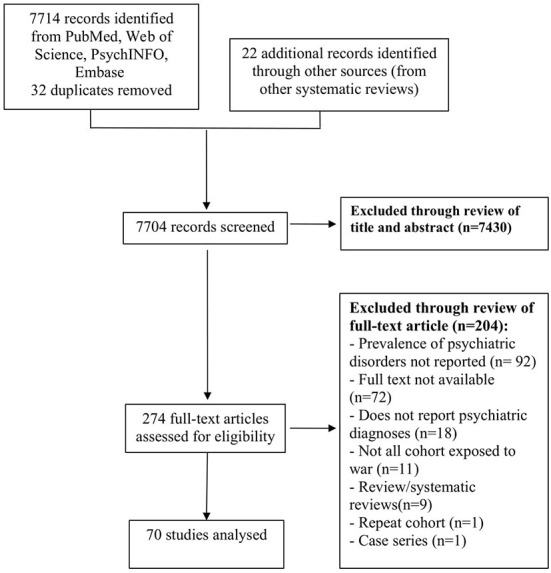
Background: With the rise of fragility, conflict and violence (FCV), understanding the prevalence and risk factors associated with mental disorders is beneficial to direct aid to vulnerable groups. To better understand mental disorders depending on the population and the timeframe, we performed a systematic review to investigate the aggregate prevalence of depression, anxiety and post-traumatic stress symptoms among both civilian and military population exposed to war.
Methods: We used MEDLINE (PubMed), Web of Science, PsycINFO, and Embase to identify studies published from inception or 1-Jan, 1945 (whichever earlier), to 31-May, 2022, to reporting on the prevalence of depression, anxiety and post-traumatic stress symptoms using structured clinical interviews and validated questionnaires as well as variables known to be associated with prevalence to perform meta-regression. We then used random-effects bivariate meta-analysis models to estimate the aggregate prevalence rate.
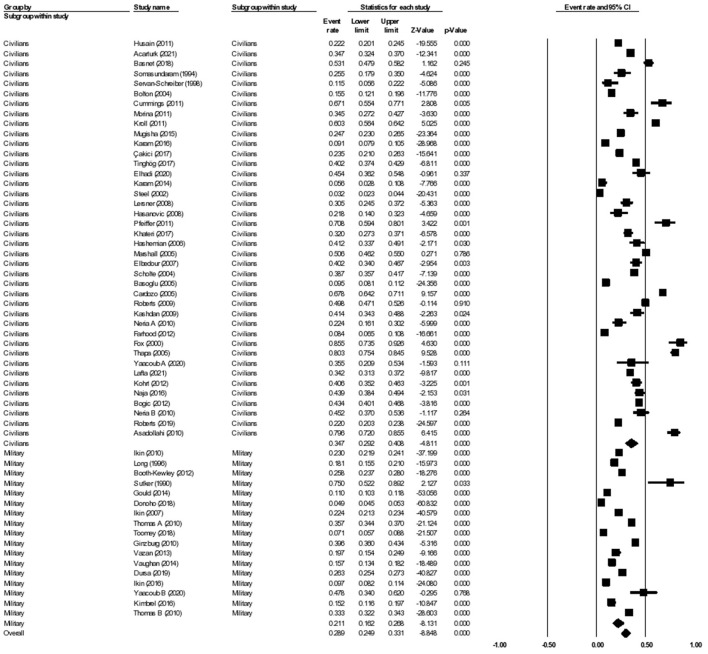
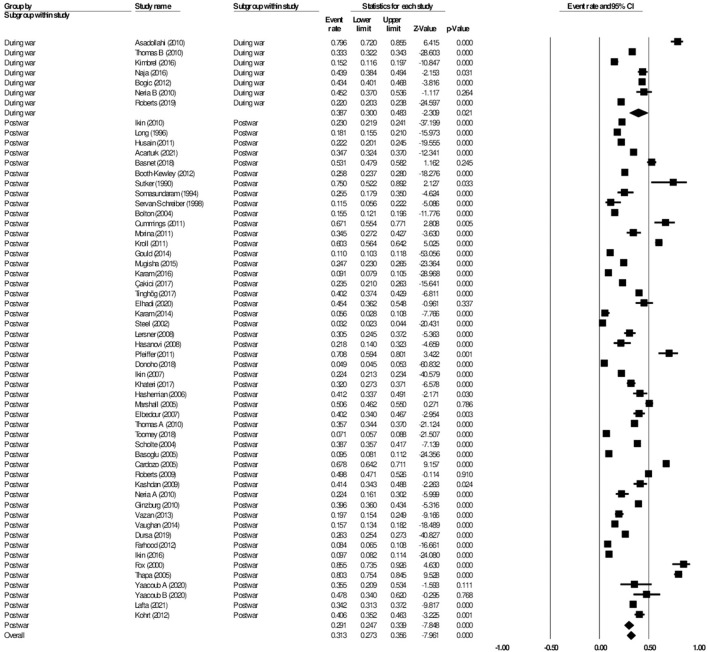
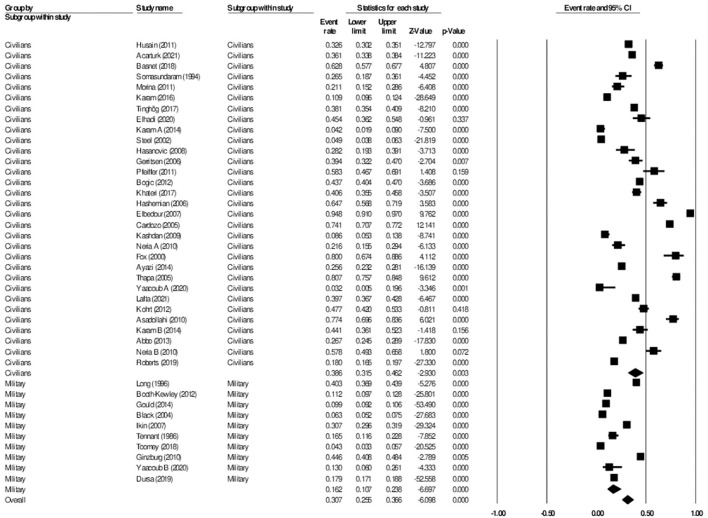
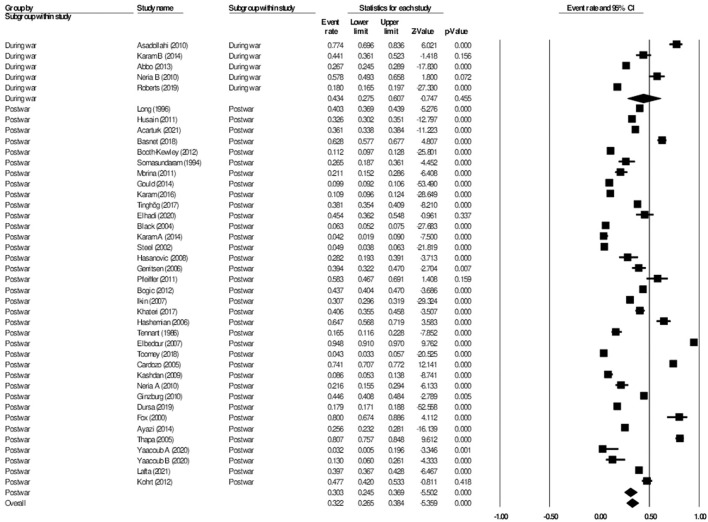
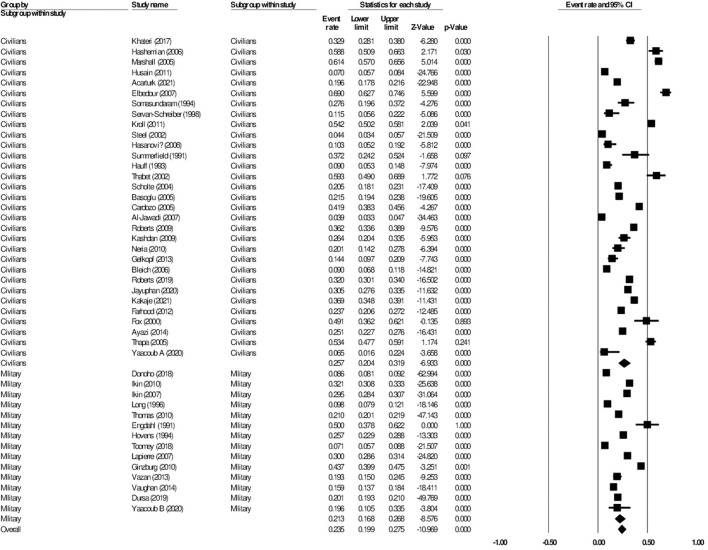
Results: The aggregate prevalence of depression, anxiety and post-traumatic stress during times of conflict or war were 28.9, 30.7, and 23.5%, respectively. Our results indicate a significant difference in the levels of depression and anxiety, but not post-traumatic stress, between the civilian group and the military group respectively (depression 34.7 vs 21.1%, p < 0.001; anxiety 38.6 vs 16.2%, p < 0.001; post-traumatic stress: 25.7 vs 21.3%, p = 0.256). The aggregate prevalence of depression during the wars was 38.7% (95% CI: 30.0-48.3, I 2 = 98.1%), while the aggregate prevalence of depression post-wars was 29.1% (95% CI: 24.7-33.9, I 2 = 99.2%). The aggregate prevalence of anxiety during the wars was 43.4% (95% CI: 27.5-60.7, I 2 = 98.6%), while the aggregate prevalence of anxiety post-wars was 30.3% (95% CI: 24.5-36.9, I 2 = 99.2%). The subgroup analysis showed significant difference in prevalence of depression, and anxiety between the civilians and military group (p < 0.001).
Conclusion: The aggregate prevalence of depression, anxiety and post-traumatic stress in populations experiencing FCV are 28.9, 30.7, and 23.5%, respectively. There is a significant difference in prevalence of depression and anxiety between civilians and the military personnels. Our results show that there is a significant difference in the prevalence of depression and anxiety among individuals in areas affected by FCV during the wars compared to after the wars. Overall, these results highlight that mental health in times of conflict is a public health issue that cannot be ignored, and that appropriate aid made available to at risk populations can reduce the prevalence of psychiatric symptoms during time of FCV.
Systematic review registration: https://www.crd.york.ac.uk/prospero/display_record.php?RecordID=337486, Identifier 337486.
Keywords: anxiety; conflict; depression; mental health; mental illness; post-traumatic stress; post-war; war.
Copyright © 2022 Lim, Tam, Chudzicka-Czupała, McIntyre, Teopiz, Ho and Ho.
Conflict of interest statement
RM has received research grant support from CIHR/GACD/National Natural Science Foundation of China (NSFC); speaker/consultation fees from Lundbeck, Janssen, Alkermes, Neumora Therapeutics, Boehringer Ingelheim, Sage, Biogen, Mitsubishi Tanabe, Purdue, Pfizer, Otsuka, Takeda, Neurocrine, Sunovion, Bausch Health, Axsome, Novo Nordisk, Kris, Sanofi, Eisai, Intra-Cellular, NewBridge Pharmaceuticals, Abbvie, Atai Life Sciences. RM is a CEO of Braxia Scientific Corp. KT has received personal fees from Braxia Scientific Corp.
Figures
References
-
- Global Humanitarian Overview 2019 United Nations Office: United Nations Office for the Co-ordination of Humanitarian Affairs. (2019). Available online at: https://www.unocha.org/sites/unocha/files/GHO2019.pdf (accessed June 4, 2022).
-
- The The World Bank: Fragility Conflict Conflict Violence: The World Bank. (2022). Available online at: https://www.worldbank.org/en/topic/fragilityconflictviolence (accessed April 13, 2022).
-
- Clausewitz CV. On War. Princeton, NJ: Princeton University Press; (1989).
-
- Steel Z, Chey T, Silove D, Marnane C, Bryant RA, van Ommeren M. Association of torture and other potentially traumatic events with mental health outcomes among populations exposed to mass conflict and displacement: a systematic review and meta-analysis. JAMA. (2009) 302:537–49. 10.1001/jama.2009.1132 - DOI - PubMed
Publication types
LinkOut - more resources
Full Text Sources
