


Supporting adolescents' mental health during COVID-19 by utilising lessons from the aftermath of the Great East Japan Earthquake
- PMID: 36187842
- PMCID: PMC9510442
- DOI: 10.1057/s41599-022-01330-1
Supporting adolescents' mental health during COVID-19 by utilising lessons from the aftermath of the Great East Japan Earthquake
Abstract
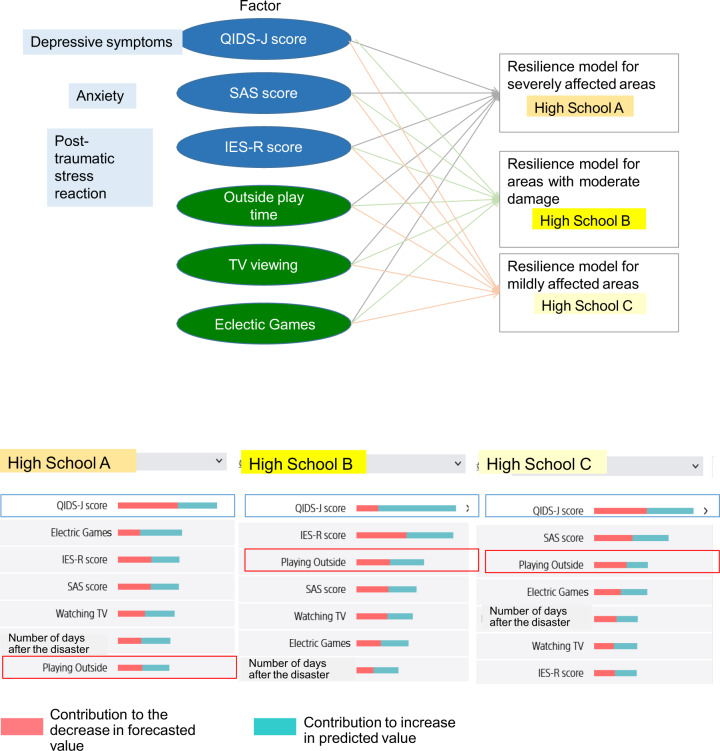
Historical data can determine how adolescents recover from difficult situations such as the Coronavirus disease 2019 (COVID-19) pandemic. This study analysed 3 years of data obtained from high-school students who had been affected by the 2011 Great East Japan Earthquake and consequently evidenced the importance of increasing resilience among affected adolescents. This involved identifying factors contributing to resilience through a model that assessed for each tsunami disaster. This model was determined by assessing the correlation between survivors' resilience scores and their measured psychological and lifestyle scores. This approach showed that, in all tsunami damage models, resilience was most affected by the depressed emotions. Thus, our approach suggests that interventions for improving the depressed mood may improve resilience in adolescents during the COVID-19 pandemic.
Keywords: Health humanities; Psychology.
© The Author(s) 2022.
Conflict of interest statement
Competing interestsThe authors declare no competing interests.
Figures
Similar articles
-
Longitudinal characteristics of resilience among adolescents: A high school student cohort study to assess the psychological impact of the Great East Japan Earthquake.Psychiatry Clin Neurosci. 2018 Nov;72(11):821-835. doi: 10.1111/pcn.12772. Epub 2018 Sep 4. Psychiatry Clin Neurosci. 2018. PMID: 30058206
-
The Impact of the COVID-19 Pandemic on Suicide Rate Trends in the Tsunami-Disaster-Affected Area Following the Great East Japan Earthquake.Crisis. 2023 Mar;44(2):93-99. doi: 10.1027/0227-5910/a000832. Epub 2021 Dec 3. Crisis. 2023. PMID: 34859681
-
[Personal resilience and post-traumatic stress symptoms of local government employees: six months after the 2011 magnitude 9.0 East Japan Earthquake].Sangyo Eiseigaku Zasshi. 2014;56(6):245-58. doi: 10.1539/sangyoeisei.B14006. Epub 2014 Sep 19. Sangyo Eiseigaku Zasshi. 2014. PMID: 25242518 Japanese.
-
Lessons learned from psychosocial support and mental health surveys during the 10 years since the Great East Japan Earthquake: Establishing evidence-based disaster psychiatry.Psychiatry Clin Neurosci. 2022 Jun;76(6):212-221. doi: 10.1111/pcn.13339. Epub 2022 Mar 1. Psychiatry Clin Neurosci. 2022. PMID: 35137504 Free PMC article. Review.
-
[Mental health care systems and provisions in the immediate and acute phase of the Great East Japan Earthquake: situational and support activities in Miyagi Prefecture].Seishin Shinkeigaku Zasshi. 2014;116(3):175-88. Seishin Shinkeigaku Zasshi. 2014. PMID: 24783439 Review. Japanese.
Cited by
-
Self-Compassion during COVID-19 in Non-WEIRD Countries: A Narrative Review.Healthcare (Basel). 2023 Jul 13;11(14):2016. doi: 10.3390/healthcare11142016. Healthcare (Basel). 2023. PMID: 37510457 Free PMC article. Review.
-
Digital support for female students in physical education universities in Japan.Sci Rep. 2025 May 14;15(1):16777. doi: 10.1038/s41598-025-98921-0. Sci Rep. 2025. PMID: 40369037 Free PMC article.
-
The effect of post-traumatic stress disorder on misinformation beliefs among survivors of the 2008 China earthquake: the mediating roles of rumination and fear of missing out.BMC Psychol. 2025 Feb 14;13(1):122. doi: 10.1186/s40359-025-02440-6. BMC Psychol. 2025. PMID: 39953633 Free PMC article.
References
-
- City of Natori . Records of the Great East Japan Earthquake in Natori City. Natori City Hall: General Affairs Department; 2012.
-
- American Psychological Association (2014) The Road to Resilience. American Psychological Association. (https://uncw.edu/studentaffairs/committees/pdc/documents/the%20road%20to...)
Publication types
LinkOut - more resources
Full Text Sources