. 2022 Sep 16:16:987939.
doi: 10.3389/fnins.2022.987939. eCollection 2022.

Absence of the Fragile X messenger ribonucleoprotein alters response patterns to sounds in the auditory midbrain

Affiliations

Absence of the Fragile X messenger ribonucleoprotein alters response patterns to sounds in the auditory midbrain

Jérémie Sibille et al. Front Neurosci. .

Abstract

Among the different autism spectrum disorders, Fragile X syndrome (FXS) is the most common inherited cause of intellectual disability. Sensory and especially auditory hypersensitivity is a key symptom in patients, which is well mimicked in the Fmr1 -/- mouse model. However, the physiological mechanisms underlying FXS's acoustic hypersensitivity in particular remain poorly understood. Here, we categorized spike response patterns to pure tones of different frequencies and intensities from neurons in the inferior colliculus (IC), a central integrator in the ascending auditory pathway. Based on this categorization we analyzed differences in response patterns between IC neurons of wild-type (WT) and Fmr1 -/- mice. Our results report broadening of frequency tuning, an increased firing in response to monaural as well as binaural stimuli, an altered balance of excitation-inhibition, and reduced response latencies, all expected features of acoustic hypersensitivity. Furthermore, we noticed that all neuronal response types in Fmr1 -/- mice displayed enhanced offset-rebound activity outside their excitatory frequency response area. These results provide evidence that the loss of Fmr1 not only increases spike responses in IC neurons similar to auditory brainstem neurons, but also changes response patterns such as offset spiking. One can speculate this to be an underlying aspect of the receptive language problems associated with Fragile X syndrome.

Keywords: Fragile X syndrome; auditory hypersensitivity; auditory processing; autism spectrum disorder; inferior colliculus; spike pattern.


Conflict of interest statement

The authors declare that the research was conducted in the absence of any commercial or financial relationships that could be construed as a potential conflict of interest.

Figures
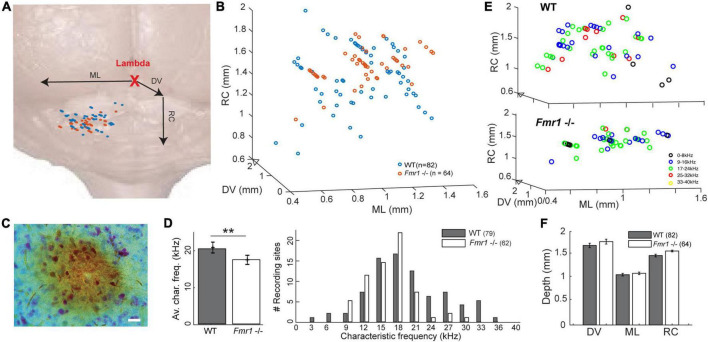
FIGURE 1
FIGURE 1
Location of the recorded IC neurons, with their characteristic frequencies. (A) Schematic reconstruction of stereotactic recording locations on top of a schematic brain picture, (orange) Fmr1 -/- neurons, (blue) WT. (B) 3D-reconstruction of the different stereotactic locations. (C) Picture of an HRP staining (20 μm). (D) (right) Histogram of all CFs. (Left) Averaged CF in the WT vs. Fmr1 -/- mice. (E) 3D stereotactic locations represented with color-coded CF (dark low, light color higher frequencies) in (up) all WT neurons, (down) all Fmr1 -/- neurons. (F) Averaged positions of all cells’ stereotactic locations in WT and Fmr1 -/- neurons.
FIGURE 2
FIGURE 2
Four neuronal response patterns in both genotypes. (A) (left) Averaged compound PSTH of all transient neurons, (brown) WT and (orange) Fmr1 -/-; (right above) Averaged FRA of all WT transient neurons and (right below) FRA of all Fmr1 -/- transient neurons. (B) (left) Averaged PSTH of all sustained neurons WT, and Fmr1 -/-; (right above) FRA of all WT sustained neurons, and (right below) their Fmr1 -/- counterparts. (C) (left) PSTH of all inhibited neurons, WT and Fmr1 -/-; (right above) FRA of all WT inhibited neurons, and (right below) their Fmr1 -/- counterparts; note the negative tuning that these neurons’ FRAs exhibit. (D) (left) PSTH of all offset neurons, WT and Fmr1 -/-; (right above) FRA of all WT all offset neurons, and (right below) their Fmr1 -/- counterparts. (E) Proportion of each cell types in (above) WT and (below) Fmr1 -/- neurons. (F) All-cell average of all compound PSTHs in the WT and Fmr1 -/- mice. Different values of the transient firing are taken in each time-window for each cell (D1-D8), used for the following principal component analysis (PCA). (G) (left) 3D-representation of all recorded neurons along the first three components. Note the four shaded areas corresponding to the four cell types detailed above. (Right) Projections of the two first principal components on the eight time-windows. (H) (above left) 3D-representation of all WT neurons; (below left) same neurons represented along the two first components; (above right) 3D-representation of all the Fmr1 -/- neurons; (below right) 2-D projection of all the Fmr1 -/- neurons on the two first components.
FIGURE 3
FIGURE 3
Fmr1 -/- neurons are over-activated and oversensitive. (A) (above) Averaged of all WT transient neurons FRA, and (below) all their Fmr1 -/- counterparts. (B) (above) Averaged of all WT sustained neurons FRA, and (below) their Fmr1 -/- counterparts. (C) (above) Averaged of all WT inhibited neurons FRA, and (below) their Fmr1 -/- counterparts. (D) (above) Averaged of all WT offset neurons FRA, and (below) their Fmr1 -/- counterparts. (E) Averaged firing rate of each of the 4 classes. (F) Average threshold of the 4 classes together. (G) Averaged Q-values measured in each neuron, resp. (Left) Q10, (middle) Q30, (right) Q50.
FIGURE 4
FIGURE 4
Fmr1 -/- neurons exhibit an earlier and stronger activation. (A) Averaged and normalized PSTH of all cells over all conditions during the FRA for all transient WT and Fmr1 -/- neurons. (B) Boxplot representation of the averaged latency in transient (53 WT, 66 Fmr1 -/-) and sustained neurons (34 WT, 16 Fmr1 -/-). (C) Boxplot representation of the timing of maximal spiking in transient and sustained neurons from WT and Fmr1 -/- mice.
FIGURE 5
FIGURE 5
Offset-rebound activity in Fmr1 -/- neurons. (A) Normalized PSTH for (left) all WT transient neurons and (right) their Fmr1 -/- counterparts; note that the red lines indicate the limits used to quantify the tuning of the rebound-offset activity. (B) Normalized PSTH (left) all WT sustained neurons and (right) all their Fmr1 -/- counterparts. (C) (above left) Averaged and normalized rebound-offset activity in all WT and Fmr1 -/- transient neurons; (above right) Corresponding histograms, note the semi-Gaussian organization of the Fmr1 -/- offset-rebound; (below left) Averaged and normalized rebound-offset activity in all WT and Fmr1 -/- sustained neurons; (below right) Corresponding histogram with a bin size of 0.05. (D) Averaged normalized FRA from spikes selected from offset-rebound activity that illustrates the tuning exhibited by the rebound-offset activity in respectively: (above left) all WT transient neurons, (above right) all Fmr1 -/- transient neurons, (below left) all WT sustained neurons, (below right) all Fmr1 -/- sustained neurons. (E) Similarly for each single individual frequency and attenuation, the time of maximal firing is averaged within the populations and illustrated in the corresponding color code to report the later peak in the PSTH outside of the FRA for (left) Transient WT, (middle left) transient Fmr1 -/-, (middle right) sustained WT and (right) Fmr1 -/- neurons.
FIGURE 6
FIGURE 6
Binaural integration of ILDs is impaired in the Fmr1 -/- mice. (A) Normalized spike rate per neuron for the different ILD conditions for: (above left) all WT transient neurons; (below left) all Fmr1 -/- transient neurons; (above right) all WT sustained neurons and (below right) all Fmr1 -/- sustained neurons. (B) (left) Averaged normalized ILD for all transient neurons WT and Fmr1 -/-; (right) ILD for all sustained neurons WT and Fmr1 -/-. (C) Quantification of resp. (Left) averaged ILD as the half height of the corresponding fitted sigmoid; (right) for the slope steepness of resp. WT and Fmr1 -/- ILDs.

References

    1. Akimov A. G., Egorova M. A., Ehret G. (2017). Spectral summation and facilitation in on- and off-responses for optimized representation of communication calls in mouse inferior colliculus. Eur. J. Neurosci. 45 440–459. 10.1111/ejn.13488 - DOI - PubMed
    1. Alkhatib A., Biebel U. W., Smolders J. W. T. (2006). Inhibitory and excitatory response areas of neurons in the central nucleus of the inferior colliculus in unanesthetized chinchillas. Exp. Brain Res. 174 124–143. 10.1007/s00221-006-0424-8 - DOI - PubMed
    1. Ayala Y. A., Malmierca M. S. (2013). Stimulus-specific adaptation and deviance detection in the inferior colliculus. Front. Neural Circuits 6:89. 10.3389/fncir.2012.00089 - DOI - PMC - PubMed
    1. Ayala Y. A., Pérez-González D., Malmierca M. S. (2016). Stimulus-specific adaptation in the inferior colliculus: The role of excitatory, inhibitory and modulatory inputs. Biol. Psychol. 116 10–22. 10.1016/j.biopsycho.2015.06.016 - DOI - PubMed
    1. Brager D. H., Akhavan A. R., Johnston D. (2012). Impaired Dendritic Expression and Plasticity of h-Channels in the fmr1−/y Mouse Model of Fragile X Syndrome. Cell Rep. 1 225–233. 10.1016/j.celrep.2012.02.002 - DOI - PMC - PubMed

LinkOut - more resources
