


Epidemiology of ICU-Onset Bloodstream Infection: Prevalence, Pathogens, and Risk Factors Among 150,948 ICU Patients at 85 U.S. Hospitals
- PMID: 36190259
- PMCID: PMC10829879
- DOI: 10.1097/CCM.0000000000005662
Epidemiology of ICU-Onset Bloodstream Infection: Prevalence, Pathogens, and Risk Factors Among 150,948 ICU Patients at 85 U.S. Hospitals
Abstract
Objectives: Bloodstream infections (BSIs) acquired in the ICU represent a detrimental yet potentially preventable condition. We determined the prevalence of BSI acquired in the ICU (ICU-onset BSI), pathogen profile, and associated risk factors.
Design: Retrospective cohort study.
Data sources: Eighty-five U.S. hospitals in the Cerner Healthfacts Database.
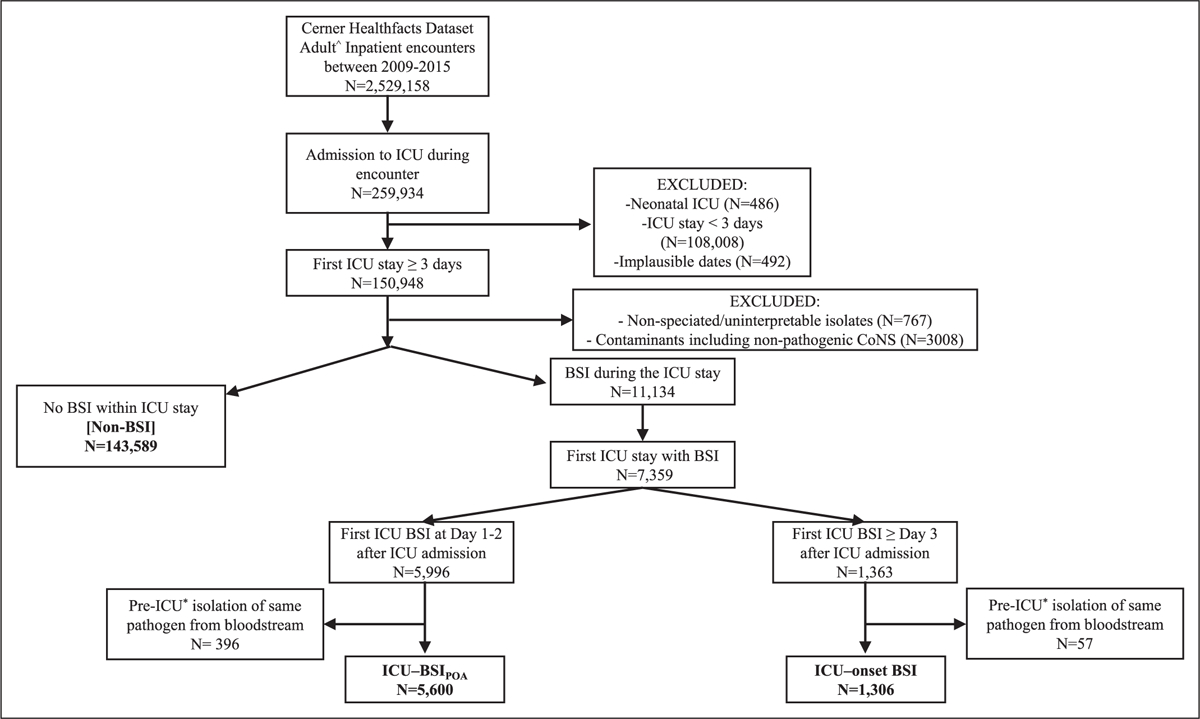
Patient selection: Adult hospitalizations between January 2009 and December 2015 including a (≥ 3 d) ICU stay.
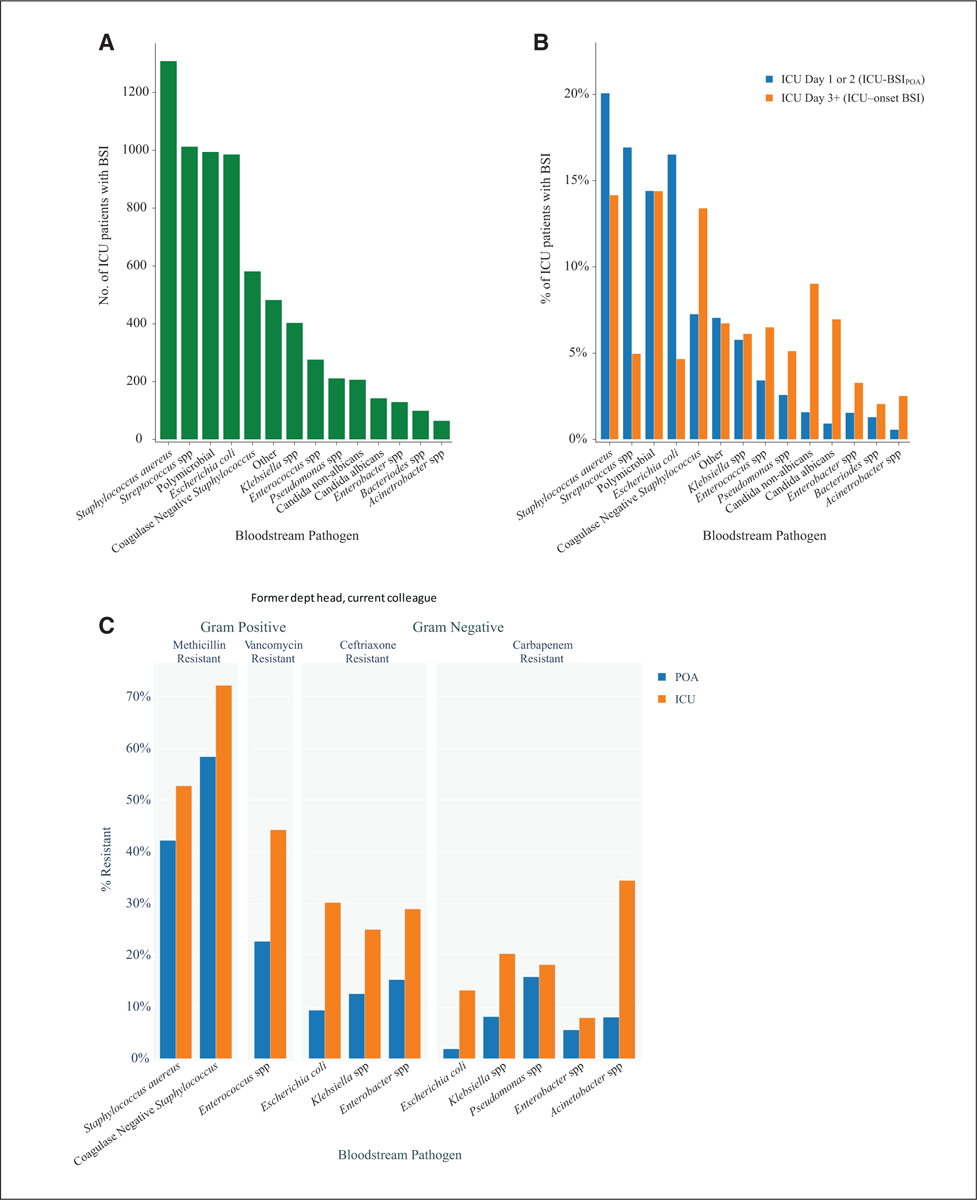
Data extraction and data synthesis: Prevalence of ICU-onset BSI (between ICU Day 3 and ICU discharge) and associated pathogen and antibiotic resistance distributions were compared with BSI present on (ICU) admission (ICU-BSI POA ); and BSI present on ICU admission day or Day 2. Cox models identified risk factors for ICU-onset BSI among host, care setting, and treatment-related factors. Among 150,948 ICU patients, 5,600 (3.7%) had ICU-BSI POA and 1,306 (0.9%) had ICU-onset BSI. Of those with ICU-BSI POA , 4,359 (77.8%) were admitted to ICU at hospital admission day. Patients with ICU-onset BSI (vs ICU-BSI POA ) displayed higher crude mortality of 37.9% (vs 20.4%) ( p < 0.001) and longer median (interquartile range) length of stay of 13 days (8-23 d) (vs 5 d [3-8 d]) ( p < 0.001) (considering all ICU stay). Compared with ICU-BSI POA , ICU-onset BSI displayed more Pseudomonas , Acinetobacter , Enterococcus, Candida , and Coagulase-negative Staphylococcus species, and more methicillin-resistant staphylococci, vancomycin-resistant enterococci, ceftriaxone-resistant Enterobacter , and carbapenem-resistant Enterobacterales and Acinetobacter species, respectively. Being younger, male, Black, Hispanic, having greater comorbidity burden, sepsis, trauma, acute pulmonary or gastrointestinal presentations, and pre-ICU exposure to antibacterial and antifungal agents was associated with greater ICU-onset BSI risk after adjusted analysis. Mixed ICUs (vs medical or surgical ICUs) and urban and small/medium rural hospitals were also associated with greater ICU-onset BSI risk. The associated risk of acquiring ICU-onset BSI manifested with any duration of mechanical ventilation and 7 days after insertion of central venous or arterial catheters.
Conclusions: ICU-onset BSI is a serious condition that displays a unique pathogen and resistance profile compared with ICU-BSI POA . Further scrutiny of modifiable risk factors for ICU-onset BSI may inform control strategies.
Copyright © 2022 by the Society of Critical Care Medicine and Wolters Kluwer Health, Inc. All Rights Reserved.
Conflict of interest statement
Drs. Swihart, Warner, Strich, Follmann, and Kadri received support for article research from the National Institutes of Health. Drs. Swihart, Warner, Strich, Mancera, Follmann, and Kadri disclosed government work. The remaining authors have disclosed that they do not have any potential conflicts of interest.
Figures
Comment in
-
Of Granularity and Generality: ICU-Onset Bloodstream Infections and the Need for Antimicrobial Stewardship and Infection Prevention.Crit Care Med. 2022 Dec 1;50(12):1828-1830. doi: 10.1097/CCM.0000000000005692. Epub 2022 Nov 17. Crit Care Med. 2022. PMID: 36394400 No abstract available.
References
-
- Goto M, Al-Hasan MN: Overall burden of bloodstream infection and nosocomial bloodstream infection in North America and Europe. Clin Microbiol Infect 2013; 19:501–509 - PubMed
-
- Garrouste-Orgeas M, Timsit JF, Tafflet M, et al. ; OUTCOMEREA Study Group: Excess risk of death from intensive care unit-acquired nosocomial bloodstream infections: A reappraisal. Clin Infect Dis 2006; 42:1118–1126 - PubMed
-
- Vincent JL, Rello J, Marshall J, et al. ; EPIC II Group of Investigators: International study of the prevalence and outcomes of infection in intensive care units. JAMA 2009; 302:2323–2329 - PubMed
-
- Tabah A, Koulenti D, Laupland K, et al. : Characteristics and determinants of outcome of hospital-acquired bloodstream infections in intensive care units: The EUROBACT international cohort study. Intensive Care Med 2012; 38:1930–1945 - PubMed
MeSH terms
Grants and funding
LinkOut - more resources
Full Text Sources
Medical
