


Rates of Antimicrobial Resistance in Helicobacter pylori Isolates From Clinical Trial Patients Across the US and Europe
- PMID: 36191284
- PMCID: PMC9889195
- DOI: 10.14309/ajg.0000000000002045
Rates of Antimicrobial Resistance in Helicobacter pylori Isolates From Clinical Trial Patients Across the US and Europe
Abstract
Introduction: Guidelines recommend that proton pump inhibitor-based triple regimens with clarithromycin not be used for Helicobacter pylori infection in areas where clarithromycin resistance is ≥15%, or in patients with prior macrolide use. Up-to-date information on local resistance patterns is limited, especially in the US. Here, we report resistance rates to antibiotics commonly used to treat H. pylori from a large study conducted in the US and Europe (pHalcon-HP).
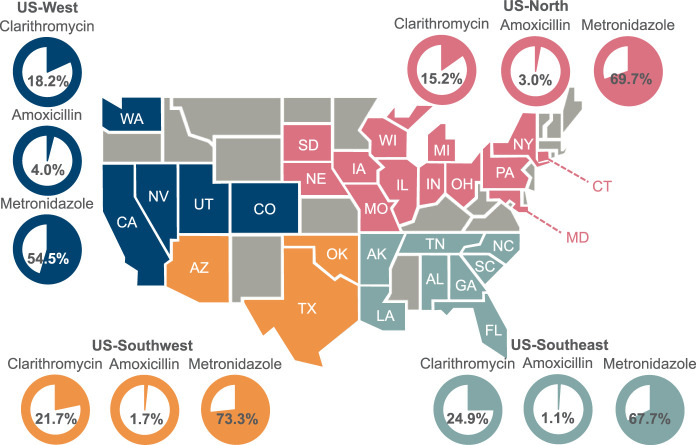
Methods: Gastric mucosal biopsies were collected from adult participants with H. pylori infection during screening. Minimum inhibitory concentrations were determined via agar dilution for clarithromycin, amoxicillin, and metronidazole, with breakpoints ≥1 μg/mL, >0.125 μg/mL, and >8 μg/mL, respectively. Resistance rates were obtained for the US and Europe, and also for US subregions and participating European countries.
Results: Resistance rates were established in isolates from 907 participants. Overall, 22.2% were resistant to clarithromycin, 1.2% to amoxicillin, and 69.2% to metronidazole. Resistance in the US and Europe was similar; metronidazole resistance was the most prevalent (50%-79%) and amoxicillin the least (≤5%). In all subregions, ≥15% of isolates were resistant to clarithromycin, except the UK (0/8 isolates). Among clarithromycin-resistant isolates, 75% were also metronidazole-resistant. Two US isolates were resistant to clarithromycin and amoxicillin; one of these was also metronidazole-resistant.
Discussion: The resistance rates observed in this study argue against the continued empiric use of proton pump inhibitor-based triple therapy containing clarithromycin, per treatment guidelines, and highlight the need for antibiotic resistance surveillance and novel treatment strategies for H. pylori infection in the US and Europe.
Trial registration: ClinicalTrials.gov NCT04167670.
Copyright © 2022 The Author(s). Published by Wolters Kluwer Health, Inc. on behalf of The American College of Gastroenterology.
Conflict of interest statement
Figures
References
-
- Hooi JKY, Lai WY, Ng WK, et al. . Global prevalence of Helicobacter pylori infection: Systematic review and meta-analysis. Gastroenterology 2017;153:420–9. - PubMed
-
- Malfertheiner P, Megraud F, O'Morain CA, et al. , European Helicobacter and Microbiota Study Group and Consensus panel. Management of Helicobacter pylori infection-the Maastricht V/Florence Consensus report. Gut 2017;66:6–30. - PubMed
-
- Nyssen OP, Bordin D, Tepes B, et al. , Hp-EuReg Investigators. European registry on Helicobacter pylori management (Hp-EuReg): Patterns and trends in first-line empirical eradication prescription and outcomes of 5 years and 21 533 patients. Gut 2021;70:40–54. - PubMed
-
- Chey WD, Leontiadis GI, Howden CW, et al. . ACG clinical guideline: Treatment of Helicobacter pylori infection. Am J Gastroenterol 2017;112:212–39. - PubMed
Publication types
MeSH terms
Substances
Associated data
LinkOut - more resources
Full Text Sources
Medical
Research Materials
Miscellaneous
