


Impact of rotavirus vaccination on diarrheal hospitalizations in children younger than 5 years of age in a rural southern Mozambique
- PMID: 36192272
- PMCID: PMC9589241
- DOI: 10.1016/j.vaccine.2022.09.050
Impact of rotavirus vaccination on diarrheal hospitalizations in children younger than 5 years of age in a rural southern Mozambique
Abstract
Background: Rotavirus vaccine(Rotarix®) was introduced in Mozambique through its Expanded Program of Immunization in September 2015. We assessed the impact of rotavirus vaccination on childhood gastroenteritis-associated hospitalizations post-vaccine introduction in a high HIV prevalence rural setting of southern Mozambique.
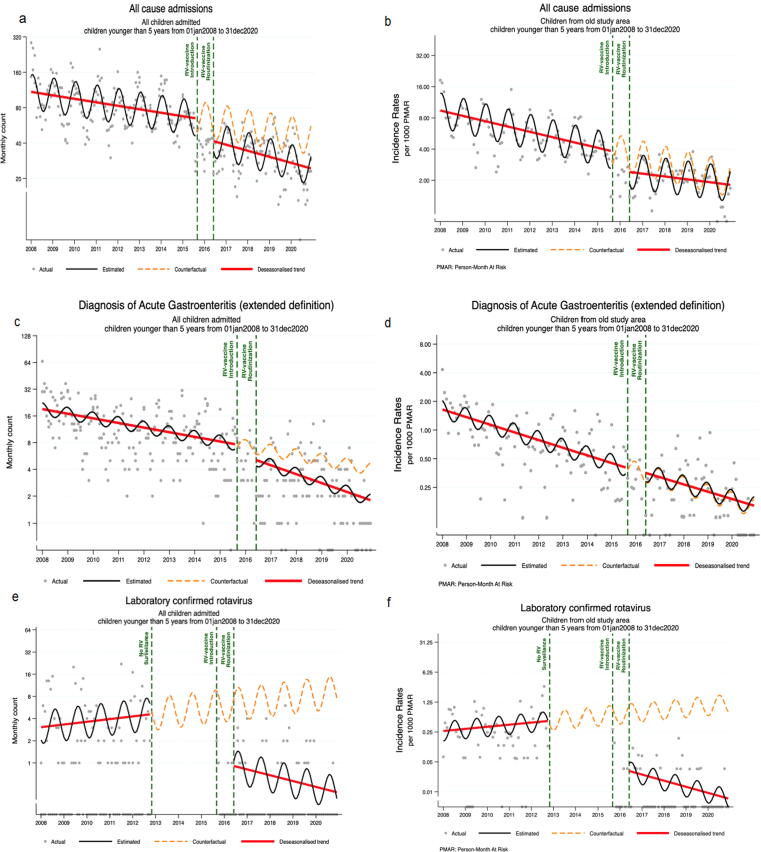
Methods: We reviewed and compared the trend of hospitalizations (prevalence) and incidence rates of acute gastroenteritis (AGE), and rotavirus associated-diarrhea (laboratory confirmed rotavirus) in pre- (January 2008-August 2015) and post-rotavirus vaccine introduction periods (September 2015-December 2020), among children <5 years of age admitted to Manhiça District Hospital.
Results: From January 2008 to December 2020, rotavirus vaccination was found to contribute to the decline of the prevalence of AGE from 19% (95% CI: 18.14-20.44) prior to the vaccine introduction to 10% (95% CI: 8.89-11.48) in the post-introduction period, preventing 40% (95 % IE: 38-42) and 84% (95 % IE: 80-87) of the expected AGE and laboratory confirmed rotavirus cases, respectively, among infants. Similarly, the overall incidence of rotavirus was 11.8-fold lower in the post-vaccine introduction period (0.4/1000 child-years-at-risk [CYAR]; 95% CI: 0.3-0.6) compared with the pre-vaccination period (4.7/1000 CYAR; 95% CI: 4.2-5.1) with the highest reduction being observed among infants (16.8-fold lower from the 15.1/1000 CYAR in the pre-vaccine to 0.9/1000 CYAR in the post-vaccine eras).
Conclusions: We documented a significant reduction in all-cause diarrhea hospitalizations and rotavirus positivity after vaccine introduction demonstrating the beneficial impact of rotavirus vaccination in a highly vulnerable population.
Keywords: Diarrhea; Manhiça; Mozambique; Rotavirus; Vaccine impact.
Copyright © 2022. Published by Elsevier Ltd.
Conflict of interest statement
Declaration of Competing Interest The authors declare that they have no known competing financial interests or personal relationships that could have appeared to influence the work reported in this paper.
Figures
References
-
- Kotloff K.L., Nataro J.P., Blackwelder W.C., Nasrin D., Farag T.H., Panchalingam S., et al. Burden and aetiology of diarrhoeal disease in infants and young children in developing countries (the Global Enteric Multicenter Study, GEMS): a prospective, case-control study. Lancet. 2013;382(9888):209–222. doi: 10.1016/S0140-6736(13)60844-2. - DOI - PubMed
-
- Kotloff K.L., Nasrin D., Blackwelder W.C., Wu Y., Farag T., Panchalingham S., et al. The incidence, aetiology, and adverse clinical consequences of less severe diarrhoeal episodes among infants and children residing in low-income and middle-income countries: a 12-month case-control study as a follow-on to the Global Enteric Multicenter Study (GEMS) Lancet Glob Health. 2019;7(5):e568–e584. doi: 10.1016/S2214-109X(19)30076-2. - DOI - PMC - PubMed
-
- Ruiz-Palacios GM, Breuer T, Innis BL, Ortega-Barría E, Salinas B, Rubio P, et al. Safety and Efficacy of an Attenuated Vaccine against Severe Rotavirus Gastroenteritis. N Engl j Med 2006:12. - PubMed
Publication types
MeSH terms
Substances
Grants and funding
LinkOut - more resources
Full Text Sources
Medical
