Effect of stimulants on final adult height
- PMID: 36193720
- PMCID: PMC9627528
- DOI: 10.1515/jpem-2022-0344
Effect of stimulants on final adult height
Abstract
Background: The use of stimulant medications for treatment of ADHD has raised concern as to whether they adversely impact linear growth. Previous studies have indicated that stimulant medications may suppress growth for a short period after treatment initiation; however, more information is needed to evaluate the long-term effects on final adult stature. This mini review aims to evaluate the effect of stimulant medications on final adult height in children with ADHD.
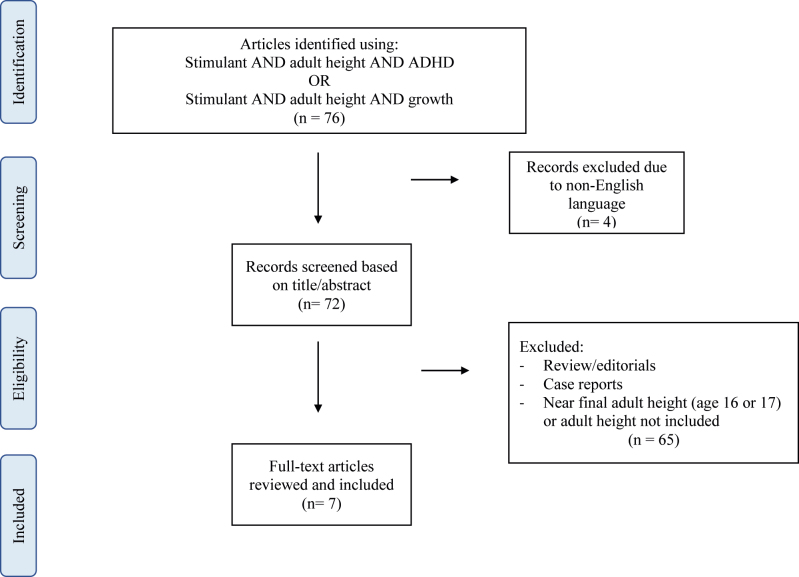
Contents: We performed a literature review across PubMed/MEDLINE database. Only articles that included data on final adult height or near final adult height (age≥16 or 17 years) were included.
Summary: Early studies investigating the long-term impacts of stimulant medications observed growth suppression during the active treatment period, but when comparing final adult height, there was no difference between the control and ADHD groups. A recent larger comprehensive study (Multimodal Treatment of ADHD study) has suggested that the long-term use of significant doses of stimulants during childhood may compromise final adult height to a clinically significant degree when comparing adult height across three long-term patterns of stimulant treatment (Consistent, Intermittent, Negligible). The consistent use subgroup was significantly shorter than other subgroups.
Outlook: For children with ADHD, a significant long-term dose of stimulant treatment should be used with caution to avoid diminishing adult height potential. Pediatric endocrinologists should consider chronic use of stimulants as a factor contributing to reduced adult height.
Keywords: ADHD; adult height; stimulant treatment.
© 2022 Walter de Gruyter GmbH, Berlin/Boston.
Conflict of interest statement
Figures
References
Publication types
MeSH terms
Substances
Grants and funding
LinkOut - more resources
Full Text Sources
Medical