


Anxiety sensitivity and cigarette use on cannabis use problems, perceived barriers for cannabis cessation, and self-efficacy for quitting among adults with cannabis use disorder
- PMID: 36194977
- PMCID: PMC10080994
- DOI: 10.1016/j.addbeh.2022.107509
Anxiety sensitivity and cigarette use on cannabis use problems, perceived barriers for cannabis cessation, and self-efficacy for quitting among adults with cannabis use disorder
Abstract
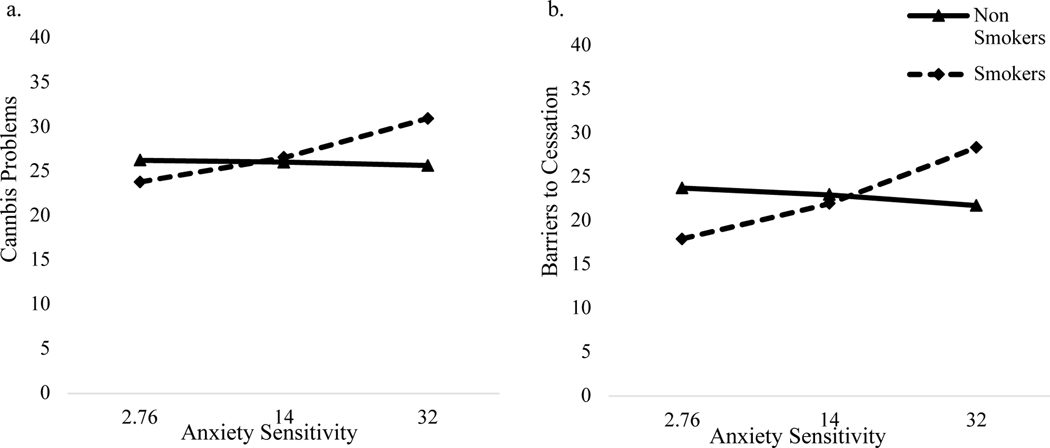
Many individuals diagnosed with cannabis use disorder (CUD) report a desire to quit using cannabis due to problems associated with use. Yet, successful abstinence is difficult for a large subset of this population. Thus, the present study sought to elucidate potential risk factors for cannabis use problems, perceived barriers for quitting, and diminished self-efficacy for remaining abstinent. Specifically, this investigation examined cigarette user status, anxiety sensitivity, and the interplay between these individual difference factors in terms of cannabis-related problems, perceived barriers for cannabis cessation, and self-efficacy for quitting cannabis use. The sample consisted of 132 adult cannabis users who met criteria for CUD and were interested in quitting (38 % female; 63.6 % Black; Mage = 37.22; SDage = 28.79; 54.6 % current tobacco users). Findings revealed a significant interaction, such that anxiety sensitivity was related to cannabis use problems and perceived barriers for cannabis cessation among current cigarette users, but not among cigarette non-users. There was no significant interaction for self-efficacy for remaining abstinent. The current findings suggest that cigarette users constitute a subgroup that may be especially vulnerable to the effects of anxiety sensitivity in terms of cannabis use problems and perceived barriers for quitting cannabis use.
Keywords: Addictive behavior; Anxiety sensitivity; Cannabis use disorder; Cannabis use problems; Perceived barriers for cessation; Self efficacy.
Copyright © 2022 Elsevier Ltd. All rights reserved.
Conflict of interest statement
Declaration of Competing Interest The authors declare that they have no known competing financial interests or personal relationships that could have appeared to influence the work reported in this paper.
Figures
References
-
- Babor TF, Higgins-Biddle JC, Saunders JB, & Monteiro MG (2001). The alcohol use disorders identification test (pp. 1–37). Geneva: World Health Organization.
MeSH terms
Substances
Grants and funding
LinkOut - more resources
Full Text Sources
Medical
Miscellaneous
