Review
. 2022 Oct 4;27(1):84.
doi: 10.1186/s11658-022-00385-x.

lncRNA PVT1: a novel oncogene in multiple cancers

Affiliations
Review

lncRNA PVT1: a novel oncogene in multiple cancers

Ruiming Li et al. Cell Mol Biol Lett. .

Abstract

Long noncoding RNAs are involved in epigenetic gene modification, including binding to the chromatin rearrangement complex in pre-transcriptional regulation and to gene promoters in gene expression regulation, as well as acting as microRNA sponges to control messenger RNA levels in post-transcriptional regulation. An increasing number of studies have found that long noncoding RNA plasmacytoma variant translocation 1 (PVT1) plays an important role in cancer development. In this review of a large number of studies on PVT1, we found that PVT1 is closely related to tumor onset, proliferation, invasion, epithelial-mesenchymal transformation, and apoptosis, as well as poor prognosis and radiotherapy and chemotherapy resistance in some cancers. This review comprehensively describes PVT1 expression in various cancers and presents novel approaches to the diagnosis and treatment of cancer.

Keywords: Cancer; Long  noncoding RNA; Oncogene; PVT1.


Conflict of interest statement

The authors declare that they have no competing interests.

Figures
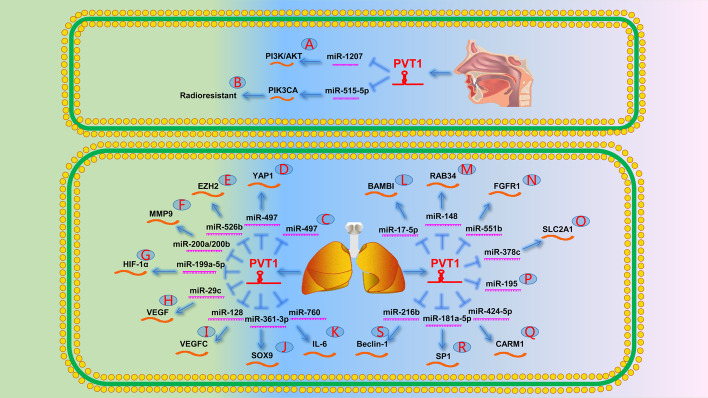
Fig. 1
Fig. 1
The role of PVT1 in the respiratory system. A PVT1 promotes the expression of PI3K/AKT by targeting miR-1207. B PVT1 promotes the expression of PIK3CA by targeting miR-515-5p, which in turn causes radioresistance. C PVT1 directly targets miR-497. D PVT1 promotes the expression of YAP1 by targeting miR-497. E PVT1 promotes the expression of EZH2 by targeting miR-526b. F PVT1 promotes the expression of MMP9 by targeting miR-200a/200b. G PVT1 promotes the expression of HIF-1α by targeting miR-199a-5p. H PVT1 promotes the expression of VEGF by targeting miR-29c. I PVT1 promotes the expression of VEGFC by targeting miR-128. J PVT1 promotes the expression of SOX9 by targeting miR-361-3p. K PVT1 promotes the expression of IL-6 by targeting miR-760. L PVT1 promotes the expression of BAMBI by targeting miR-17-5p. M PVT1 promotes the expression of RAB34 by targeting miR-148. N PVT1 promotes the expression of FGFR1 by targeting miR-551b. O PVT1 promotes the expression of SLC2A1 by targeting miR-378c. P PVT1 directly targets miR-195. Q PVT1 promotes the expression of CARM1 by targeting miR-424-5p. R PVT1 promotes the expression of SP1 by targeting miR-181a-5p. S PVT1 promotes the expression of Beclin-1 by targeting miR-216b
Fig. 2
Fig. 2
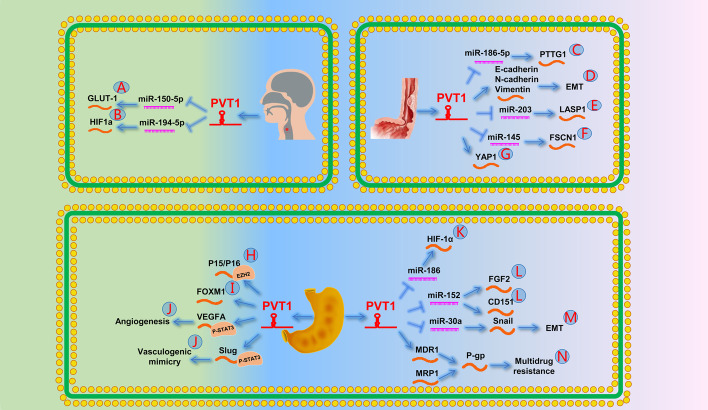
The role of PVT1 in the digestive system [1]. A PVT1 promotes the expression of GLUT-1 by targeting miR-150-5p. B PVT1 promotes HIF1a by targeting miR-194-5p and leads to cisplatin resistance in OSCC. C PVT1 promotes the expression of PTTG1 by targeting miR-186-5p. D PVT1 can promote the expression of EMT markers (E-cadherin, N-cadherin, and vimentin) in EC cells, indicating that it can promote the occurrence of EMT. E PVT1 promotes the expression of LASP1 by targeting miR-203. F PVT1 promotes the expression of FSCN1 by targeting miR-145. G PVT1 prevents the inactivation of Hippo’s downstream effector YAP1 by reducing its phosphorylation. H PVT1 downregulates P15/P16 expression by recruiting EZH2. I A positive feedback loop between PVT1 and FOXM1 promotes GC growth and invasion. J PVT1 can promote the expression of VEGFA and Slug by binding to STAT3 and ultimately promote angiogenesis and VM. K PVT1 promotes the expression of HIF-1α by targeting miR-186. L PVT1 promotes the expression of FGF2 and CD151 by targeting miR-152. M PVT1 promotes the expression of Snail by targeting miR-30a. N PVT1 promotes GC multidrug resistance by upregulating the ATP-dependent efflux pump P-gp by promoting the expression of MDR1 and MRP1
Fig. 3
Fig. 3
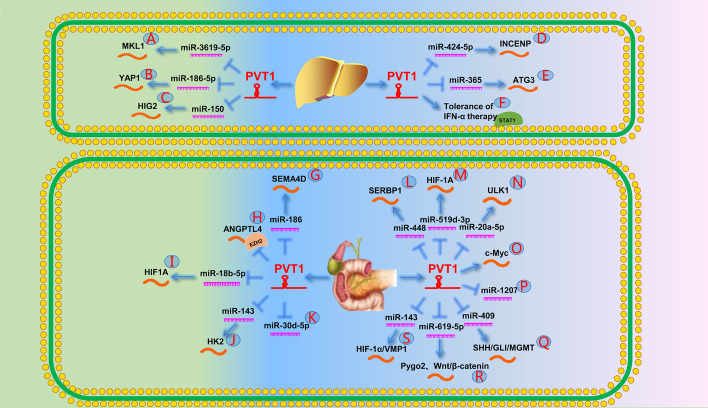
The role of PVT1 in the digestive system [2]. A PVT1 promotes the expression of MKL1 by targeting miR-3619-5p. B PVT1 promotes the expression of YAP1 by targeting miR-186-5p. C PVT1 promotes the expression of HIG2 by targeting miR-150. D PVT1 promotes the expression of INCENP by targeting miR-424-5p. E PVT1 promotes the expression of ATG3 by targeting miR-365. F PVT1 can decrease the phosphorylation of STAT1 and finally leads to the tolerance of IFN-α therapy. G PVT1 promotes the expression of SEMA4D by targeting miR-186. H PVT1 downregulates its expression by recruiting EZH2 to the ANGPTL4 promoter region. I PVT1 downregulates miR-18b-5p expression by binding to EZH2 and promotes HIF1A expression. J PVT1 promotes the expression of HK2 by targeting miR-143. K PVT1 directly binds to miR-30d-5p. (L) PVT1 promotes the expression of SERBP1 by targeting miR-448. M PVT1 promotes the expression of HIF-1A by targeting miR-519d-3p. N PVT1 promotes the expression of ULK1 by targeting miR-20a-5p. O PVT1 enhances gemcitabine resistance of PDAC by increasing c-Myc expression. P PVT1 enhances gemcitabine resistance of PC by inhibiting miR-1207 expression. Q PVT1 promotes the SHH/GLI/MGMT signal pathway by targeting miR-409. R PVT1 upregulates Pygo2 by targeting miR-619-5p and ultimately activates Wnt/β-catenin signaling pathway, resulting in PC resistance to gemcitabine chemotherapy. S PVT1 promotes the HIF-1α/VMP1 signaling pathway by targeting miR-143, resulting in PC resistance to gemcitabine chemotherapy
Fig. 4
Fig. 4
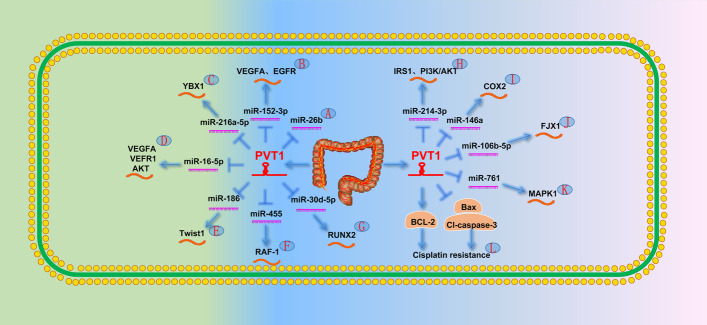
The role of PVT1 in the digestive system [3]. A PVT1 directly targets miR-26b. B PVT1 promotes the expression of VEGFA and EGFR by targeting miR-152-3p. C PVT1 promotes YBX1 expression by targeting miR-216a-5p and ultimately leads to EMT in CRC cells. D By targeting miR-16-5p, PVT1 leads to increased VEGFA, VEGFR1, and AKT expression and ultimately leads to EMT in CRC cells. E PVT1 ultimately promotes EMT in CRC cells by targeting miR-186 and leading to increased Twist1 expression. F PVT1 promotes RAF-1 by targeting miR-455. G PVT1 promotes the expression of RUNX2 by targeting miR-30d-5p. H PVT1 upregulates IRS1 by targeting miR-214-3p and ultimately activates PI3K/AKT signaling pathway. I PVT1 promotes the expression of COX2 by targeting miR-146a. J PVT1 promotes the expression of FJX1 by targeting miR-106b-5p. K PVT1 promotes the expression of MAPK1 by targeting miR-761. L PVT1 promotes the occurrence of EMT in CRC cells by downregulating the pro-apoptotic proteins Bax and Cl-caspase-3 and upregulating the expression of the anti-apoptotic protein BCL-2
Fig. 5
Fig. 5
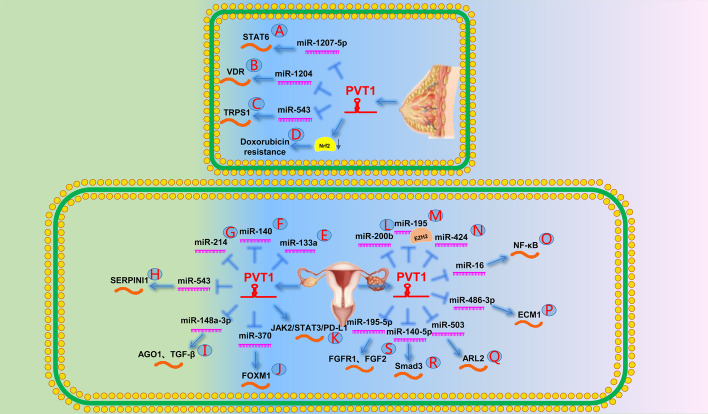
The role of PVT1 in the endocrine reproductive system. A PVT1 downregulates STAT6 by generating miR-1207-5p. B PVT1 targets VDR by generating miR-1204. C PVT1 promotes the expression of TRPS1 by targeting miR-543. D PVT1 caused Nrf2 degradation, eventually leading to doxorubicin resistance in TNBC. E PVT1 directly targets miR-133a. F PVT1 directly targets miR-140. G PVT1 directly targets miR-214. H PVT1 promotes SERPINI1 expression by targeting miR-543. I PVT1 upregulates AGO1 by targeting miR-148a-3p to promote the expression of TGF-β and ultimately leads to cisplatin resistance in OC. J PVT1 promotes FOXM1 expression by targeting miR-370. K PVT1 promotes OC cisplatin resistance by affecting the JAK2/STAT3/PD-L1 signaling pathway. L PVT1 directly targets miR-200b. M PVT1 directly targets miR-195. N PVT1 directly targets miR-424. O PVT1 promotes NF-κB signaling by targeting miR-16. P PVT1 promotes ECM1 expression by targeting miR-486-3p. Q PVT1 promotes ARL2 expression by targeting miR-503. R PVT1 promotes Smad3 expression by targeting miR-140-5p. S PVT1 promotes the expression of FGF2 and FGFR1 by targeting miR-195-5p
Fig. 6
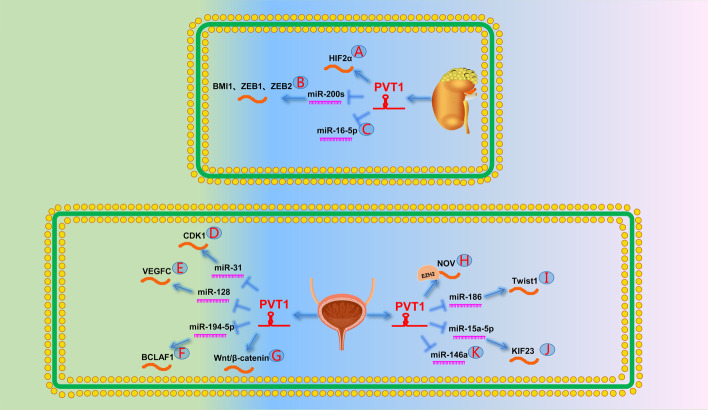
Fig. 6
The role of PVT1 in the urinary system. A PVT1 forms a positive feedback loop with HIF2α protein. B PVT1 promotes BMI1, ZEB1, and ZEB2 by targeting miR-200s. C PVT1 can directly target miR-16-5p. D PVT1 promotes the expression of CDK1 by targeting miR-31. E PVT1 promotes the expression of VEGFC by targeting miR-128. F PVT1 promotes the expression of BCLAF1 by targeting miR-194-5p. G PVT1 leads to chemoresistance in BCa by activating the Wnt/β-catenin signaling pathway. H PVT1 represses NOV expression by recruiting EZH2 to the promoter region of NOV. I PVT1 promotes Twist1 expression by targeting miR-186 and ultimately leads to EMT. J PVT1 promotes the expression of KIF23 by targeting miR-15a-5p. K PVT1 can directly target miR-146a
Fig. 7
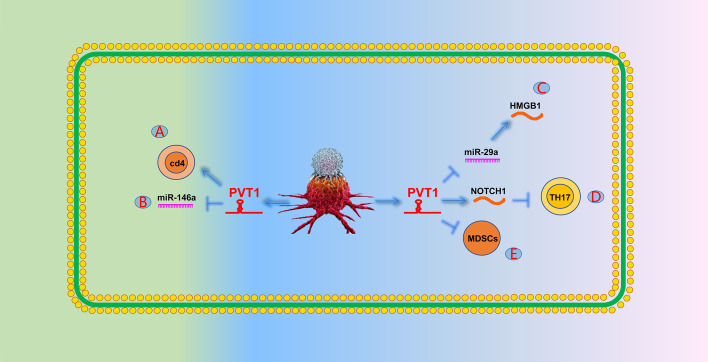
Fig. 7
The role of PVT1 in the immune system. A PVT1 can activate CD4+ T cells. B PVT1 can promote autophagy of regulatory T cells by targeting miR-146a. C PVT1 can promote the expression of HMGB1 and promote the polarization of M1 macrophages by targeting miR-29a. D PVT1 can reduce TH17 differentiation by attenuating NOTCH1 expression. E PVT1 can promote the effect of MDSCs to achieve tumor immune suppression
Fig. 8
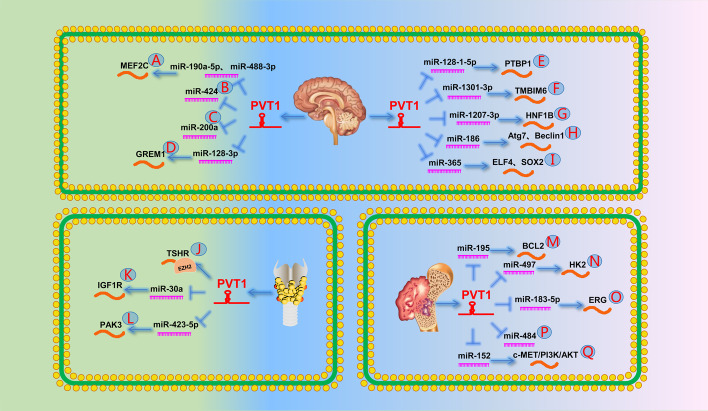
Fig. 8
The role of PVT1 in the other systems. A PVT1 promotes the expression of MEF2C by targeting miR-190a-5p and miR-488-3p. B PVT1 can directly target miR-424. C PVT1 can directly target miR-200a. D PVT1 promotes the expression of GREM1 by targeting miR-128-3p. E PVT1 promotes PTBP1 by targeting miR-128-1-5p. F PVT1 promotes TMBIM6 by targeting miR-1301-3p. G PVT1 promotes HNF1B by targeting miR-1207-3p. H PVT1 promotes Atg7 and Beclin1 by targeting miR-186. I PVT1 promotes the expression of ELF4 by targeting miR-365 to regulate the expression of SOX2. J PVT1 represses its expression by recruiting EZH2 to the promoter region of TSHR. K PVT1 can directly target miR-30a. L PVT1 promotes the expression of PAK3 by targeting miR-423-5p. M PVT1 promotes the expression BCL2 by targeting miR-195. N PVT1 promotes the expression of HK2 by targeting miR-497. O PVT1 promotes the expression of ERG by targeting miR-183-5p. P PVT1 can directly target miR-484. Q PVT1 promotes the expression of the c-MET/PI3K/AKT signaling pathway by targeting miR-152, which leads to chemoresistance

References

    1. Siegel RL, Miller KD, Fuchs HE, Jemal A. Cancer statistics, 2022. Cancer J Clin. 2022;72(1):234. doi: 10.3322/caac.21708. - DOI - PubMed
    1. Ransohoff JD, Wei Y, Khavari PA. The functions and unique features of long intergenic non-coding RNA. Nat Rev Mol Cell Biol. 2018;19(3):143–157. doi: 10.1038/nrm.2017.104. - DOI - PMC - PubMed
    1. Brockdorff N, Ashworth A, Kay GF, McCabe VM, Norris DP, Cooper PJ, et al. The product of the mouse Xist gene is a 15 kb inactive X-specific transcript containing no conserved ORF and located in the nucleus. Cell. 1992;71(3):515–526. doi: 10.1016/0092-8674(92)90519-I. - DOI - PubMed
    1. Kandoth C, McLellan MD, Vandin F, Ye K, Niu B, Lu C, et al. Mutational landscape and significance across 12 major cancer types. Nature. 2013;502(7471):333–339. doi: 10.1038/nature12634. - DOI - PMC - PubMed
    1. Lin A, Hu Q, Li C, Xing Z, Ma G, Wang C, et al. The LINK-A lncRNA interacts with PtdIns(3,4,5)P3 to hyperactivate AKT and confer resistance to AKT inhibitors. Nat Cell Biol. 2017;19(3):238–251. doi: 10.1038/ncb3473. - DOI - PMC - PubMed