Success factors of a collaborative project to reduce healthcare-associated infections in intensive care units in Northeastern Brazil
- PMID: 36197370
- PMCID: PMC9749087
- DOI: 10.5935/0103-507X.20220070-pt
Success factors of a collaborative project to reduce healthcare-associated infections in intensive care units in Northeastern Brazil
Abstract
Objective: To describe the implementation and results of the collaborative PROADI-SUS project by the Brazilian Ministry of Health to reduce healthcare-associated infections: ventilator-associated pneumonia, primary central line-associated bloodstream infection and catheter-associated urinary tract infections.
Methods: This was a prospective observational study that investigated the implementation stages and outcomes during 18 months in five intensive care units in the city of Recife. Reductions in healthcare-associated infections in each unit were calculated using previous medians compared to those of the study period.
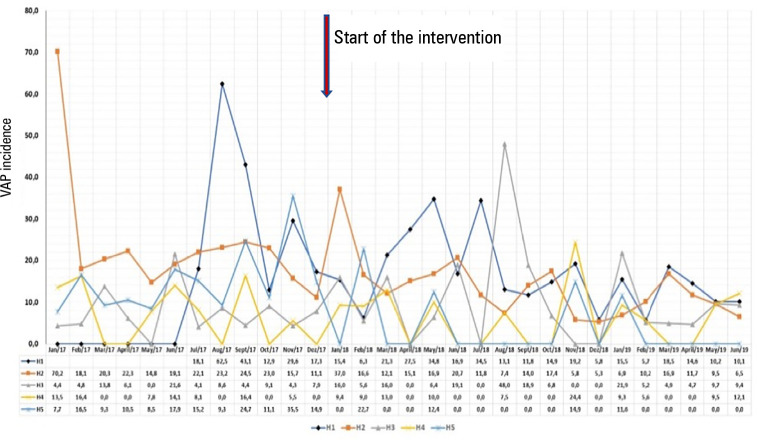
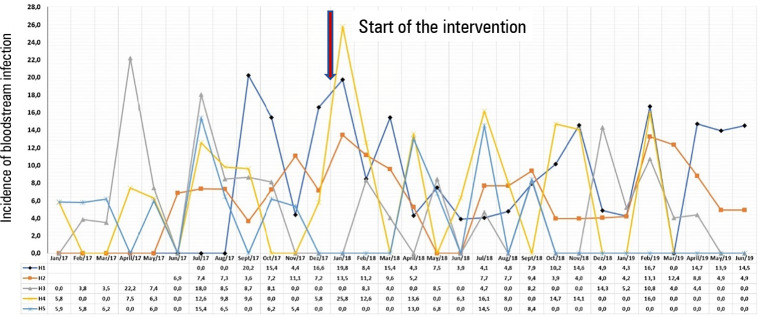
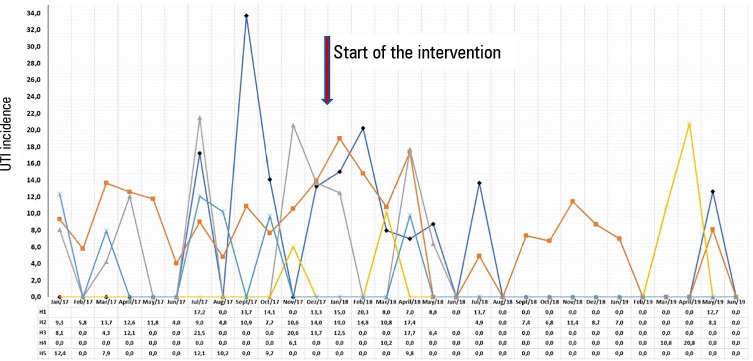
Results: The goal of reducing the three healthcare-associated infections, i.e., 30% in 18 months, was achieved in at least one of the healthcare-associated infections and was also achieved for two healthcare-associated infections in two hospitals and three healthcare-associated infections in just one hospital; the latter reached the target of 36 months. Implementing the bundles and monitoring the results by the professionals were considered essential actions by the local management teams. In addition, the acquisition of supplies and their availability alongside the beds, signage, checklists, staff awareness, adaptation, team building, training and celebration of achievements were assessed as being relevant for reducing healthcare-associated infections.
Conclusion: The collaborative approach reduced healthcare-associated infections, despite partial adherence to the bundles. The hypothesis is that success is related to the project methodology and motivated multidisciplinary teams, especially nursing teams.
Objetivo: Descrever a implementação e os resultados da colaborativa PROADI-SUS, do Ministério da Saúde Brasileiro, para redução das infecções relacionadas à assistência à saúde: pneumonia associada à ventilação mecânica, infecção primária da corrente sanguínea associada ao cateter venoso central e infecção do trato urinário associada ao cateter vesical de demora.
Métodos: Estudo observacional prospectivo que pesquisou as etapas da implementação e dos resultados por 18 meses, em cinco unidades de terapia intensiva de Recife. As reduções de infecções relacionadas à assistência à saúde em cada unidade foram calculadas pelas medianas anteriores comparadas ao período do estudo.
Resultados: A meta de redução das três infecções relacionadas à assistência à saúde, ou seja, 30% em 18 meses, foi obtida em no mínimo uma das infecções relacionadas à assistência à saúde nas cinco unidades de terapia intensiva, sendo ainda atingida para duas infecções relacionadas à assistência à saúde em dois hospitais e nas três infecções relacionadas à assistência à saúde em apenas um hospital; este último atingiu a meta prevista para 36 meses. Foram ações consideradas essenciais pelas equipes gestoras locais a implantação dos bundles e o acompanhamento dos resultados pelos profissionais. Também, aquisição de insumos e disponibilização junto aos leitos, sinalização, checklists, conscientização da equipe, adaptação, criação de times, treinamento e comemoração de conquistas foram avaliados como relevantes para redução das infecções relacionadas à assistência à saúde.
Conclusão: A colaborativa reduziu infecções relacionadas à assistência à saúde, apesar da adesão parcial aos bundles. A hipótese é a de que o êxito se relacione com a metodologia do projeto e equipes multiprofissionais motivadas, especialmente a enfermagem.
Conflict of interest statement
Figures
Similar articles
-
Partnership among hospitals to reduce healthcare associated infections: a quasi-experimental study in Brazilian ICUs.BMC Infect Dis. 2021 Feb 25;21(1):212. doi: 10.1186/s12879-021-05896-0. BMC Infect Dis. 2021. PMID: 33632137 Free PMC article.
-
Estimating the savings of a national project to prevent healthcare-associated infections in intensive care units.J Hosp Infect. 2024 Jan;143:8-17. doi: 10.1016/j.jhin.2023.10.001. Epub 2023 Oct 6. J Hosp Infect. 2024. PMID: 37806451
-
Quality improvement project to reduce infection indicators in intensive care.Rev Gaucha Enferm. 2025 Jun 2;46:e20240126. doi: 10.1590/1983-1447.2025.20240126.en. eCollection 2025. Rev Gaucha Enferm. 2025. PMID: 40465959 English, Portuguese.
-
Infection prevention in the intensive care unit.Infect Dis Clin North Am. 2009 Sep;23(3):703-25. doi: 10.1016/j.idc.2009.04.012. Infect Dis Clin North Am. 2009. PMID: 19665091 Review.
-
Evidence for the effectiveness of chlorhexidine bathing and health care-associated infections among adult intensive care patients: a trial sequential meta-analysis.BMC Infect Dis. 2018 Dec 19;18(1):679. doi: 10.1186/s12879-018-3521-y. BMC Infect Dis. 2018. PMID: 30567493 Free PMC article. Review.
Cited by
-
Daily Chlorhexidine Bath for Health Care Associated Infection Prevention (CLEAN-IT): protocol for a multicenter cluster randomized crossover open-label trial.Crit Care Sci. 2024 Sep 27;36:e20240053en. doi: 10.62675/2965-2774.20240053-en. eCollection 2024. Crit Care Sci. 2024. PMID: 39356897 Free PMC article.
-
A National Implementation Project to Prevent Healthcare-Associated Infections in Intensive Care Units: A Collaborative Initiative Using the Breakthrough Series Model.Open Forum Infect Dis. 2023 Mar 9;10(4):ofad129. doi: 10.1093/ofid/ofad129. eCollection 2023 Apr. Open Forum Infect Dis. 2023. PMID: 37077504 Free PMC article.
-
VATICAN (Ventilator-Associated Tracheobronchitis Initiative to Conduct Antibiotic Evaluation): protocol for a multicenter randomized open-label trial of watchful waiting versus antimicrobial therapy for ventilator-associated tracheobronchitis.Crit Care Sci. 2024 Aug 26;36:e20240029en. doi: 10.62675/2965-2774.20240029-en. eCollection 2024. Crit Care Sci. 2024. PMID: 39194024 Free PMC article.
-
The burden of healthcare-associated infections in Brazil: multi-hospital point prevalence using a matched case-control study.Sao Paulo Med J. 2025 Apr 28;143(2):e2023307. doi: 10.1590/1516-3180.2023.0307.R1.03072024. eCollection 2025. Sao Paulo Med J. 2025. PMID: 40298774 Free PMC article.
-
Motivational drivers for health professionals in a large quality improvement collaborative project in Brazil: a qualitative study.BMC Health Serv Res. 2024 Feb 9;24(1):183. doi: 10.1186/s12913-024-10678-w. BMC Health Serv Res. 2024. PMID: 38336769 Free PMC article.
References
-
- Brasil. Ministério da Saúde. PROADI-SUS . Saúde em nossas mãos. Melhorando a segurança do paciente em larga escala no Brasil (2018 - 2020) Brasil: Ministério da Saúde; 2020. [citado 2022 Julho 17]. Disponível em: http://hospitais.proadi-sus.org.br/projeto/melhorando-a-seguranca-do-pac... .
-
- Institute for Healthcare Improvement . The Breakthrough Series: IHI’s Collaborative Model for Achieving Breakthrough Improvement. IHI Innovation Series white paper. Boston: IHI; 2003. [cited 2022 July 17]. Available at: https://www.https://www.ihi.org/resources/Pages/IHIWhitePapersTheBreakth... .
-
- Wells S, Tamir O, Gray J, Naidoo D, Bekhit M, Goldmann D. Are quality improvement collaboratives effective? A systematic review. BMJ Qual Saf. 2018;27(3):226–240. - PubMed
Publication types
MeSH terms
LinkOut - more resources
Full Text Sources
Medical