Female Reproductive Events and Subclinical Atherosclerosis of the Brain and Carotid Arteriopathy: the Ohasama Study
- PMID: 36198521
- PMCID: PMC10406647
- DOI: 10.5551/jat.63592
Female Reproductive Events and Subclinical Atherosclerosis of the Brain and Carotid Arteriopathy: the Ohasama Study
Abstract
Aims: Few studies have investigated the subclinical atherosclerotic changes in the brain and carotid artery, and in East Asian populations. We sought to investigate whether gravidity, delivery, the age at menarche and menopause and estrogen exposure period are associated with subclinical atherosclerosis of the brain and carotid arteriopathy.
Methods: This cross-sectional study formed part of a cohort study of Ohasama residents initiated in 1986. Brain atherosclerosis and carotid arteriopathy were diagnosed as white matter hyperintensity (WMH) and lacunae evident on brain magnetic resonance imaging (MRI) and carotid intimal media thickness (IMT) or plaque revealed by ultrasound, respectively. The effect of the reproductive events on brain atherosclerosis and carotid arteriopathy was investigated using logistic regression and general linear regression models after adjusting for covariates.
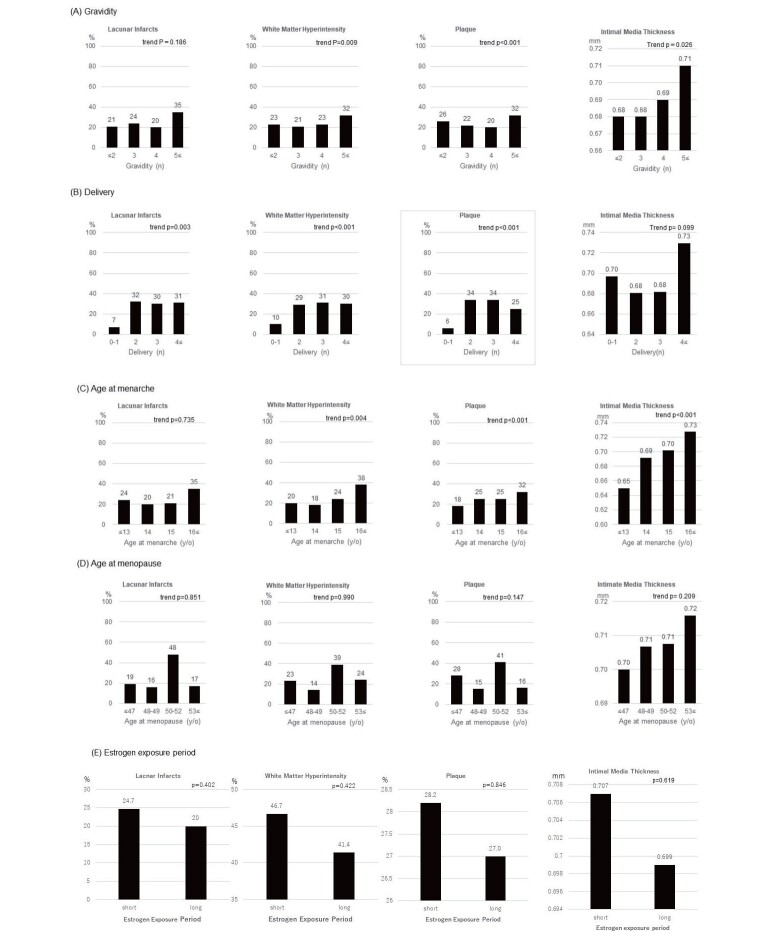
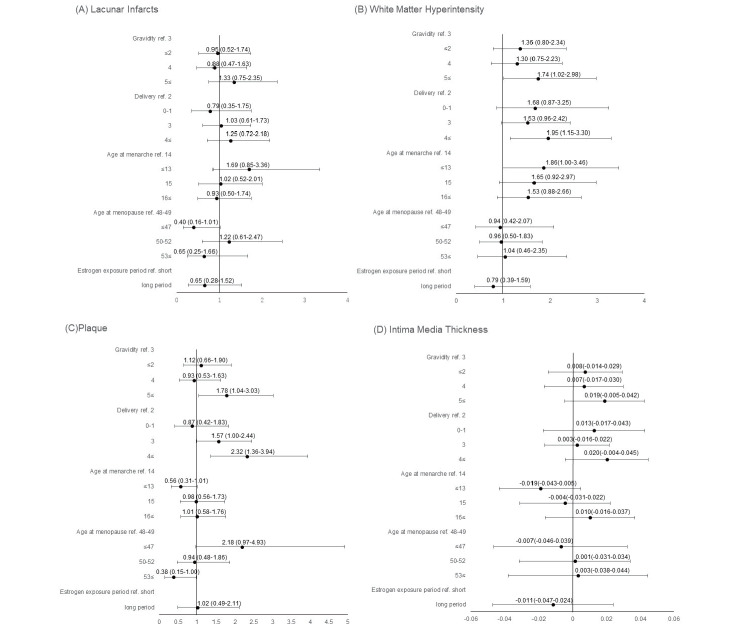
Results: Among 966 women aged ≥ 55 years in 1998, we identified 622 and 711 women (mean age: 69.2 and 69.7 years, respectively) who underwent either MRI or carotid ultrasound between 1992-2008 or 1993-2018, respectively. The highest quartile of gravidity (≥ 5 vs. 3) and delivery (≥ 4 vs. 2), and the highest and second highest (3 vs. 2) quartiles of delivery were associated with an increased risk of WMH and carotid artery plaque, respectively. Neither of age at menarche, menopause, and estrogen exposure period estimated by subtracting age at menarche from age at menopause was associated with atherosclerotic changes of brain and carotid arteries.
Conclusions: Higher gravidity and delivery are associated with subclinical atherosclerosis of the brain and carotid plaque.
Keywords: Carotid plaque; Delivery; Gravidity; Lacunar; Menarche; Menopause; Plaque; Reproductive events; White matter hyperintensity.
Conflict of interest statement
H.M., K.A., Y.I., and T.O. concurrently held the position of director of the Tohoku Institute for Management of Blood Pressure and were supported by Omron Healthcare Co., Ltd. K.A. and T.O. received a joint research grant from Omron Healthcare Co., Ltd.
Figures
References
-
- Mishra SR, Chung HF, Waller M, and Mishra GD: Duration of estrogen exposure during reproductive years, age at menarche and age at menopause, and risk of cardiovascular disease events, all-cause and cardiovascular mortality: A systematic review and meta-analysis. BJOG, 2021; 128: 809-821 - PubMed
-
- Muka T, Oliver-Williams C, Kunutsor S, Laven JS, Fauser BC, Chowdhury R, Kavousi M, and Franco OH: Association of age at onset of menopause and time since onset of menopause with cardiovascular outcomes, intermediate vascular traits, and all-cause mortality. JAMA Cardiol, 2016; 1: 767-776 - PubMed
-
- Zhu D, Chung HF, Dobson AJ, Pandeya N, Giles GG, Bruinsma F, Brunner EJ, Kuh D, Hardy R, Avis NE, Gold EB, Derby CA, Matthews KA, Cade JE, Greenwood DC, Demakakos P, Brown DE, Sievert LL, Anderson D, Hayashi K, Lee JS, Mizunuma H, Tillin T, Simonsen MK, Adami HO, Weiderpass E, and Mishra GD: Age at natural menopause and risk of incident cardiovascular disease: a pooled analysis of individual patient data. Lancet Public Health, 2019; 4: e553-e564 - PMC - PubMed