Review
. 2022 Oct;10(19):e15480.
doi: 10.14814/phy2.15480.

Role of macrophages during skeletal muscle regeneration and hypertrophy-Implications for immunomodulatory strategies

Affiliations
Review

Role of macrophages during skeletal muscle regeneration and hypertrophy-Implications for immunomodulatory strategies

Clara Bernard et al. Physiol Rep. 2022 Oct.

Abstract

Skeletal muscle is a plastic tissue that regenerates ad integrum after injury and adapts to raise mechanical loading/contractile activity by increasing its mass and/or myofiber size, a phenomenon commonly refers to as skeletal muscle hypertrophy. Both muscle regeneration and hypertrophy rely on the interactions between muscle stem cells and their neighborhood, which include inflammatory cells, and particularly macrophages. This review first summarizes the role of macrophages in muscle regeneration in various animal models of injury and in response to exercise-induced muscle damage in humans. Then, the potential contribution of macrophages to skeletal muscle hypertrophy is discussed on the basis of both animal and human experiments. We also present a brief comparative analysis of the role of macrophages during muscle regeneration versus hypertrophy. Finally, we summarize the current knowledge on the impact of different immunomodulatory strategies, such as heat therapy, cooling, massage, nonsteroidal anti-inflammatory drugs and resolvins, on skeletal muscle regeneration and their potential impact on muscle hypertrophy.


Figures

FIGURE 1
FIGURE 1
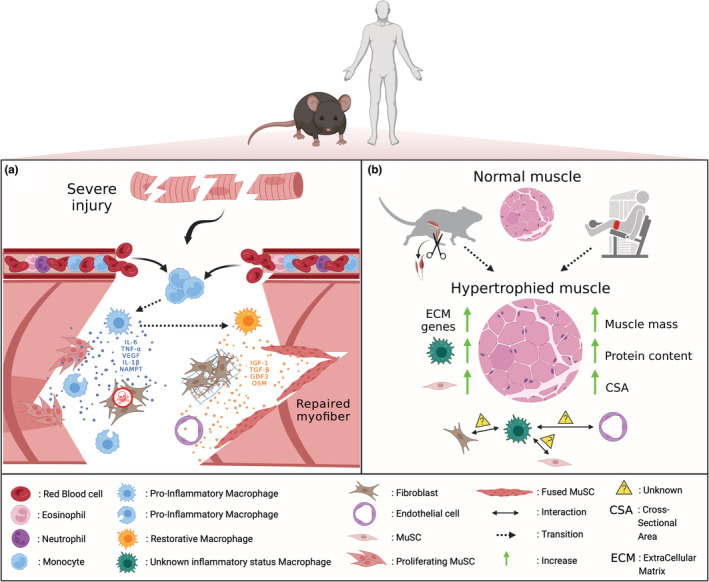
Role of macrophages during muscle regeneration and hypertrophy in animals and human. (a) after a severe injury usually induced by injection of a snake venom (e.g., cardiotoxin or notexin) into the mouse muscle, blood circulating monocytes enter the injured muscle and become pro‐inflammatory macrophages. They secrete cytokines such as IL‐6, TNF‐α, VEGF, IL‐1β and NAMPT to promote the proliferation of MuSCs and apoptosis of fibroblasts. Thanks to the phagocytosis of cell debris, pro‐inflammatory macrophages switch to become restorative macrophages and deliver other effectors such as IGF‐1, TGF‐β, GDF3 and OSM. They stimulate differentiation and fusion of MuSCs to repair the injured myofibers and promote angiogenesis and extracellular matrix remodeling. Human investigations also reported an accumulation of pro‐inflammatory macrophages in regenerating areas containing proliferating MuSCs while restorative macrophages were mainly located in areas containing differentiating MuSCs after a severe exercise‐induced muscle damage. (b) Hypertrophy can be induced experimentally by synergistic ablation of hindlimb muscles in animals or by resistance training in human, which is sometimes performed under blood flow restriction (the pneumatic cuff placed around the thigh is represented in red). These models are associated with an increase in muscle mass, myofiber cross‐sectional area, protein content, number of MuSCs, expression of genes involved in the regulation of extracellular matrix and macrophage infiltration. However, the inflammatory status of macrophages is not known in this context and how they interact with MuSCs, fibroblasts and endothelial cells to regulate changes in muscle mass has to be determined.
FIGURE 2
FIGURE 2
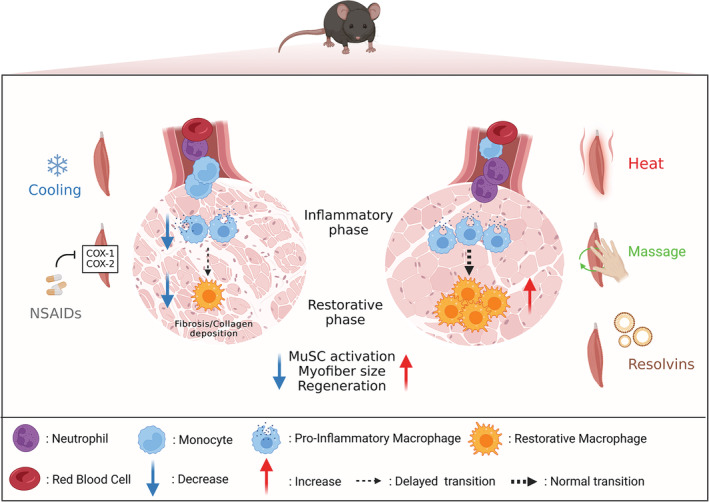
Impact of different therapeutic strategies on the muscle regeneration process in animals. Following muscle injury, cooling or administration of nonsteroidal anti‐inflammatory drugs administration (NSAIDs) can contribute to muscle regeneration defect and myofiber size decrease. Cooling decreases macrophage number and delays the shift towards anti‐inflammatory/restorative macrophages. Similarly, NSAIDs act upstream to reduce or delay macrophage infiltration through the inhibition of cyclooxygenase (COX‐1 and COX‐2) enzyme activity. As a result of perturbed inflammation, MuSCs are unable to activate properly and to repair damaged muscle fibers leading to the accumulation of necrotic muscle fibers in conjunction with collagen/fibrosis deposition. On the contrary, heating, massage or treatment with resolvins, show beneficial effects on muscle regeneration. Heating results in rapid increase of macrophages capable of resolving faster inflammation. Likewise, massage by applying cyclic movements on the injured muscle contributes to reduce the inflammatory infiltrate and favors early clearance of neutrophils. In addition, resolvins enhance the resolution of inflammation by limiting neutrophil infiltration and increasing macrophage efferocytosis. These mechanisms are associated with a better activation and differentiation of MuSCs.

References

    1. Almekinders, L. C. , & Gilbert, J. A. (1986). Healing of experimental muscle strains and the effects of nonsteroidal antiinflammatory medication. The American Journal of Sports Medicine, 14, 303–308. 10.1177/036354658601400411 - DOI - PubMed
    1. Armstrong, R. B. , Marum, P. , Tullson, P. , & Saubert, C. W. (1979). Acute hypertrophic response of skeletal muscle to removal of synergists. Journal of Applied Physiology: Respiratory, Environmental and Exercise Physiology, 46, 835–842. 10.1152/jappl.1979.46.4.835 - DOI - PubMed
    1. Arnold, L. , Henry, A. , Poron, F. , Baba‐Amer, Y. , van Rooijen, N. , Plonquet, A. , Gherardi, R. K. , & Chazaud, B. (2007). Inflammatory monocytes recruited after skeletal muscle injury switch into antiinflammatory macrophages to support myogenesis. The Journal of Experimental Medicine, 204, 1057–1069. 10.1084/jem.20070075 - DOI - PMC - PubMed
    1. Baht, G. S. , Bareja, A. , Lee, D. E. , Rao, R. R. , Huang, R. , Huebner, J. L. , Bartlett, D. B. , Hart, C. R. , Gibson, J. R. , Lanza, I. R. , Kraus, V. B. , Gregory, S. G. , Spiegelman, B. M. , & White, J. P. (2020). Meteorin‐like facilitates skeletal muscle repair through a Stat3/IGF‐1 mechanism. Nature Metabolism, 2, 278–289. 10.1038/s42255-020-0184-y - DOI - PMC - PubMed
    1. Ballotta, V. , Driessen‐Mol, A. , Bouten, C. V. C. , & Baaijens, F. P. T. (2014). Strain‐dependent modulation of macrophage polarization within scaffolds. Biomaterials, 35, 4919–4928. 10.1016/j.biomaterials.2014.03.002 - DOI - PubMed

LinkOut - more resources