


Central auditory processing in children after traumatic brain injury
- PMID: 36202032
- PMCID: PMC9535263
- DOI: 10.1016/j.clinsp.2022.100118
Central auditory processing in children after traumatic brain injury
Abstract
Introduction: Traumatic brain injury can impair the central auditory pathways and auditory cortex. Hence, individuals who suffered a traumatic brain injury may be at risk of central auditory processing disorders, which can be identified with behavioral tests that assess central auditory function.
Objective: To characterize and compare the performance of children and adolescents with and without a history of traumatic brain injury in behavioral tests that assess central auditory processing.
Method: The sample comprised 8- to 18-year-old individuals of both sexes who suffered moderate or severe closed traumatic brain injury 3 to 24 months before their participation in the study and whose hearing thresholds were normal. These individuals were matched for sex and age with other subjects without a history of traumatic brain injury and submitted to behavioral assessment of the central auditory processing with special tests to assess hearing skills (namely, auditory closure, figure-ground, and temporal processing), selected according to their chronological age and response-ability.
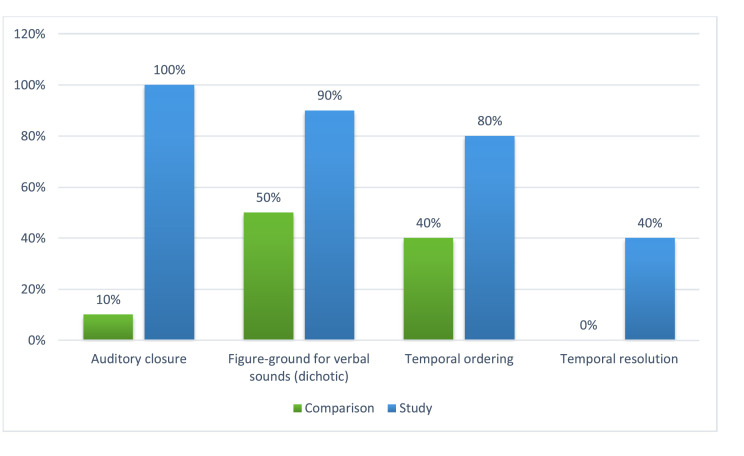
Results: The study group performed statistically worse than the comparison group in auditory closure, figure-ground in verbal dichotic listening, and temporal ordering. The central auditory processing tests with abnormal results in the comparison group were different from those in the study group.
Conclusion: Central auditory processing disorders were identified in all subjects of the study group, especially involving auditory closure and temporal processing skills, in comparison with subjects without a history of traumatic brain injury.
Keywords: Auditory perceptual disorders; Child; Hearing; Hearing tests; Traumatic brain injury.
Copyright © 2022 HCFMUSP. Published by Elsevier España, S.L.U. All rights reserved.
Conflict of interest statement
Declaration of Competing Interest The authors declare no conflicts of interest.
Figures
References
-
- Teasdale G., Jennett B. Assessment of coma and impaired consciousness. Lancet. 1974;2(7872):81–84. - PubMed
-
- Braga F.M., Ferraz F.A.P. In: Atualização Terapêutica. Manual Prático de Diagnóstico e Tratamento. 17ª ed. Prado F.C., Ramos J., Valle J.R., editors. Livraria Editora Artes Médicas Ltda; São Paulo: 1995. Traumatismo crânio-encefálico (TCE) pp. 728–730.
-
- Carvalho L.F., Affonseca C.A., Guerra S.D., Ferreira A.R., Goulart E.M. Severe traumatic braininjury in children and adolescents. Rev Bras Ter Intensiva. 2007;19(1):98–106. - PubMed
-
- Guerra S.D., Jannuzzi M.A., Moura A.D. Pediatric head injury. J Pediatr. 1999;75(Suppl 2):279–292. - PubMed
-
- Ministério da Saúde [Internet]. 2000. [acessado em 01 de julho de 2003]. Disponível em: http://www.datasus.gov.br.
MeSH terms
LinkOut - more resources
Full Text Sources
Medical
