Effectiveness of Clonidine in Child and Adolescent Sleep Disorders
- PMID: 36202109
- PMCID: PMC9536883
- DOI: 10.30773/pi.2022.0117
Effectiveness of Clonidine in Child and Adolescent Sleep Disorders
Abstract
Objective: We aimed to investigate the improvement in sleep quantity and quality when clonidine was used in children and adolescents with insomnia. We also examined how sociodemographic characteristics such as age, sex, underlying psychological problems, and levels of depression and anxiety affected the effect of clonidine.
Methods: We retrospectively reviewed outpatients aged 6 to 24 who took clonidine due to insomnia from September 2019 to September 2021 at the Department of Psychiatry at Eunpyeong St. Mary's Hospital of Catholic University. We used the Pittsburgh Sleep Quality Index (PSQI), Children's Depression Inventory (CDI), and State-Trait Anxiety Inventory (STAI) for our study.
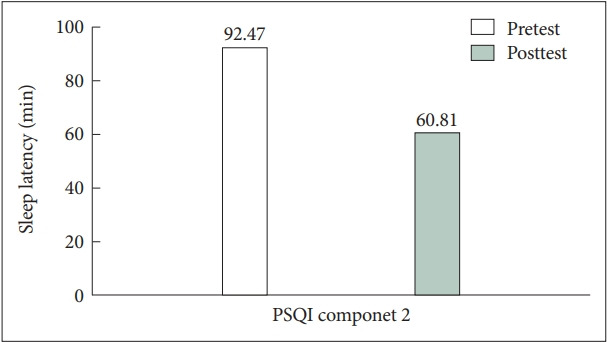
Results: A total of 62 participants were included in our study (34 females, mean age 13.94±4.94 years). After using clonidine, there was a significant decrease in PSQI components 1, 2, and 5, especially PSQI component 2. There was a greater decrease in sleep latency when clonidine was used in females, those aged between 13 and 24, those with mood/anxiety disorder or attention-deficit/hyperactivity disorder, those whose sleep latency exceeded 60 minutes at baseline, and those who used clonidine for more than 14 days. Those with higher STAI-Trait scores and CDI scores at baseline showed less improvement in total PSQI scores.
Conclusion: Considering that there are currently no Food and Drug Administration-approved sleep drugs for children and adolescents and no apparent difference in efficacy and safety among sleep drugs, we demonstrated that treatment with clonidine might be a good approach to improve sleep quality and quantity for children and adolescents.
Keywords: Adolescent; Child; Clonidine; Sleep latency; Sleep quality.
Conflict of interest statement
Min-Hyeon Park, a contributing editor of the
Figures
References
-
- Owens J. Classification and epidemiology of childhood sleep disorders. Sleep Med Clin. 2007;2:353–361.
-
- Liu X, Buysse DJ, Gentzler AL, Kiss E, Mayer L, Kapornai K, et al. Insomnia and hypersomnia associated with depressive phenomenology and comorbidity in childhood depression. Sleep. 2007;30:83–90. - PubMed
-
- Puig-Antich J, Goetz R, Hanlon C, Davies M, Thompson J, Chambers WJ, et al. Sleep architecture and REM sleep measures in prepubertal children with major depression: a controlled study. Arch Gen Psychiatry. 1982;39:932–939. - PubMed
-
- Tikotzky L, Sadeh A. The role of cognitive-behavioral therapy in behavioral childhood insomnia. Sleep Med. 2010;11:686–691. - PubMed
LinkOut - more resources
Full Text Sources