. 2022 Oct 6;5(1):1061.
doi: 10.1038/s42003-022-03978-6.

Copy number variants as modifiers of breast cancer risk for BRCA1/BRCA2 pathogenic variant carriers

Christopher Hakkaart  1 John F Pearson  1 Louise Marquart  2   3 Joe Dennis  4 George A R Wiggins  1 Daniel R Barnes  4 Bridget A Robinson  5   6 Peter D Mace  7 Kristiina Aittomäki  8 Irene L Andrulis  9   10 Banu K Arun  11 Jacopo Azzollini  12 Judith Balmaña  13   14 Rosa B Barkardottir  15   16 Sami Belhadj  17 Lieke Berger  18 Marinus J Blok  19 Susanne E Boonen  20 Julika Borde  21   22   23 Angela R Bradbury  24 Joan Brunet  25 Saundra S Buys  26 Maria A Caligo  27 Ian Campbell  28   29 Wendy K Chung  30 Kathleen B M Claes  31 GEMO Study CollaboratorsEMBRACE CollaboratorsMarie-Agnès Collonge-Rame  32 Jackie Cook  33 Casey Cosgrove  34 Fergus J Couch  35 Mary B Daly  36 Sita Dandiker  17 Rosemarie Davidson  37 Miguel de la Hoya  38 Robin de Putter  31 Capucine Delnatte  39 Mallika Dhawan  40 Orland Diez  13   41 Yuan Chun Ding  42 Susan M Domchek  43 Alan Donaldson  44 Jacqueline Eason  45 Douglas F Easton  4   46 Hans Ehrencrona  47   48 Christoph Engel  49   50 D Gareth Evans  51   52 Ulrike Faust  53 Lidia Feliubadaló  25 Florentia Fostira  54 Eitan Friedman  55   56 Megan Frone  57 Debra Frost  4 Judy Garber  58 Simon A Gayther  59 Andrea Gehrig  60 Paul Gesta  61 Andrew K Godwin  62 David E Goldgar  63 Mark H Greene  57 Eric Hahnen  21   23 Christopher R Hake  64 Ute Hamann  65 Thomas V O Hansen  66 Jan Hauke  21   22   23 Julia Hentschel  67 Natalie Herold  21   22   23 Ellen Honisch  68 Peter J Hulick  69   70 Evgeny N Imyanitov  71 SWE-BRCA InvestigatorskConFab InvestigatorsHEBON InvestigatorsClaudine Isaacs  72 Louise Izatt  73 Angel Izquierdo  25 Anna Jakubowska  74   75 Paul A James  29   76 Ramunas Janavicius  77   78 Esther M John  79   80 Vijai Joseph  17 Beth Y Karlan  81 Zoe Kemp  82 Judy Kirk  83 Irene Konstantopoulou  54 Marco Koudijs  84 Ava Kwong  85   86   87 Yael Laitman  55 Fiona Lalloo  88 Christine Lasset  89 Charlotte Lautrup  90 Conxi Lazaro  25 Clémentine Legrand  91 Goska Leslie  4 Fabienne Lesueur  92   93   94 Phuong L Mai  95 Siranoush Manoukian  12 Véronique Mari  96 John W M Martens  97 Lesley McGuffog  4 Noura Mebirouk  92   93   94 Alfons Meindl  98 Austin Miller  99 Marco Montagna  100 Lidia Moserle  100 Emmanuelle Mouret-Fourme  101 Hannah Musgrave  102 Sophie Nambot  103 Katherine L Nathanson  43 Susan L Neuhausen  42 Heli Nevanlinna  104 Joanne Ngeow Yuen Yie  105   106 Tu Nguyen-Dumont  107   108 Liene Nikitina-Zake  109 Kenneth Offit  17   110 Edith Olah  111 Olufunmilayo I Olopade  112 Ana Osorio  113 Claus-Eric Ott  114 Sue K Park  115   116   117 Michael T Parsons  118 Inge Sokilde Pedersen  119   120   121 Ana Peixoto  122 Pedro Perez-Segura  38 Paolo Peterlongo  123 Timea Pocza  111 Paolo Radice  124 Juliane Ramser  125 Johanna Rantala  126 Gustavo C Rodriguez  127 Karina Rønlund  128 Efraim H Rosenberg  129 Maria Rossing  130   131 Rita K Schmutzler  21   22   23 Payal D Shah  24 Saba Sharif  132 Priyanka Sharma  133 Lucy E Side  134 Jacques Simard  135 Christian F Singer  136 Katie Snape  137 Doris Steinemann  138 Dominique Stoppa-Lyonnet  101   139   140 Christian Sutter  141 Yen Yen Tan  136 Manuel R Teixeira  122   142 Soo Hwang Teo  143   144 Mads Thomassen  20 Darcy L Thull  145 Marc Tischkowitz  146   147 Amanda E Toland  148 Alison H Trainer  76   149 Vishakha Tripathi  150 Nadine Tung  151 Klaartje van Engelen  152 Elizabeth J van Rensburg  153 Ana Vega  154   155   156 Alessandra Viel  157 Lisa Walker  158 Jeffrey N Weitzel  159 Marike R Wevers  160 Georgia Chenevix-Trench  118 Amanda B Spurdle  118 Antonis C Antoniou  4 Logan C Walker  161
Collaborators, Affiliations

Copy number variants as modifiers of breast cancer risk for BRCA1/BRCA2 pathogenic variant carriers

Christopher Hakkaart et al. Commun Biol. .

Abstract

The contribution of germline copy number variants (CNVs) to risk of developing cancer in individuals with pathogenic BRCA1 or BRCA2 variants remains relatively unknown. We conducted the largest genome-wide analysis of CNVs in 15,342 BRCA1 and 10,740 BRCA2 pathogenic variant carriers. We used these results to prioritise a candidate breast cancer risk-modifier gene for laboratory analysis and biological validation. Notably, the HR for deletions in BRCA1 suggested an elevated breast cancer risk estimate (hazard ratio (HR) = 1.21), 95% confidence interval (95% CI = 1.09-1.35) compared with non-CNV pathogenic variants. In contrast, deletions overlapping SULT1A1 suggested a decreased breast cancer risk (HR = 0.73, 95% CI 0.59-0.91) in BRCA1 pathogenic variant carriers. Functional analyses of SULT1A1 showed that reduced mRNA expression in pathogenic BRCA1 variant cells was associated with reduced cellular proliferation and reduced DNA damage after treatment with DNA damaging agents. These data provide evidence that deleterious variants in BRCA1 plus SULT1A1 deletions contribute to variable breast cancer risk in BRCA1 carriers.


Conflict of interest statement

The authors declare no competing interests

Figures
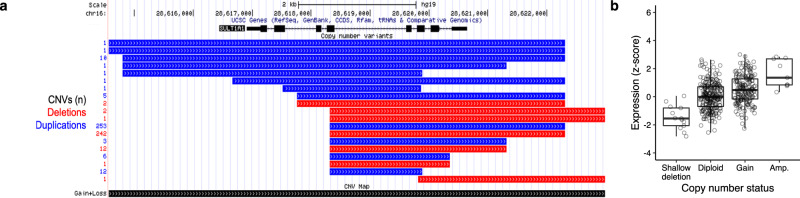
Fig. 1
Fig. 1. Characterisation of SULT1A1.
a Genomic viewer (UCSC) of the SULT1A1 gene locus with copy number variants; deletion (red) and duplication (blue). b Dosage effect in breast tumours with SULT1A1 copy number variants. CNVs copy number variants.
Fig. 2
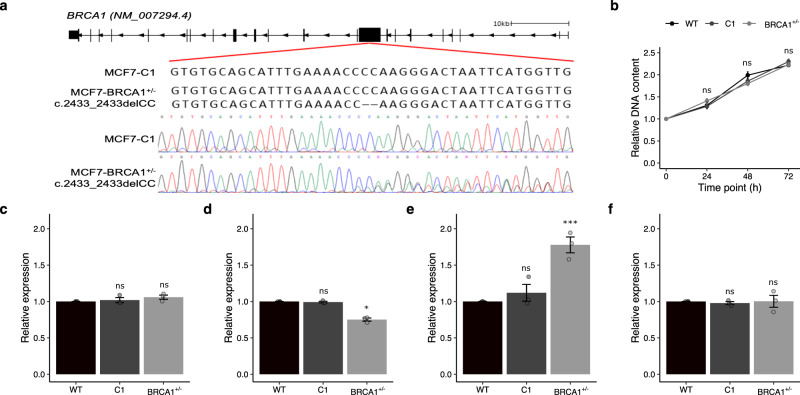
Fig. 2. Characterisation of MCF7–WT, and isogenic MCF7–C1, and MCF7–BRCA1+/− cell lines.
a Sequence of heterozygous pathogenic BRCA1 c.2432_2433del variant introduced by CRISPR-Cas9. b Relative proliferation of MCF7–WT and clonally expanded CRISPR-Cas9 MCF7–C1 and MCF7–BRCA1+/− cells for 72 h post seeding. Relative expression of c BRCA1, d ESR1, e CYP1A1, and f SULT1A1 for MCF7–WT, MCF7–C1 and MCF7–BRCA1+/− cells. 4-OHE2 4-hydroxyestradiol, MMC Mitomycin C, Error bars = standard error of the mean; ns = p > 0.05; *p < 0.05; **p < 0.01; ***p < 0.001; n = 3 independent biological replicates; unpaired two-sided t-test.
Fig. 3
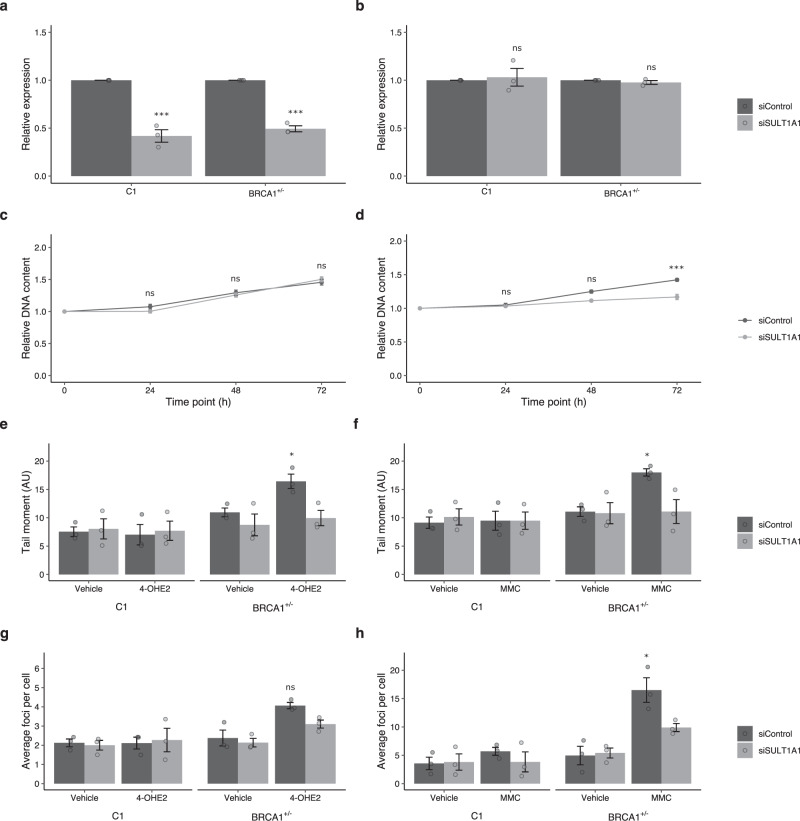
Fig. 3. siRNA knockdown of SULT1A1 reduces proliferation and DNA damage of MCF7–BRCA1+/− cells but not MCF7–C1 cells.
Expression of (a) SULT1A1 and (b) BRCA1 72 h post transfection. Relative DNA content of transfected (c) MCF7–C1 and (d) MCF7–BRCA1+/− cells 72 h post transfection. Quantification of transfected DNA damage using the comet assay (e, f) and ϒ-H2AX/53BP1 foci quantification (g, h) for MCF7–C1 and MCF7–BRCA1+/− cells, with and without siSULT1A1 transfection, 21 h post treatment with 1 μm 4-OHE2 (e and g) or 10 μm MMC (f and h). Significance of differences in relative expression and DNA content was determined by unpaired two-sided t-test. Gene expression and DNA content of siSULT1A1 transfected cells normalised to siControl transfected cells. Differences in DNA damage were determined by two-way analysis of variance. Example images of comet and ϒ-H2AX/53BP1 foci shown in Supplementary Figs. 3–6. 4-OHE2 = 4-hydroxyestradiol; MMC = Mitomycin C; Error bars = standard error of the mean; ns = p > 0.05; *p < 0.05; **p < 0.01; ***p < 0.001; n = 3 independent biological replicates.

References

    1. Kuchenbaecker KB, et al. Risks of breast, ovarian, and contralateral breast cancer for BRCA1 and BRCA2 mutation carriers. JAMA. 2017;317:2402–2416. doi: 10.1001/jama.2017.7112. - DOI - PubMed
    1. Chenevix-Trench G, et al. An international initiative to identify genetic modifiers of cancer risk in BRCA1 and BRCA2 mutation carriers: the Consortium of Investigators of Modifiers of BRCA1 and BRCA2 (CIMBA) Breast Cancer Res. 2007;9:104. doi: 10.1186/bcr1670. - DOI - PMC - PubMed
    1. Milne RL, Antoniou AC. Modifiers of breast and ovarian cancer risks for BRCA1 and BRCA2 mutation carriers. Endocr. Relat. Cancer. 2016;23:T69–T84. doi: 10.1530/ERC-16-0277. - DOI - PubMed
    1. Coignard J, et al. A case-only study to identify genetic modifiers of breast cancer risk for BRCA1/BRCA2 mutation carriers. Nat. Commun. 2021;12:1078. doi: 10.1038/s41467-020-20496-3. - DOI - PMC - PubMed
    1. Milne RL, et al. Identification of ten variants associated with risk of estrogen-receptor-negative breast cancer. Nat. Genet. 2017;49:1767–1778. doi: 10.1038/ng.3785. - DOI - PMC - PubMed

Publication types

Grants and funding