Review
. 2022 Sep 27:2022:7883945.
doi: 10.1155/2022/7883945. eCollection 2022.

Crosstalk between the Intestinal Virome and Other Components of the Microbiota, and Its Effect on Intestinal Mucosal Response and Diseases

Affiliations
Review

Crosstalk between the Intestinal Virome and Other Components of the Microbiota, and Its Effect on Intestinal Mucosal Response and Diseases

Njinju Asaba Clinton et al. J Immunol Res. .

Abstract

In recent years, there has been ample evidence illustrating the effect of microbiota on gut immunity, homeostasis, and disease. Most of these studies have engaged more efforts in understanding the role of the bacteriome in gut mucosal immunity and disease. However, studies on the virome and its influence on gut mucosal immunity and pathology are still at infancy owing to limited metagenomic tools. Nonetheless, the existing studies on the virome have largely been focused on the bacteriophages as these represent the main component of the virome with little information on endogenous retroviruses (ERVs) and eukaryotic viruses. In this review, we describe the gut virome, and its role in gut mucosal response and disease progression. We also explore the crosstalk between the virome and other microorganisms in the gut mucosa and elaborate on how these interactions shape the gut mucosal immunity going from bacteriophages through ERVs to eukaryotic viruses. Finally, we elucidate the potential contribution of this crosstalk in the pathogenesis of inflammatory bowel diseases and colon cancer.


Conflict of interest statement

The authors declare that they have no conflict of interest.

Figures
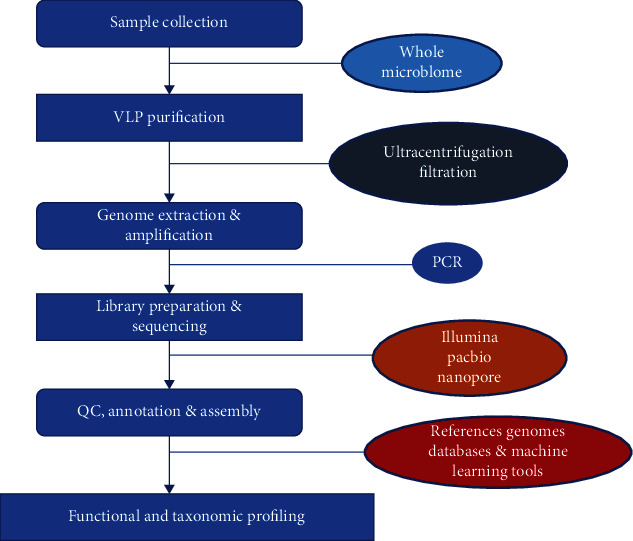
Figure 1
Figure 1
Viral metagenomic workflow. A schematic representation of the steps and processes involved in the isolation, identification, and analysis of the virome. Following sample collection, the sample is purified through a series of steps involving ultracentrifugation and filtration to retain the virus-like particles (VLPs). This is followed by extraction steps to isolate the genomes of the VLPs which are then amplified by PCR, utilized for library preparation and sequenced using sequencing technologies such as Illumina, Pacbio, or Oxford nanopore technology. The sequencing generates reads—short, long, or ultra-long—which are quality controlled, annotated, and assembled using different databases and machine learning tools. Finally, the identified VLPs are then subjected to taxonomic and functional profiling to answer key biological questions.
Figure 2
Figure 2
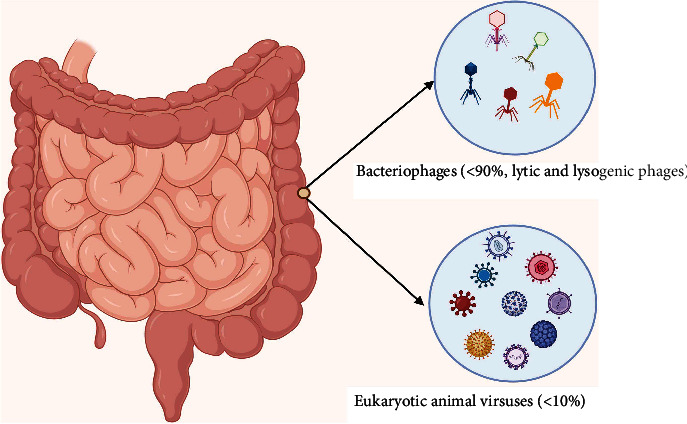
Figure illustrates the two main compositions of the human intestinal virome (bacteriophages and eukaryotic viruses). The bacteriophages present the most abundant and can be subdivided into lytic and lysogenic phages depending on the infection outcome in bacteria.
Figure 3
Figure 3
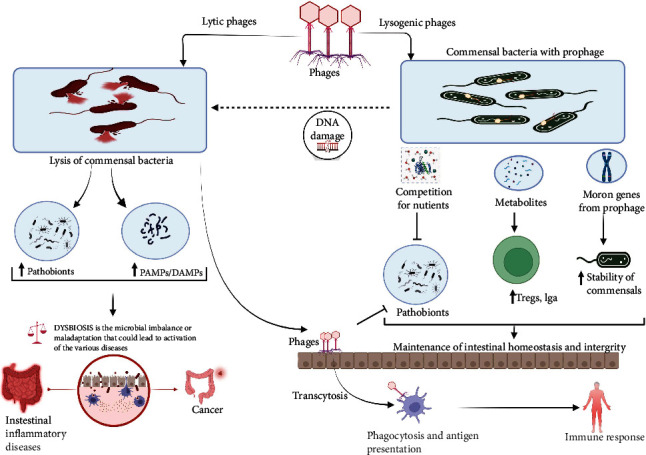
This figure illustrates the role of lytic and lysogenic phages in the induction and protection of intestinal dysbiosis and inflammation. The lysis of bacteria by lytic phages leads to the release of pathogen-associated molecular patterns (PAMPS) and danger-associated molecular patterns (DAMPS) which trigger the release of proinflammatory cytokines leading to intestinal inflammation and dysbiosis. However, phages released from lysed bacteria can bind to the intestinal mucosa and protect against pathobionts. Phages can also cross the mucosal barrier by transcytosis and induce local and systemic immune response. On the contrary, commensal bacteria protect the intestinal mucosa from pathobionts and helps in the maintenance of intestinal homeostasis and integrity via competition for nutrients with pathobionts, induction of Tregs, IgA. Nevertheless, following stress factors which lead to DNA damage these prophages can become lytic triggering inflammation.
Figure 4
Figure 4
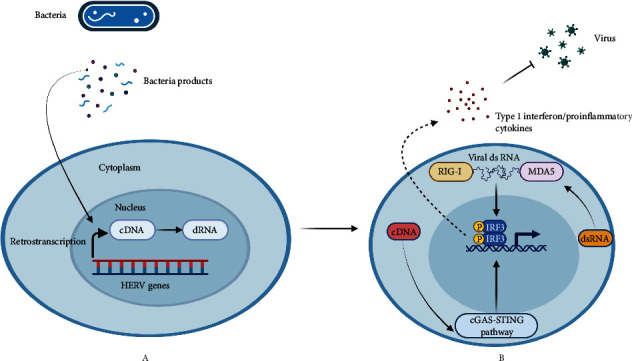
An illustration of retro-transcription of HERV (human endogenous retroviruses) or endogenous retroelements following stimuli released from commensal bacteria (a). Retro-transcription of human endogenous retroviruses (HERV) lead to the formation of cDNA and dsRNA that is released into the cytoplasm. The presence of cytosolic cDNA and dsRNA initiates a protective antiviral immune response via the activation of cGAS/STING and RIG-1/MAV pathways (b).

References

    1. Mowat A. M., Agace W. W. Regional specialization within the intestinal immune system. Nature Reviews Immunology . 2014;14(10):667–685. doi: 10.1038/nri3738. - DOI - PubMed
    1. Gu B.-H., Kim M., Yun C.-H. Regulation of gastrointestinal immunity by metabolites. Nutrients . 2021;13(1):p. 167. doi: 10.3390/nu13010167. - DOI - PMC - PubMed
    1. Allaire J. M., Crowley S. M., Law H. T., Chang S. Y., Ko H. J., Vallance B. A. The intestinal epithelium: central coordinator of mucosal immunity. Trends in Immunology . 2018;39(9):677–696. doi: 10.1016/j.it.2018.04.002. - DOI - PubMed
    1. Lebedev K., Ponyakina I. Immunophysiology of epithelial cells and pattern-recognition receptors. Human Physiology . 2006;32(2):224–234. doi: 10.1134/S0362119706020198. - DOI - PubMed
    1. Keir M. E., Yi T., Lu T. T., Ghilardi N. The role of IL-22 in intestinal health and disease. Journal of Experimental Medicine . 2020;217(3, article e20192195) doi: 10.1084/jem.20192195. - DOI - PMC - PubMed

LinkOut - more resources