


Time trends in the incidence of essential tremor: Evidences from UK and France primary care data
- PMID: 36203992
- PMCID: PMC9531026
- DOI: 10.3389/fneur.2022.987618
Time trends in the incidence of essential tremor: Evidences from UK and France primary care data
Abstract
Introduction: Although essential tremor (ET) is considered a common adult movement disorder, evidence on its incidence is still scant. This study aims at estimating ET incidence in two European countries, namely, the UK and France.
Methods: Incident cases of ET were identified within the Health Improvement Network (THIN®) database between 1st January 2014 and 31 December 2019. Yearly crude and standardized incidence rates (IR) were estimated across the study period for both countries. Poisson regression models were built to assess temporal trends in IRs and differences between sexes and age classes.
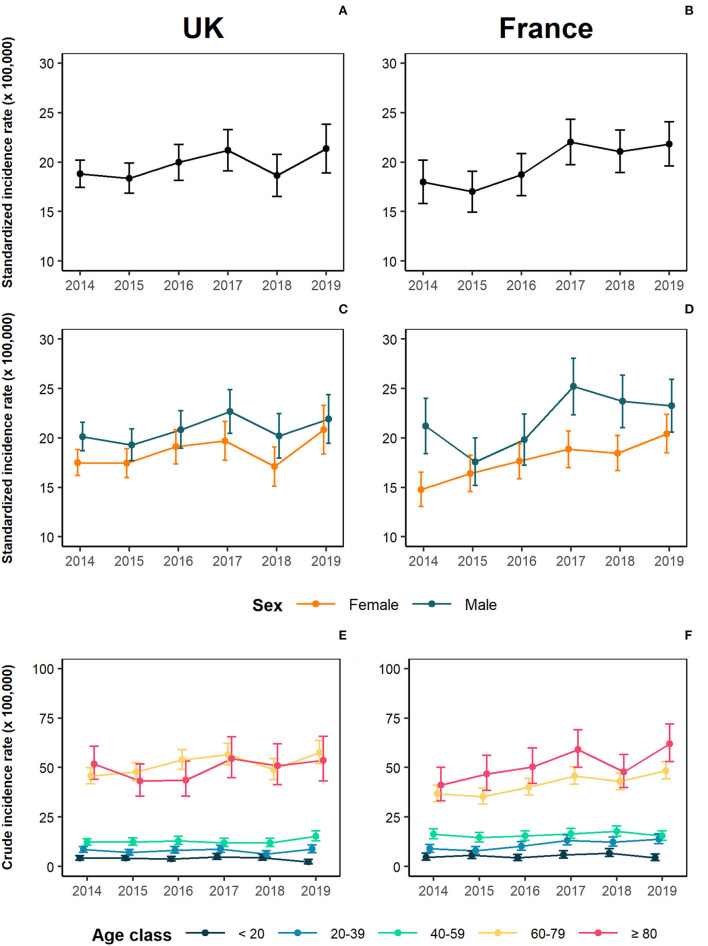
Results: In total, 4,970 and 4,905 incident cases of ET were identified in the UK and France, respectively. The yearly average crude IR (per 100,000 person-years) was 18.20 (95%CI: 15.09-21.32) in UK and 21.42 (17.83-25.00) in France, whereas standardized ones were 19.51 (18.97-20.01) and 19.50 (18.97-20.05). Regression analyses showed slightly increasing trends in both countries, higher incidence among males, and a significant increase with age. Yearly average IR increased from 3.96 (0.95-6.97) and 5.28 (1.12-9.44) in subjects aged <20 years to 49.27 (26.29-72.24) and 51.52 (30.19-72.86) in those aged >80 year in UK and France.
Conclusions: Standardized ET incidence was comparable in the UK and France, showing a slight increase in both countries, reporting a higher value among people aged 60 years and older. This study outlines the need to conduct future studies to estimate the burden of ET in terms of disease control and healthcare resource utilization.
Keywords: France; THIN® database; United Kingdom; epidemiology; essential tremor.
Copyright © 2022 Antonazzo, Conti, Rozza, Fornari, Eteve-Pitsaer, Paris, Gantzer, Valentine, Mantovani and Mazzaglia.
Conflict of interest statement
Author LM has received grants and personal fees from Bayer AG, Boehringer Ingelheim, Pfizer and Daiichi-Sankyo. Authors CE-P, CP, LG, and DV are employed by Cegedim. The remaining authors declare that the research was conducted in the absence of any commercial or financial relationships that could be construed as a potential conflict of interest.
Figures
Comment in
-
Commentary: Time trends in the incidence of essential tremor: Evidences from UK and France primary care data.Front Neurol. 2023 Jan 20;14:1136150. doi: 10.3389/fneur.2023.1136150. eCollection 2023. Front Neurol. 2023. PMID: 36741281 Free PMC article. No abstract available.
References
-
- Bhatia KP, Bain P, Bajaj N, Elble RJ, Hallett M, Louis ED, et al. Tremor Task Force of the International Parkinson and Movement Disorder Society. Consensus Statement on the classification of tremors from the task force on tremor of the International Parkinson and Movement Disorder Society. Mov Disord. (2018) 33:75–87. 10.1002/mds.27121 - DOI - PMC - PubMed
-
- Bain P, Brin M, Deuschl G, Elble R, Jankovic J, Findley L, et al. Criteria for the diagnosis of essential tremor. Neurology. (2000) 54(Suppl. 4): S7. - PubMed
LinkOut - more resources
Full Text Sources
