


Associations of insulin resistance and insulin secretion with bone mineral density and osteoporosis in a general population
- PMID: 36204101
- PMCID: PMC9530363
- DOI: 10.3389/fendo.2022.971960
Associations of insulin resistance and insulin secretion with bone mineral density and osteoporosis in a general population
Abstract
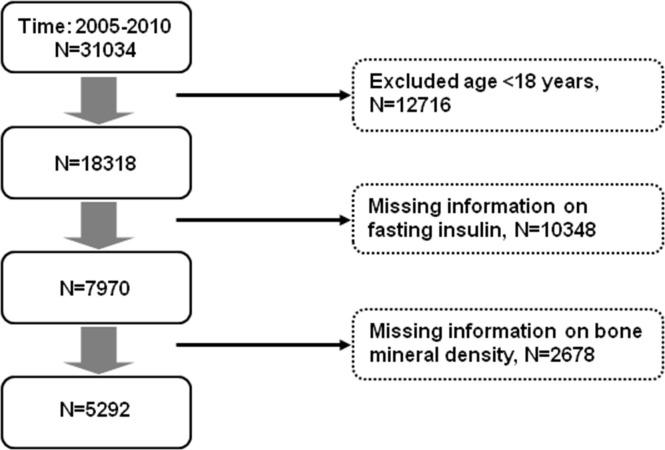
We investigated the associations of insulin resistance and β-cell secretion with bone mineral density (BMD) and osteoporosis using data from the National Health and Nutrition Examination Survey. Data on BMD assessed using dual-energy x-ray absorptiometry from 5292 participants were analyzed. Insulin resistance and β-cell secretion were assessed using the Homeostatic Model Assessment for Insulin Resistance (HOMA-IR) and β-cell function (HOMA-β), respectively. We divided the study population into four groups according to HOMA-IR (<2 vs. ≥ 2) and HOMA-β (<100 vs. ≥ 100). BMD and T score at the lumbar spine, hip joint, and femur were used for analyses. Osteoporosis was defined as a T score ≤ -2.5. Logistic regression analyses were conducted to examine the associations of HOMA-IR and HOMA-β with osteoporosis, and the joint effects of HOMA-IR and HOMA-β on osteoporosis. We found a positive association between HOMA-IR and osteoporosis in participants with a HOMA-β ≥ 100 (OR 8.773, 95% CI 2.160-35.637, p=0.002 at the femoral neck). A negative association between HOMA-β and osteoporosis was noted in those with a HOMA-IR <2 (OR 0.183, 95% CI 0.038-0.882, p=0.034 at the femoral neck). Compared with participants who had HOMA-IR <2 and HOMA-β <100, those with HOMA-IR <2 and HOMA-β ≥ 100 had a lower risk of osteoporosis (OR 0.126, 95% CI 0.020-0.805, p=0.032 at the femoral neck). In conclusion, the association between HOMA-β and BMD/osteoporosis changed as HOMA-IR increased. HOMA-β was negatively associated with osteoporosis when HOMA-IR <2. The association was not significant when HOMA-IR ≥ 2.
Keywords: bone mineral density; insulin; insulin resistance; insulinemia; osteoporosis.
Copyright © 2022 Fu, Liu, Lee and Wang.
Conflict of interest statement
The authors declare that the research was conducted in the absence of any commercial or financial relationships that could be construed as a potential conflict of interest.
Figures
References
Publication types
MeSH terms
LinkOut - more resources
Full Text Sources
Medical
