


Health workers' experiences of implementation of Helping Mothers Survive Bleeding after Birth training in Tanzania: a process evaluation using the i-PARIHS framework
- PMID: 36207715
- PMCID: PMC9547459
- DOI: 10.1186/s12913-022-08605-y
Health workers' experiences of implementation of Helping Mothers Survive Bleeding after Birth training in Tanzania: a process evaluation using the i-PARIHS framework
Abstract
Background: In-service training, including the competency-based Helping Mothers Survive Bleeding After Birth (HMS BAB) is widely implemented to improve the quality of maternal health services. To better understand how this specific training responds to the needs of providers and fits into the existing health systems, we explored health workers' experiences of the HMS BAB training.
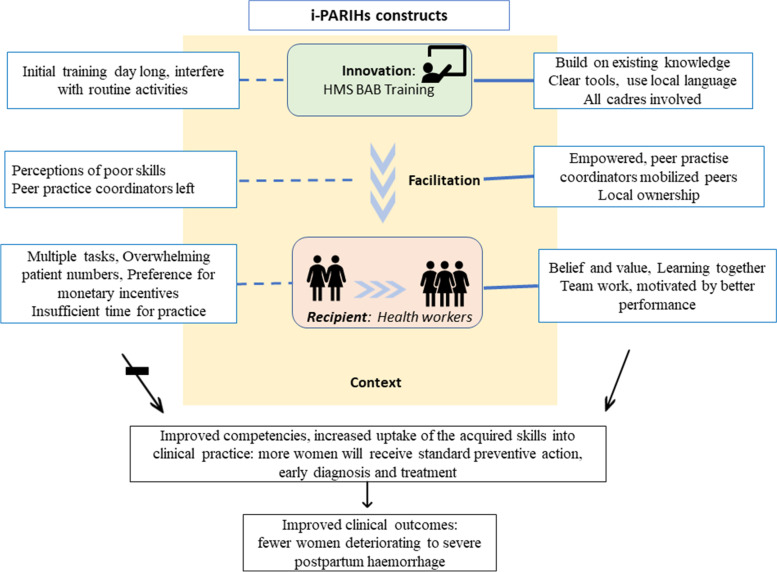
Methods: Our qualitative process evaluation was done as part of an effectiveness trial and included eight focus group discussions with 51 healthcare workers in the four districts which were part of the HMS BAB trial. We employed deductive content analysis informed by the Integrated Promoting Action on Research Implementation in Health Services (i-PARIHS) construct of context, recipients, innovation and facilitation.
Results: Overall, health workers reported positive experiences with the training content and how it was delivered. They are perceived to have improved competencies leading to improved health outcomes. Interviews proposed that peer practice coordinators require more support to sustain the weekly practices. Competing tasks within the facility in the context of limited time and human resources hindered the sustainability of weekly practices. Most health facilities had outlined the procedure for routine learning environments; however, these were not well operational.
Conclusion: The HMS BAB training has great potential to improve health workers' competencies around the time of childbirth and maternal outcomes. Challenges to successful implementation include balancing the intervention within the routine facility setting, staff motivation and workplace cultures.
Keywords: Competency-based training; Helping Mothers Survive Bleeding after Birth; In-facility training; Peer practice facilitators; Postpartum haemorrhage; Simulation; i-PARIHS framework.
© 2022. The Author(s).
Conflict of interest statement
None of the authors has a competing interest.
Figures
References
-
- Trends in Maternal Mortality: 2000 to 2017. Estimates by WHO, UNICEF, UNFPA, World Bank Group and the United Nations Population Division [https://www.who.int/reproductivehealth/publications/maternal-mortality-2....]
-
- WHO: WHO recommendations for the prevention and treatment of postpartum haemorrhage. Geneva: World Health Organization; 2012. - PubMed
MeSH terms
LinkOut - more resources
Full Text Sources
