


Maternal exposure to ambient black carbon particles and their presence in maternal and fetal circulation and organs: an analysis of two independent population-based observational studies
- PMID: 36208643
- PMCID: PMC9553674
- DOI: 10.1016/S2542-5196(22)00200-5
Maternal exposure to ambient black carbon particles and their presence in maternal and fetal circulation and organs: an analysis of two independent population-based observational studies
Abstract
Background: Maternal exposure to particulate air pollution during pregnancy has been linked to multiple adverse birth outcomes causing burden of disease later in the child's life. To date, there is a paucity of data on whether or not ambient particles can both reach and cross the human placenta to exert direct effects on fetal organ systems during gestation.
Methods: In this analysis, we used maternal-perinatal and fetal samples collected within the framework of two independent studies: the ENVIRONAGE (Environmental Influences on Ageing in Early Life) birth cohort of mothers giving birth at the East-Limburg Hospital in Genk, Belgium, and the SAFeR (Scottish Advanced Fetal Research) cohort of terminated, normally progressing pregnancies among women aged 16 years and older in Aberdeen and the Grampian region, UK. From the ENVIRONAGE study, we included 60 randomly selected mother-neonate pairs, excluding all mothers who reported that they ever smoked. From the SAFeR study, we included 36 fetuses of gestational age 7-20 weeks with cotinine concentrations indicative of non-smoking status. We used white light generation under femtosecond pulsed illumination to detect black carbon particles in samples collected at the maternal-fetal interface. We did appropriate validation experiments of all samples to confirm the carbonaceous nature of the identified particles.
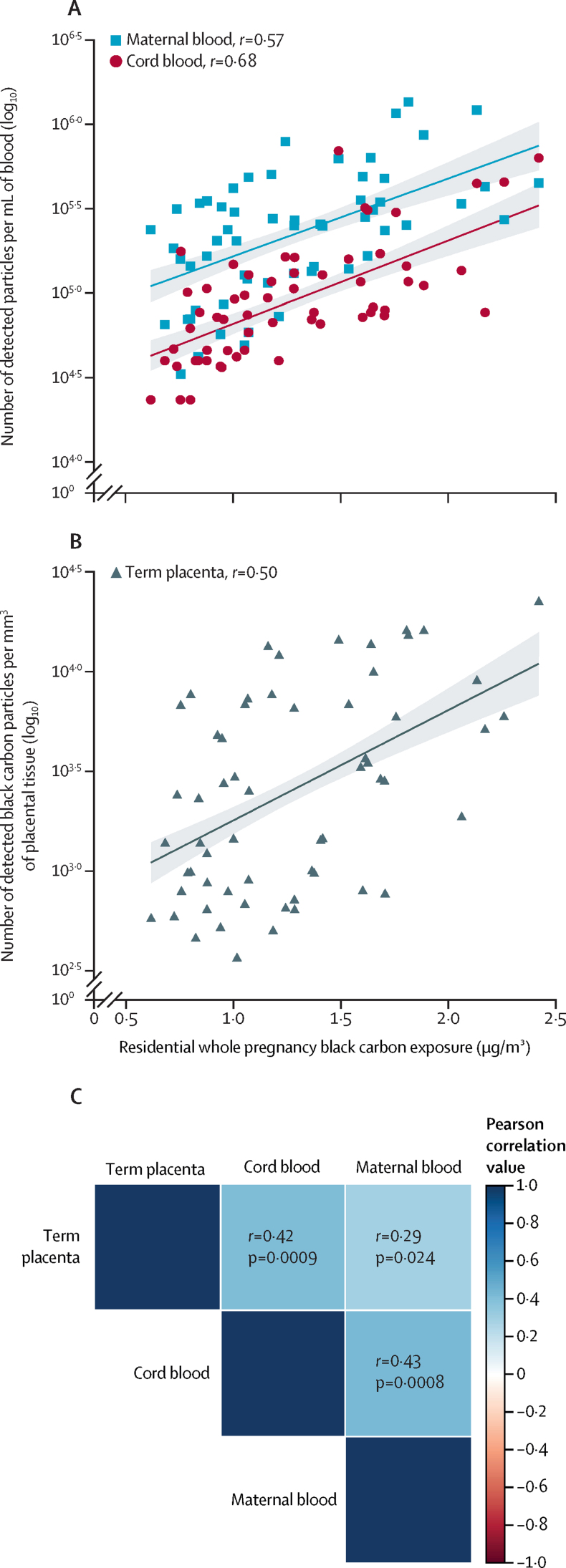
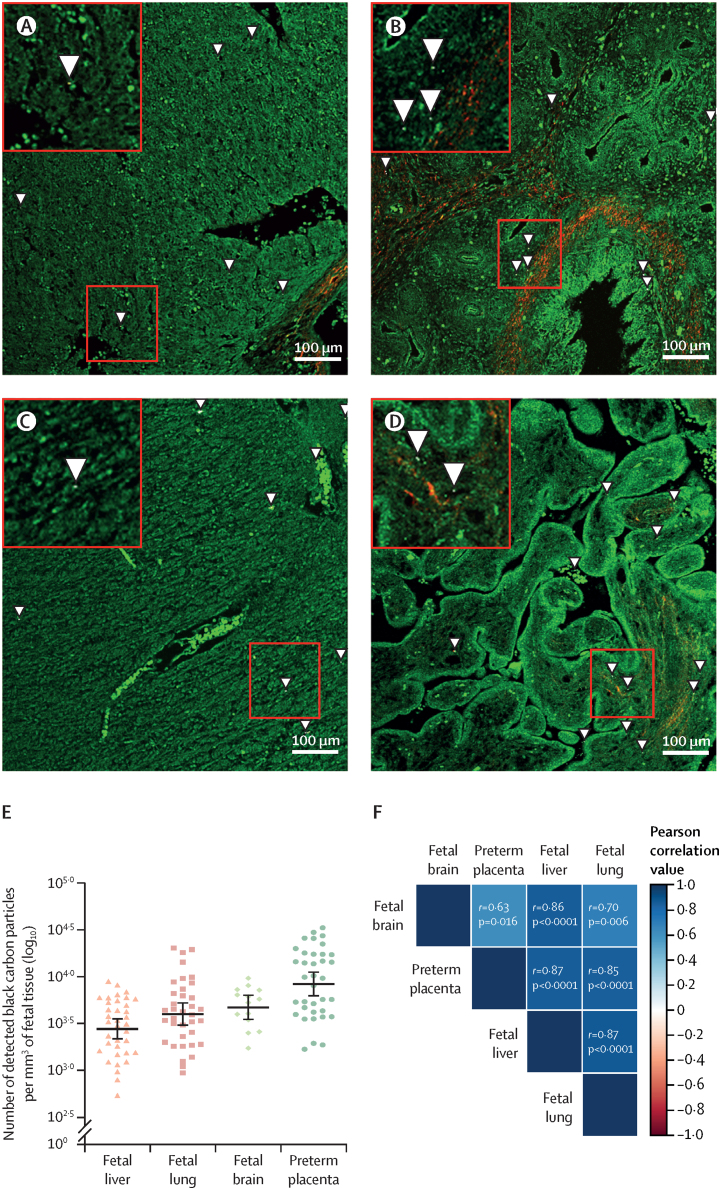
Findings: We found evidence of the presence of black carbon particles in cord blood, confirming the ability of these particles to cross the placenta and enter the fetal circulation system. We also found a strong correlation (r ≥0·50; p<0·0001) between the maternal-perinatal particle load (in maternal blood [n=60], term placenta [n=60], and cord blood [n=60]) and residential ambient black carbon exposure during pregnancy. Additionally, we found the presence of black carbon particles in first and second trimester tissues (fetal liver [n=36], lung [n=36], and brain [n=14]) of electively terminated and normally progressing pregnancies from an independent study.
Interpretation: We found that maternally inhaled carbonaceous air pollution particles can cross the placenta and then translocate into human fetal organs during gestation. These findings are especially concerning because this window of exposure is key to organ development. Further studies are needed to elucidate the mechanisms of particle translocation.
Funding: European Research Council, Flemish Scientific Research Foundation, Kom op Tegen Kanker, UK Medical Research Council, and EU Horizon 2020.
Copyright © 2022 The Author(s). Published by Elsevier Ltd. This is an Open Access article under the CC BY-NC-ND 4.0 license. Published by Elsevier Ltd.. All rights reserved.
Conflict of interest statement
Declaration of interests HB, MBJR, MA, and TSN declare that aspects of the work mentioned in the paper are the subject of an awarded patent (Method for detecting or quantifying carbon black and/or black carbon particles, reference codes: EP3403068B1 and US11002679B2) filed by Hasselt University (Hasselt, Belgium) and KU Leuven (Leuven, Belgium). All other authors declare no competing interests.
Figures
References
-
- Bond TC, Doherty SJ, Fahey DW, et al. Bounding the role of black carbon in the climate system: a scientific assessment. J Geophys Res Atmos. 2013;118:5380–5552.
-
- Pedersen M, Stayner L, Slama R, et al. Ambient air pollution and pregnancy-induced hypertensive disorders: a systematic review and meta-analysis. Hypertension. 2014;64:494–500. - PubMed
-
- Mozzoni P, Iodice S, Persico N, et al. Maternal air pollution exposure during the first trimester of pregnancy and markers of inflammation and endothelial dysfunction. Environ Res. 2022;212 - PubMed
Publication types
MeSH terms
Substances
Grants and funding
LinkOut - more resources
Full Text Sources
Medical
Miscellaneous
