. 2022 Oct 10;13(1):5947.
doi: 10.1038/s41467-022-33745-4.

Cross-species evolution of a highly potent AAV variant for therapeutic gene transfer and genome editing

Affiliations

Cross-species evolution of a highly potent AAV variant for therapeutic gene transfer and genome editing

Trevor J Gonzalez et al. Nat Commun. .

Abstract

Recombinant adeno-associated viral (AAV) vectors are a promising gene delivery platform, but ongoing clinical trials continue to highlight a relatively narrow therapeutic window. Effective clinical translation is confounded, at least in part, by differences in AAV biology across animal species. Here, we tackle this challenge by sequentially evolving AAV capsid libraries in mice, pigs and macaques. We discover a highly potent, cross-species compatible variant (AAV.cc47) that shows improved attributes benchmarked against AAV serotype 9 as evidenced by robust reporter and therapeutic gene expression, Cre recombination and CRISPR genome editing in normal and diseased mouse models. Enhanced transduction efficiency of AAV.cc47 vectors is further corroborated in macaques and pigs, providing a strong rationale for potential clinical translation into human gene therapies. We envision that ccAAV vectors may not only improve predictive modeling in preclinical studies, but also clinical translatability by broadening the therapeutic window of AAV based gene therapies.


Conflict of interest statement

T.J.G, L.P.H., and A.A. have filed patent applications on the subject matter of this manuscript. A.A. is a co-founder at StrideBio and TorqueBio and serves on the advisory boards of Atsena Therapeutics, Isolere Bio, Mammoth Bio, Ring Therapeutics, and Kriya Therapeutics. C.A.G. is an advisor to Sarepta Therapeutics, Tune Therapeutics, Levo Therapeutics, and Iveric Bio and a co-founder of Tune Therapeutics, Element Genomics, and Locus Biosciences. R.M.C.R. and M.S.M. were employed at StideBio Inc., at this time. The remaining authors declare no competing interests.

Figures
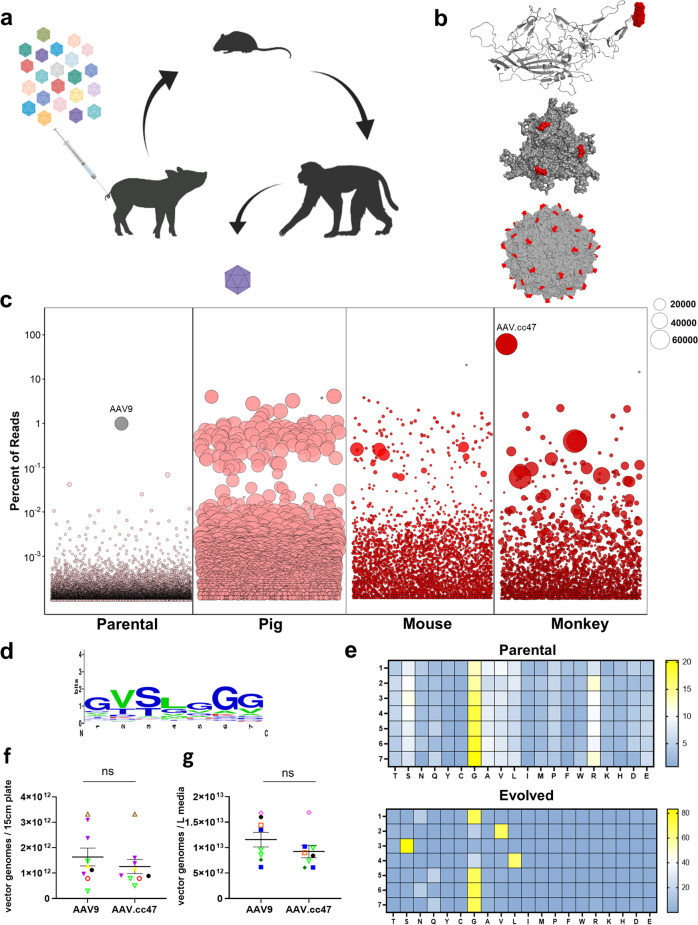
Fig. 1
Fig. 1. Cross-species evolution of AAV capsid libraries yields a dominant new variant.
a Schematic of AAV capsid library evolution in pigs, mice, and non-human primates following intravenous dosing b AAV9 VP3 monomer, trimer, and full capsid identifying the 7 amino acid residues mutated in our capsid library (red). The images were generated using PyMOL. c Next-generation sequencing identifies AAV.cc47 as the top enriched AAV variant following three rounds of evolution in each animal species. Each amino acid sequence was assigned a random number 1–1000 and is plotted on the x-axis, and the y-axis represents the percent of reads of each sequence in the library. The bubbles represent an individual amino acid sequence and its size corresponds to the fold enrichment of each sequence in the evolved library compared to the parental library. d Consensus motif analysis of the top 100 enriched AAV mutants following three rounds of evolution, for residues 452 − 458 (VP1 numbering). e Heat map of parental and final evolved libraries identifying amino acid frequencies at each library position following in vivo cycling of libraries. f, g Comparison of multiple recombinant AAV9 or AAV.cc47 production yields in both adherent (n = 9) and suspension (n = 15) HEK293 systems. Final, post-purified AAV yields from adherent 293 s are plotted as vector genome titers per 15 cm plate and from suspension HEK293s are plotted as vector genome titers per liter of media. Data points represented here consist of vectors packaging the same transgene cassette for AAV9 and AAV.cc47. Each symbol and color combination represents a different transgene cassette used for vector preparation, the dash represents the mean value and error bars represent the standard error mean. Vectors that were single-stranded genomes include black circles, yellow triangles, open red circles, open brown triangles, and purple triangles. Vectors that were self-complementary genomes include open upside-down light green triangles, blue square, open orange square, dark green diamond, and open pink diamonds. Statistical significance was determined by a two-tailed paired Student t Test (Adherent, P < 0.081; Suspension, P < 0.056). ns not significant. Source data are provided as a Source Data file.
Fig. 2
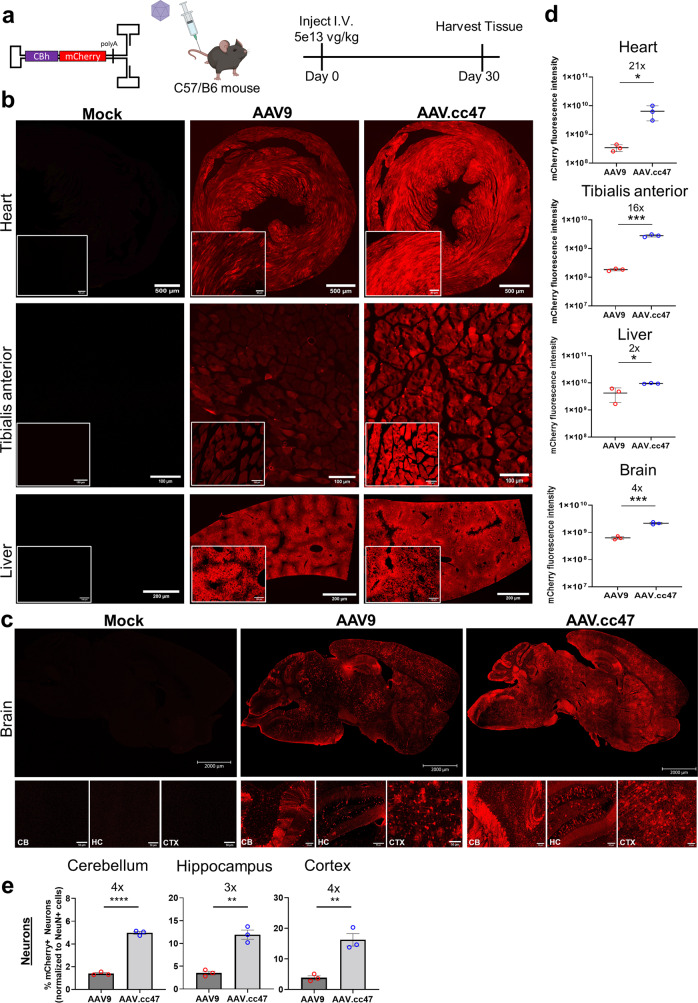
Fig. 2. AAV.cc47 transduces mouse heart, skeletal muscle, and brain more efficiently than AAV9 following systemic administration.
a 8–10 week old C57/B6 mice (n = 3) were injected intravenously at a dose of 5e13vg/kg with AAV9 (red) or AAV.cc47 (blue) and organs were harvested 4 weeks post injection. Vectors delivered a self-complementary AAV genome with the chicken-beta actin hybrid (CBh) promoter driving mCherry reporter expression. b Representative images of native mCherry fluorescence in heart, tibialis anterior and liver. c Representative images of native mCherry fluorescence in whole brain, cerebellum (CB), hippocampus (HC), and cortex (CTX). d Quantification of native mCherry fluorescence intensity in heart (P < 0.0386), tibialis anterior (P < 0.0001), liver (P < 0.0172), and brain (P < 0.0172). Brain mCherry fluorescence intensity was measured from rostral, midbrain, and caudal brain regions, and are summarized as a single brain tissue. e Quantification of percent neurons transduced in the CB (P < 0.0001), HC (P < 0.0015), and CTX (P < 0.0045) of C57/B6 mice was determined via immunofluorescence staining of mCherry and NeuN proteins and taking the ratio of total mCherry+ neuron counts to total NeuN+ cell counts in each brain region. Fifty micrometers thick cross sections were obtained via a vibratome for the heart, liver, and brain, while 7 μm thick cross sections were obtained for tibialis anterior via cryostat. For all quantification, 2 sections per mouse and 3 images per section (a total of 6 images) were used to quantify fluorescence intensity and cell counts using ImageJ. Each dot represents an individual mouse for fluorescence intensity, and for cell counting each dot represents an individual mouse, fold change is listed above significance, the dash and bars represent the mean value and error bars represent the standard error mean. Statistical significance was determined by a two-tailed Student t Test. *P < 0.05; ** P < 0.01; ***P < 0.001; ****P < 0.0001; ns not significant. Source data are provided as a Source Data file.
Fig. 3
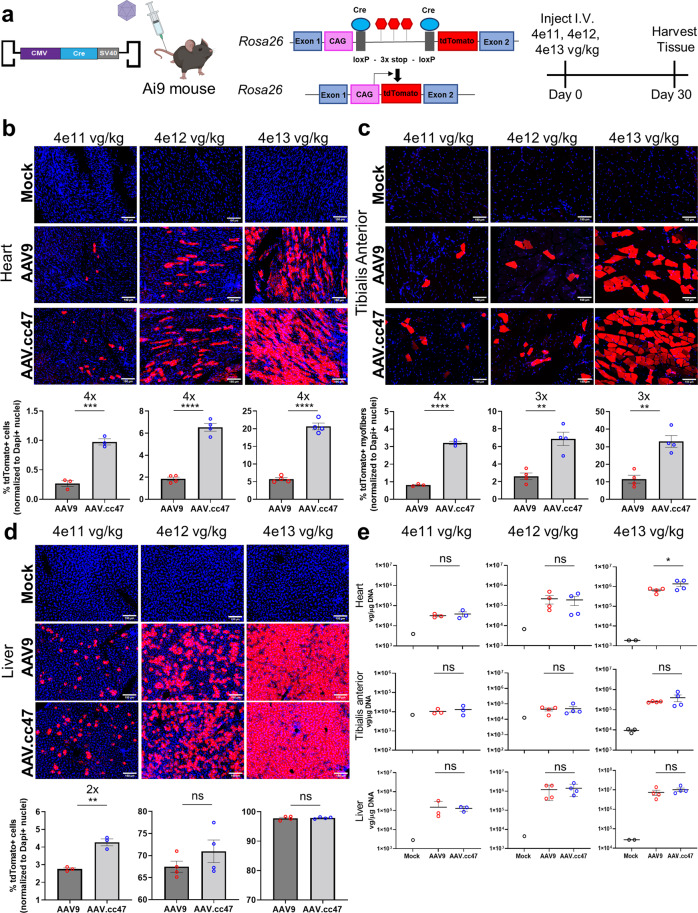
Fig. 3. AAV.cc47 outperforms AAV9 in Cre recombination in the Ai9 reporter mice at all tested doses following intravenous (IV) administration.
a 8–10 week old Ai9 reporter mice (n = 4) were injected intravenously at 4e11, 4e12, and 4e13 vg/kg with AAV9 (red) or AAV.cc47 (blue). Vectors delivered a single stranded AAV genome with the cytomegalovirus (CMV) promoter driving Cre recombinase. Representative immunofluorescence images and quantification for tdTomato (red) and DAPI (blue) for mice injected at each dose in heart (b), tibialis anterior (c), and liver (d). Fifty micrometers thick cross sections were obtained via a vibratome for heart and liver, while 7 μm thick cross sections were obtained for skeletal muscle via cryostat. Total number of tdTomato+ cells (heart and liver) and total number of tdTomato+ myofibers (tibialis anterior) were counted and normalized to the total number of DAPI + nuclei in each tissue. e Vector genome copy numbers per μg DNA were calculated by normalizing Cre recombinase copy numbers to total μg DNA input for qPCR quantification and are represented as log vg/μg DNA. Each dot represents an individual mouse, fold change is listed above significance, the dash and bars represent the mean value and error bars represent the standard error mean. Quantifications in panels B-E are listed in ascending order of dosing from left to right, starting with 4e11 vg/kg and going to 4e13 vg/kg for each tissue type. Statistical significance was determined by One-Way ANOVA with Tukey’s post-test (3 treatment groups) for vector genome biodistribution analysis (High dose heart, P < 0.0279). An unpaired two-tailed Student t Test (2 treatment groups) was used for histological quantification (High dose heart, P < 0.001; tibialis anterior, P < 0.0018; liver, P < 0.7883; Mid dose heart, P < 0.0001; tibialis anterior, P < 0.0023; liver, P < 0.2666; low dose heart, P < 0.0006; tibialis anterior, P < 0.0001; liver, P < 0.0019). *P < 0.05; **P < 0.01; ***P < 0.001; ****P < 0.0001; ns not significant. Source data are provided as a Source Data file.
Fig. 4
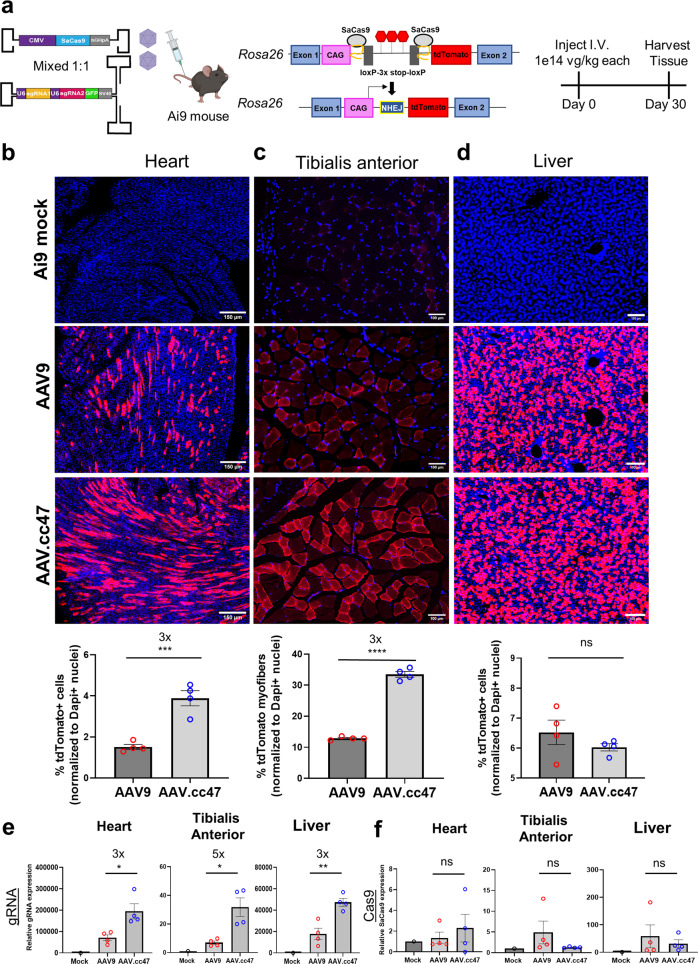
Fig. 4. Systemic administration of AAV.cc47-CRISPR increases genome editing efficiencies in heart and skeletal muscle of Ai9 reporter mice compared to AAV9.
a 8–10 week old Ai9 reporter mice (n = 4) were injected with AAV.cc47 (blue) or AAV9 (red) using our lead dual AAV vector system consisting of a single-stranded genome with cytomegalovirus (CMV) driven SaCas9 and a self-complementary genome with 2 gRNAs driven by U6 promoters targeting the Rosa26 locus. The total dose administered was 2.0e14 vg/kg (1.0e14 vg/kg each vector). Representative immunofluorescence images for tdTomato (red) and histological quantification in heart (b), skeletal muscle (c), and liver (d). Fifty micrometers thick cross sections were obtained via a vibratome for the heart and liver, while 7 μm thick cross sections were obtained for skeletal muscle via cryostat. Quantification of the percentage of tdTomato+ cells (heart and liver) and myofibers (tibialis anterior) was normalized to the number of DAPI + nuclei in each tissue. For all histological quantification, 2 sections per mouse and 3 images per section (total of 6 images) were used to quantify % transduced cells and myofibers using ImageJ. Quantitative RT-PCR was performed with primers amplifying each gRNA (e) or SaCas9 (f) mRNA relative to mouse Actb. Each dot represents an individual mouse, fold change is listed above significance, the bar graphs represent the mean value and error bars represent the standard error mean. Statistical significance was determined by a two-tailed Student t Test (2 treatment groups; heart, P < 0.0009; tibialis anterior, P < 0.0227; liver, P < 0.2892) or One-Way ANOVA with Tukey’s posttest (3 treatment groups; heart gRNA, P < 0.0314, Cas9, P < 0.7966; tibialis anterior gRNA, P < 0.0348, Cas9, P < 0.4459; liver gRNA, P < 0.0126, Cas9, P < 0.8205). *P < 0.05; **P < 0.01; ***P < 0.001; ****P < 0.0001; ns not significant. Source data are provided as a Source Data file.
Fig. 5
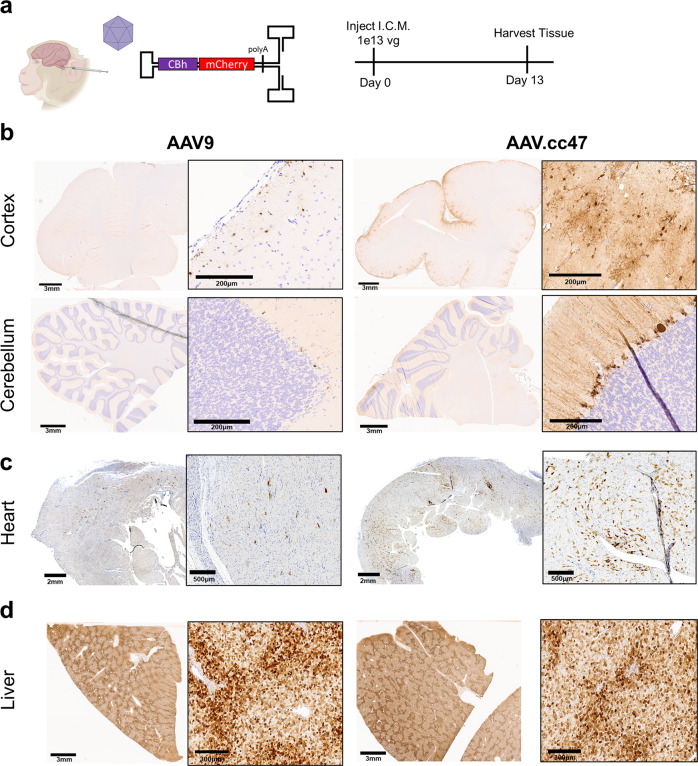
Fig. 5. AAV.cc47 transduces non-human primate (NHP) brain and heart more effectively than AAV9 following intracisternal magna (ICM) infusion.
a ICM infusion of 1e13 total vg of AAV9 or AAV.cc47 vectors in 2-year-old cynomolgus macaques (n = 2). Organs were harvested at 13 days post infusion. Vectors packaging self-complementary AAV genome with a truncated chicken beta-actin (CBh) promoter driving mCherry expression were utilized for the study. Representative images of immunohistochemically stained NHP brain (b), heart (c), and liver (d) are shown. Tissue was embedded in paraffin following fixation and cut 5 μm thick and 3,3′-Diaminobenzidine (DAB) was used to visualize mCherry protein in tissues. Source data are provided as a Source Data file.
Fig. 6
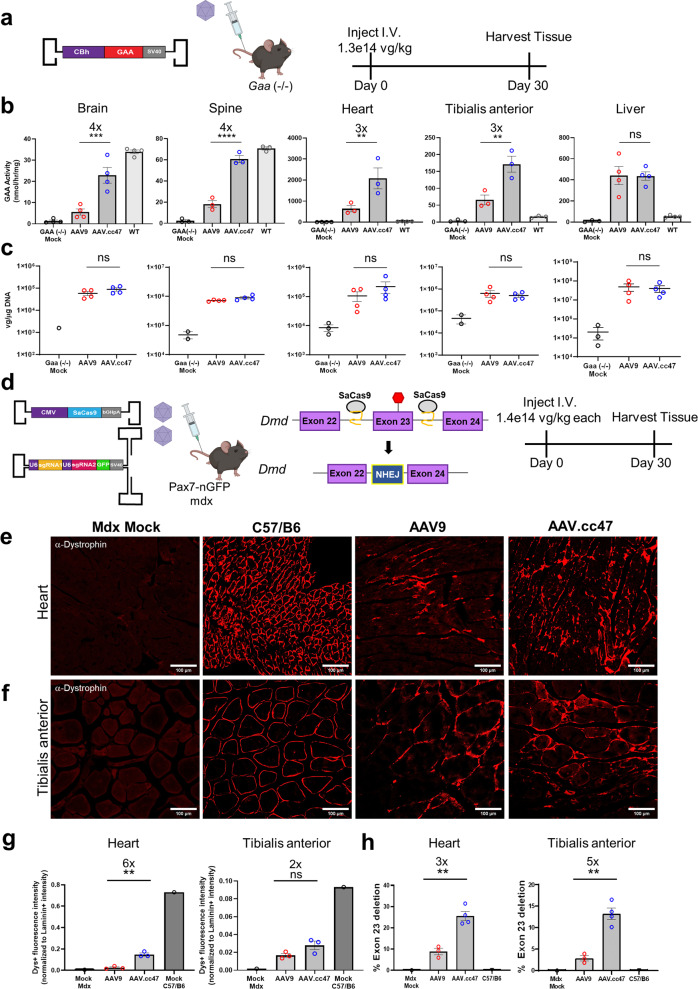
Fig. 6. Systemic administration of AAV.cc47 leads to increased Acid alpha-glucosidase (GAA) expression in the Pompe mouse model and enhanced restoration of dystrophin through genome editing in mdx mice compared to AAV9.
a Pompe study schematic. 8–10 week old Gaa (−/−) mice (n = 4) were injected with 1.3e14vg/kg of a single stranded AAV genome expressing the human acid alpha-glucosidase gene driven by the CBh promoter. b GAA enzyme activity was quantified in tissues of AAV9 (red) or AAV.cc47 (blue) treated Gaa (−/−) mice. Data is represented as nmol per hour activity per mg BSA protein. c Vector genome copy numbers per μg DNA were calculated by normalizing SV40 polyA copy numbers to total μg DNA input for qPCR quantification and are represented as log vg/μg DNA. GAA enzyme levels for different brain and spinal cord regions are summarized in analysis. d Mdx study schematic. 8–10 week old Pax7-nGFP mdx mice (n = 4) were injected with a total dose of 2.8e14 vg/kg consisting of a single-stranded genome expressing SaCas9 driven by the CMV promoter and a self-complementary genome expressing two gRNAs driven by the U6 promoter mixed in a 1:1 ratio. Representative immunofluorescence images for dystrophin (red) in the heart (e) and tibialis anterior (f) from AAV treated Pax7-nGFP mdx mice. Ten micrometres thick and 7μm thick cross sections were obtained via a cryostat for the heart and tibialis anterior, respectively. g Quantification of dystrophin expression intensity normalized to laminin expression intensity in heart and tibialis anterior. h Quantification of exon 23-deleted transcripts in cardiac and skeletal muscles via Taqman quantitative RT-PCR. Statistical significance was determined by One-Way ANOVA with Tukey’s posttest (GAA enzyme brain, P < 0.0003; spine, P < 0.0001, heart, P < 0.0062, tibialis anterior, P < 0.0029, liver, P < 0.9999; Dystrophin histology quantification heart, P < 0.0057, tibialis anterior, P < 0.2700; % Dmd exon 23 deletion heart, P < 0.0075, tibialis anterior, P < 0.0056). Data points included represent an individual mouse for all assays. Fold changes are shown above significance and all graphs represent the mean value and error bars represent the standard error mean. *P < 0.05; **P < 0.01; ***P < 0.001; ****P < 0.0001; ns not significant. Source data are provided as a Source Data file.

References

    1. Kuzmin DA, et al. The clinical landscape for AAV gene therapies. Nat. Rev. Drug Disco. 2021;20:173–174. doi: 10.1038/d41573-021-00017-7. - DOI - PubMed
    1. Mendell JR, et al. Current clinical applications of in vivo gene therapy with AAVs. Mol. Ther. 2021;29:464–488. doi: 10.1016/j.ymthe.2020.12.007. - DOI - PMC - PubMed
    1. Mendell JR, et al. Single-dose gene-replacement therapy for spinal muscular atrophy. N. Engl. J. Med. 2017;377:1713–1722. doi: 10.1056/NEJMoa1706198. - DOI - PubMed
    1. Mullard A. Gene therapy community grapples with toxicity issues, as pipeline matures. Nat. Rev. Drug Disco. 2021;20:804–805. doi: 10.1038/d41573-021-00164-x. - DOI - PubMed
    1. Wilson JM, Flotte TR. Moving forward after two deaths in a gene therapy trial of myotubular myopathy. Hum. Gene Ther. 2020;31:695–696. doi: 10.1089/hum.2020.182. - DOI - PubMed

Publication types

LinkOut - more resources