


SK3 in POMC neurons plays a sexually dimorphic role in energy and glucose homeostasis
- PMID: 36210455
- PMCID: PMC9549684
- DOI: 10.1186/s13578-022-00907-2
SK3 in POMC neurons plays a sexually dimorphic role in energy and glucose homeostasis
Abstract
Background: Pro-opiomelanocortin (POMC) neurons play a sexually dimorphic role in body weight and glucose balance. However, the mechanisms for the sex differences in POMC neuron functions are not fully understood.
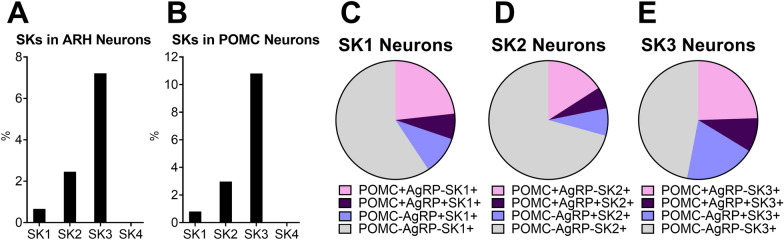
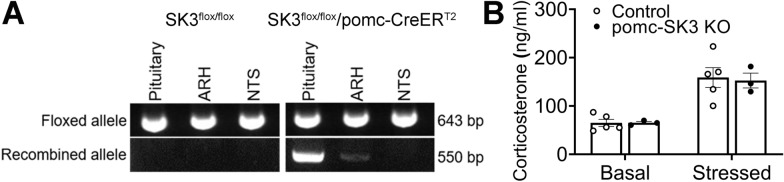
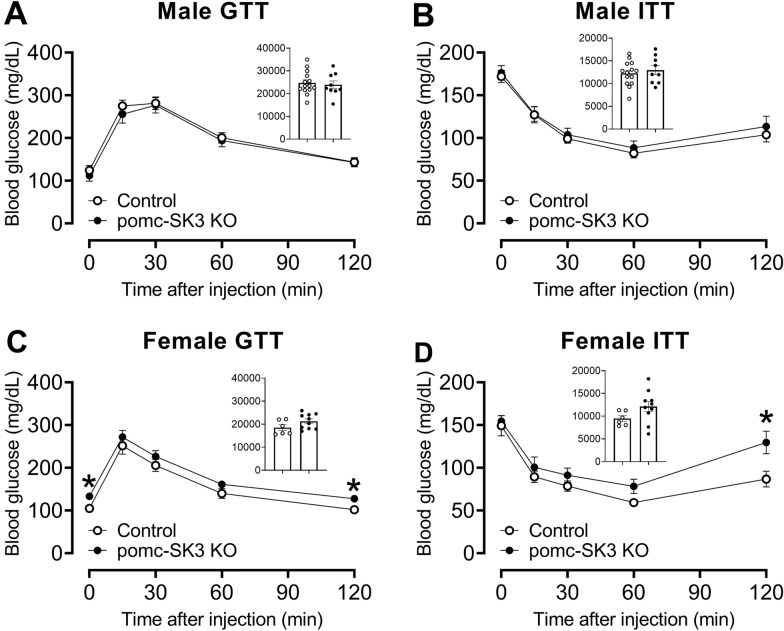
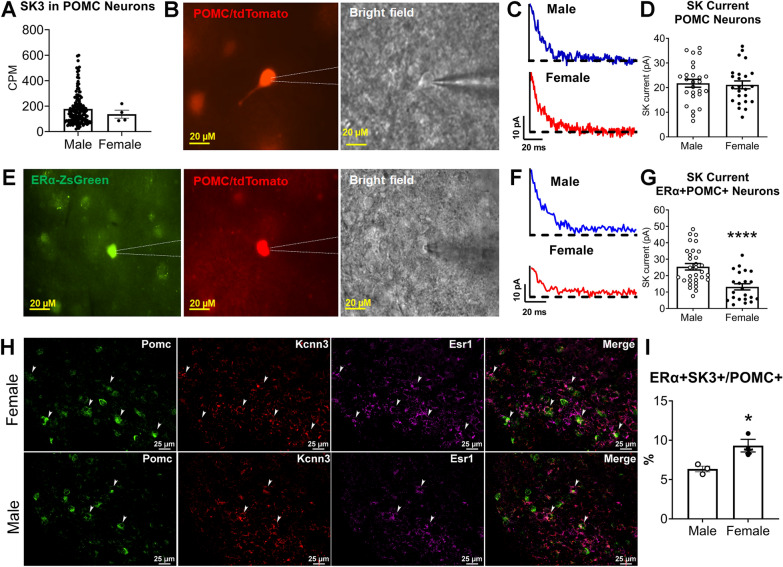
Results: We detected small conductance calcium-activated potassium (SK) current in POMC neurons. Secondary analysis of published single-cell RNA-Seq data showed that POMC neurons abundantly express SK3, one SK channel subunit. To test whether SK3 in POMC neurons regulates POMC neuron functions on energy and glucose homeostasis, we used a Cre-loxP strategy to delete SK3 specifically from mature POMC neurons. POMC-specific deletion of SK3 did not affect body weight in either male or female mice. Interestingly, male mutant mice showed not only decreased food intake but also decreased physical activity, resulting in unchanged body weight. Further, POMC-specific SK3 deficiency impaired glucose balance specifically in female mice but not in male mice. Finally, no sex differences were detected in the expression of SK3 and SK current in total POMC neurons. However, we found higher SK current but lower SK3 positive neuron population in male POMC neurons co-expressing estrogen receptor α (ERα) compared to that in females.
Conclusion: These results revealed a sexually dimorphic role of SK3 in POMC neurons in both energy and glucose homeostasis independent of body weight control, which was associated with the sex difference of SK current in a subpopulation of POMC + ERα + neurons.
Keywords: Energy and glucose homeostasis; POMC neurons; SK current; Sexually dimorphism.
© 2022. The Author(s).
Conflict of interest statement
The authors declare that they have no competing interests.
Figures


References
Grants and funding
- R01 DK123098/DK/NIDDK NIH HHS/United States
- R00DK107008/NH/NIH HHS/United States
- K01DK119471/NH/NIH HHS/United States
- P30 DK072476/DK/NIDDK NIH HHS/United States
- K01 DK119471/DK/NIDDK NIH HHS/United States
- P20 GM135002/NH/NIH HHS/United States
- R01DK120858/NH/NIH HHS/United States
- R01DK117281/NH/NIH HHS/United States
- P20 GM135002/GM/NIGMS NIH HHS/United States
- R01DK123098/NH/NIH HHS/United States
- P01DK113954/NH/NIH HHS/United States
- R01DK125480/NH/NIH HHS/United States
- R00 DK107008/DK/NIDDK NIH HHS/United States
- R01DK129548/NH/NIH HHS/United States
- R01 DK129548/DK/NIDDK NIH HHS/United States
- R01DK115761/NH/NIH HHS/United States
LinkOut - more resources
Full Text Sources
Miscellaneous
