


The longitudinal course of childhood bullying victimization and associations with self-injurious thoughts and behaviors in children and young people: A systematic review of the literature
- PMID: 36210652
- PMCID: PMC10092090
- DOI: 10.1002/jad.12097
The longitudinal course of childhood bullying victimization and associations with self-injurious thoughts and behaviors in children and young people: A systematic review of the literature
Abstract
Introduction: Bullying victimization has consistently been highlighted as a risk factor for self-injurious thoughts and behaviors (SITBs) in young people. This systematic review of prospective, community-based studies explored associations between bullying victimization (traditional/face-to-face and cyber) across the full spectrum of self-harm and suicidality, in children and young people aged up to (and including) 25 years. Importantly, associations by sex/gender were explored.
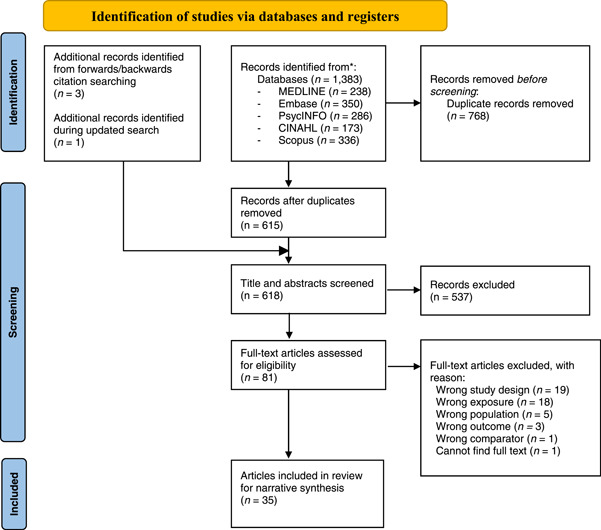
Methods: MEDLINE, Embase, PsycINFO, CINAHL and Scopus were searched for articles meeting the inclusion criteria. Articles were screened by title, abstract and full text. Quality appraisal was performed using the Newcastle-Ottawa Scale for cohort studies. Data were synthesized narratively. The protocol is registered on PROSPERO (CRD42021261916) and followed PRISMA 2020 guidelines.
Results: A total of 35 papers were included, across 17 countries. Results were presented by bullying type: traditional/face-to-face (n = 25), cyber (n = 7) and/or an aggregate of both types (n = 7). Outcomes included suicidal ideation (n = 17), self-harm (n = 10), suicide attempt (n = 4), NSSI (n = 4), other (n = 7). Studies measured outcomes in under 18s (n = 24), 18-25-year-olds (n = 8) and both under 18s and 18-25-year-olds (n = 3). Studies exploring the role of sex/gender (20%) found some interesting nuances.
Conclusions: Some weak to strong associations between bullying and SITBs were found yet conclusions are tentative due to study heterogeneity (e.g., methods used, conceptualizations and operationalisations of exposures/outcomes). Future research should address methodological issues raised in this review, and further explore gender differences in bullying, including by bullying sub-types (e.g., overt or relational) and victim status (e.g., victim or bully-victim).
Keywords: bullying; gender; review; self-harm; suicide; youth.
© 2022 The Authors. Journal of Adolescence published by Wiley Periodicals LLC on behalf of Foundation for Professionals in Services to Adolescents.
Conflict of interest statement
The authors declare no conflicts of interest.
Figures
References
-
- Alsaker, F. D. (2003). Quälgeister und ihre Opfer. Mobbing unter Kindern‐und wie man damit umgeht . Bern: Hans Huber.
-
- Alsaker, F. D. , & Brunner, A. (1999). Switzerland. In Smith P. K., Catalano R., Junger‐Tas J. J., Slee P. P., Morita Y., & Olweus D. (Eds.), The nature of school bullying: A cross‐national perspective (pp. 250–263). Routledge.
-
- American Psychiatric Association . (1994). Diagnostic and statistical manual of mental disorders: DSM‐IV. 4th Edition
-
- American School Health Association, Association for the Advancement of Health Education, & Society for Public Health Education . (1989). The National Adolescent Student Health Survey: A report on the health of America's youth. American Alliance for Health, Physical Education, Recreation & Dance. https://eric.ed.gov/?id=ED316535
Publication types
MeSH terms
Grants and funding
LinkOut - more resources
Full Text Sources
Medical