


Diagnostic accuracy of SARS-CoV-2 rapid antigen test from self-collected anterior nasal swabs in children compared to rapid antigen test and RT-PCR from nasopharyngeal swabs collected by healthcare workers: A multicentric prospective study
- PMID: 36210936
- PMCID: PMC9532740
- DOI: 10.3389/fped.2022.980549
Diagnostic accuracy of SARS-CoV-2 rapid antigen test from self-collected anterior nasal swabs in children compared to rapid antigen test and RT-PCR from nasopharyngeal swabs collected by healthcare workers: A multicentric prospective study
Abstract
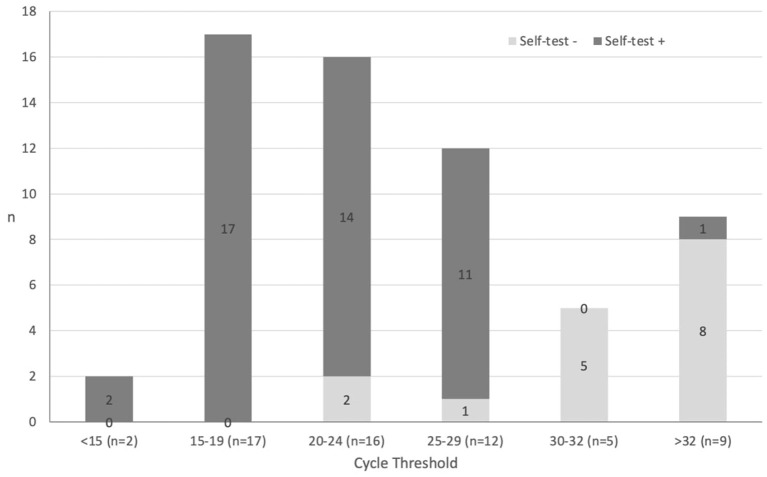
Testing for SARS-CoV-2 is central to COVID-19 management. Rapid antigen test from self-collected anterior nasal swabs (SCANS-RAT) are often used in children but their performance have not been assessed in real-life. We aimed to compare this testing method to the two methods usually used: reverse transcription polymerase chain reaction from nasopharyngeal swabs collected by healthcare workers (HCW-PCR) and rapid antigen test from nasopharyngeal swabs collected by healthcare workers (HCW-RAT), estimating the accuracy and acceptance, in a pediatric real-life study. From September 2021 to January 2022, we performed a manufacturer-independent cross-sectional, prospective, multicenter study involving 74 pediatric ambulatory centers and 5 emergency units throughout France. Children ≥6 months to 15 years old with suggestive symptoms of COVID-19 or children in contact with a COVID-19-positive patient were prospectively enrolled. We included 836 children (median 4 years), 774 (92.6%) were symptomatic. The comparators were HCW-PCR for 267 children, and HCW-RAT for 593 children. The sensitivity of the SCANS-RAT test compared to HCW-RAT was 91.3% (95%CI 82.8; 96.4). Sensitivity was 70.4% (95%CI 59.2; 80.0) compared to all HCW-PCR and 84.6% (95%CI 71.9; 93.1) when considering cycle threshold <33. The specificity was always >97%. Among children aged ≥6 years, 90.9% of SCANS-RAT were self-collected without adult intervention. On appreciation rating (from 1, very pleasant, to 10, very unpleasant), 77.9% of children chose a score ≤3. SCANS-RAT have good sensitivity and specificity and are well accepted by children. A repeated screening strategy using these tests can play a major role in controlling the pandemic.
Keywords: COVID-19; ambulatory setting; pediatric; self-test; test.
Copyright © 2022 Cohen, Aupiais, Filleron, Cahn-Sellem, Romain, Béchet, Auvrignon, Batard, Virey, Jung, Rybak and Levy.
Conflict of interest statement
The authors declare that the research was conducted in the absence of any commercial or financial relationships that could be construed as a potential conflict of interest.
Figures
References
-
- European Centre for Disease Prevention Control. Data on Country Response Measures to COVID-19. (2022). Available online at: https://www.ecdc.europa.eu/en/publications-data/download-data-response-m... (accessed September 6, 2022).
-
- Haute Autorité de Santé,. COVID-19 - Quel Test Faire? (2022). Available online at: https://www.has-sante.fr/upload/docs/application/pdf/2022-01/fu_covid19_... (accessed September 6, 2022).
-
- Direction de la Recherche, des, Etudes, de l'Evaluation et des, Statistiques,. 168 215 000 tests RT-PCR et antigéniques validés en 2021. (2022). Available from: https://drees.solidarites-sante.gouv.fr/delais-covid19-2022-01-06#:~:tex... (accessed September 6, 2022).
LinkOut - more resources
Full Text Sources
Miscellaneous
