


doi: 10.1021/acsomega.2c04653.
eCollection 2022 Oct 4.
Synthesis of 7-Aminocoumarins from 7-Hydroxycoumarins via Amide Smiles Rearrangement
Affiliations
- PMID: 36211046
- PMCID: PMC9535735
- DOI: 10.1021/acsomega.2c04653
Item in Clipboard
Synthesis of 7-Aminocoumarins from 7-Hydroxycoumarins via Amide Smiles Rearrangement
ACS Omega.
.
Abstract
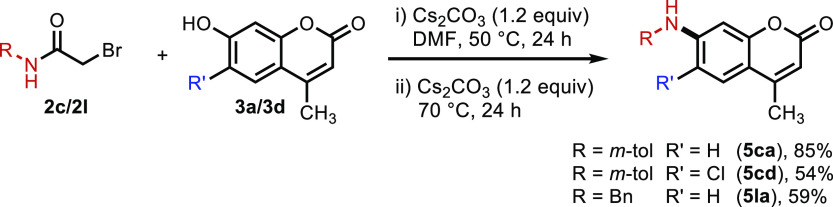
N-Substituted 7-aminocoumarins can be synthesized from readily available 7-hydroxycoumarins via alkylation with α-bromoacetamides and subsequent tandem O → N Smiles rearrangement-amide hydrolysis. The key rearrangement sequence proceeds under mild conditions to provide convenient access to various N-alkyl and N-aryl products in moderate to high yields. The process is operationally simple, inexpensive, transition-metal-free, and can be telescoped into a one-pot process.
© 2022 The Authors. Published by American Chemical Society.
Conflict of interest statement
The authors declare no competing financial interest.
Figures

Methods for synthesizing 7-aminocoumarins: (a) Pechmann condensation
of aminophenols, (b) Buchwald–Hartwig cross-coupling of sulfonylated
hydroxycoumarins, and (c) amination of coumarin ethers via Smiles
rearrangement–hydrolysis.


Reactions were performed
on a
0.31 mmol scale. Yields refer to isolated yields following column
chromatography. bReaction was performed under standard
conditions, followed by HCl, EtOH, 90 °C for 5 h. cReaction was performed at 100 °C for 30 h.
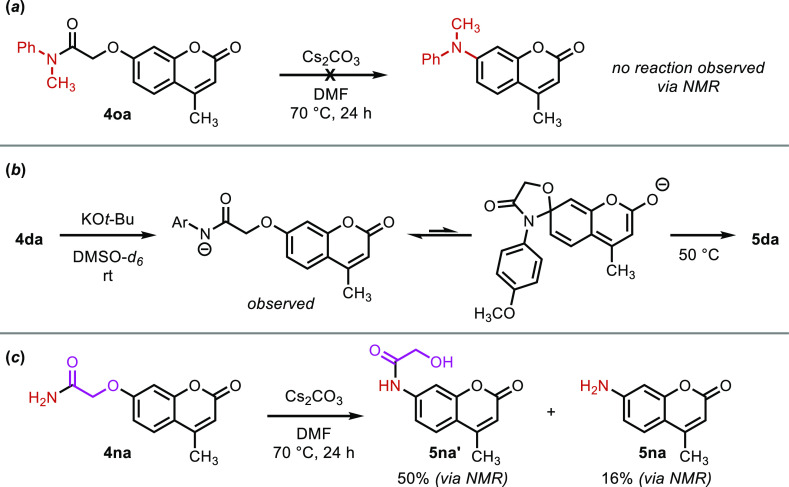
Mechanistic
studies: (a) treatment of tertiary amide 4oa with standard
reaction conditions, (b) stepwise analysis of the
rearrangement–hydrolysis sequence of 4da via NMR
monitoring, and (c) formation of the unhydrolyzed intermediate when
applying standard reaction conditions to primary amide 4na.

References
-
- Calcio Gaudino E. C.; Tagliapietra S.; Martina K.; Palmisano G.; Cravotto G. Recent Advances and Perspectives in the Synthesis of Bioactive Coumarins. RSC Adv. 2016, 6, 46394–46405. 10.1039/C6RA07071J. - DOI
LinkOut - more resources
Full Text Sources