


Quality of online video resources concerning patient education for neck pain: A YouTube-based quality-control study
- PMID: 36211682
- PMCID: PMC9533122
- DOI: 10.3389/fpubh.2022.972348
Quality of online video resources concerning patient education for neck pain: A YouTube-based quality-control study
Abstract
Background: More than 70 percent of the world's population is tortured with neck pain more than once in their vast life, of which 50-85% recur within 1-5 years of the initial episode. With medical resources affected by the epidemic, more and more people seek health-related knowledge via YouTube. This article aims to assess the quality and reliability of the medical information shared on YouTube regarding neck pain.
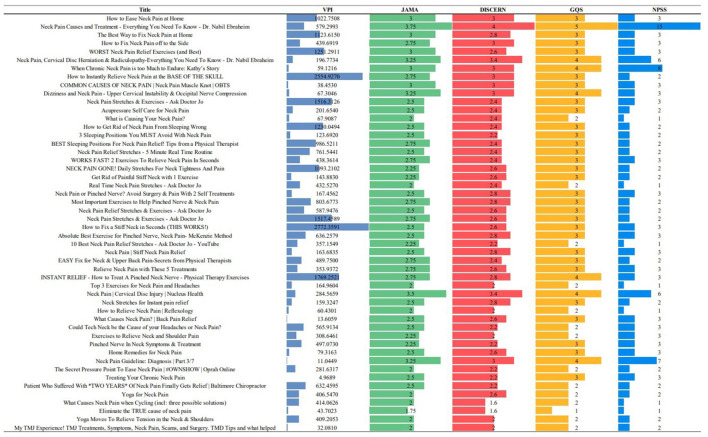
Methods: We searched on YouTube using the keyword "neck pain" to include the top 50 videos by relevance, then divided them into five and seven categories based on their content and source. Each video was quantitatively assessed using the Journal of American Medical Association (JAMA), DISCERN, Global Quality Score (GQS), Neck Pain-Specific Score (NPSS), and video power index (VPI). Spearman correlation analysis was used to evaluate the correlation between JAMA, GQS, DISCERN, NPSS and VPI. A multiple linear regression analysis was applied to identify video features affecting JAMA, GQS, DISCERN, and NPSS.
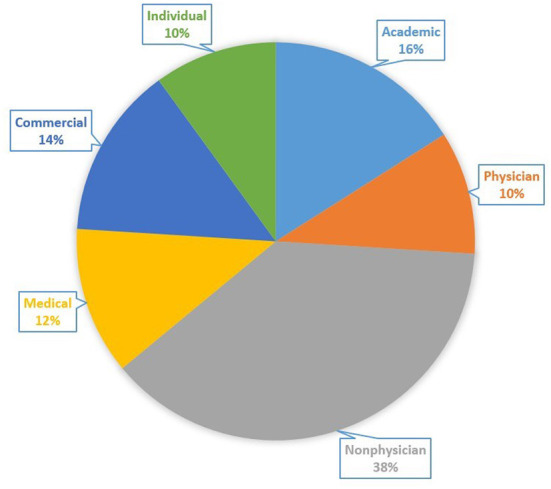
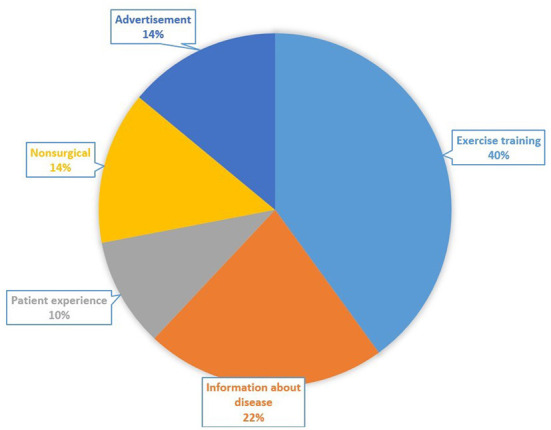
Results: The videos had a mean JAMA score of 2.56 (SD = 0.43), DISCERN of 2.55 (SD = 0.44), GQS of 2.86 (SD = 0.72), and NPSS of 2.90 (SD = 2.23). Classification by video upload source, non-physician videos had the greatest share at 38%, and sorted by video content, exercise training comprised 40% of the videos. Significant differences between the uploading sources were observed for VPI (P = 0.012), JAMA (P < 0.001), DISCERN (P < 0.001), GQS (P = 0.001), and NPSS (P = 0.007). Spearman correlation analysis showed that JAMA, DISCERN, GQS, and NPSS significantly correlated with each other (JAMA vs. DISCERN, p < 0.001, JAMA vs. GQS, p < 0.001, JAMA vs. NPSS, p < 0.001, DISCERN vs. GQS, p < 0.001, DISCERN vs. NPSS, p < 0.001, GQS vs. NPSS, p < 0.001). Multiple linear regression analysis suggested that a higher JAMA score, DISCERN, or GQS score were closely related to a higher probability of an academic, physician, non-physician or medical upload source (P < 0.005), and a higher NPSS score was associated with a higher probability of an academic source (P = 0.001) than of an individual upload source.
Conclusions: YouTube videos pertaining to neck pain contain low quality, low reliability, and incomplete information. Patients may be put at risk for health complications due to inaccurate, and incomplete information, particularly during the COVID-19 crisis. Academic groups should be committed to high-quality video production and promotion to YouTube users.
Keywords: YouTube; content analysis; education; neck pain; quality-control study.
Copyright © 2022 Zhang, Yang, Shen, Zhang, Ma, Ding, Wang, Meng and Liu.
Conflict of interest statement
The authors declare that the research was conducted in the absence of any commercial or financial relationships that could be construed as a potential conflict of interest.
Figures
References
Publication types
MeSH terms
LinkOut - more resources
Full Text Sources
Medical
