


Host Genotype Links to Salivary and Gut Microbiota by Periodontal Status
- PMID: 36214094
- PMCID: PMC9986680
- DOI: 10.1177/00220345221125402
Host Genotype Links to Salivary and Gut Microbiota by Periodontal Status
Abstract
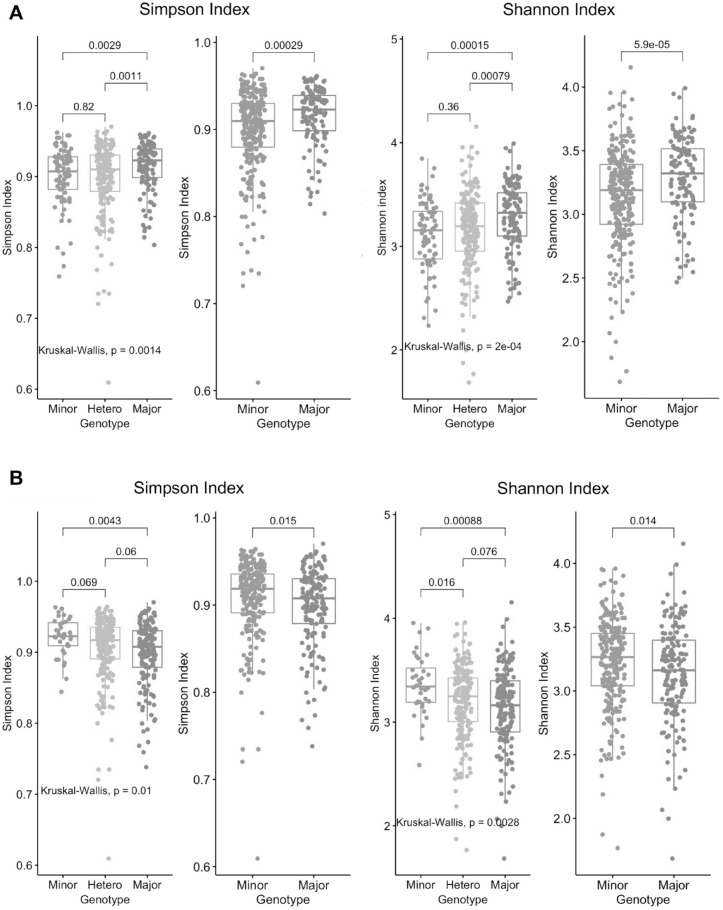
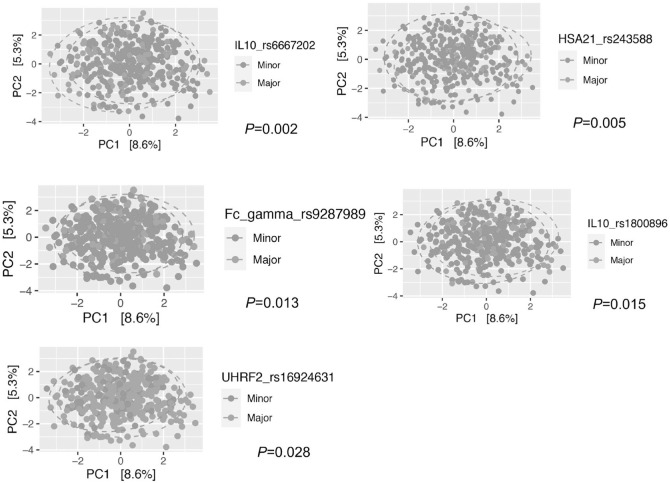
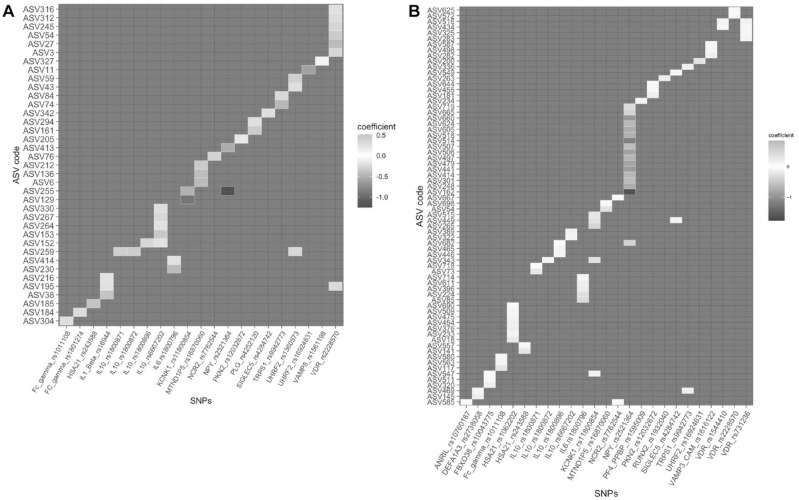
Limited evidence describing how host genetic variants affect the composition of the microbiota is currently available. The aim of this study was to assess the associations between a set of candidate host genetic variants and microbial composition in both saliva and gut in the TwinsUK registry. A total of 1,746 participants were included in this study and provided stool samples. A subset of 1,018 participants also provided self-reported periodontal data, and 396 of those participants provided a saliva sample. Host DNA was extracted from whole-blood samples and processed for Infinium Global screening array, focusing on 37 selected single-nucleotide polymorphisms (SNPs) previously associated with periodontitis. The gut and salivary microbiota of participants were profiled using 16S ribosomal RNA amplicon sequencing. Associations between genotype on the selected SNPs and microbial outcomes, including α diversity, β diversity, and amplicon sequence variants (ASVs), were investigated in a multivariate mixed model. Self-reported periodontal status was also compared with microbial outcomes. Downstream analyses in gut microbiota and salivary microbiota were carried out separately. IL10 rs6667202 and VDR 2228570 SNPs were associated with salivary α diversity, and SNPs in IL10, HSA21, UHRF2, and Fc-γR genes were associated with dissimilarity matrix generated from salivary β diversity. The SNP that was associated with the greatest number of salivary ASVs was VDR 2228570 followed by IL10 rs6667202, and that of gut ASVs was NPY rs2521364. There were 77 salivary ASVs and 39 gut ASVs differentially abundant in self-reported periodontal disease versus periodontal health. The dissimilarity between saliva and gut microbiota within individuals appeared significantly greater in self-reported periodontal cases compared to periodontal health. IL10 and VDR gene variants may affect salivary microbiota composition. Periodontal status may drive variations in the salivary microbiota and possibly, to a lesser extent, in the gut microbiota.
Keywords: bacteria; genetics; infectious disease(s); microbiome; periodontal disease(s)/periodontitis; saliva.
Conflict of interest statement
The authors declared no potential conflicts of interest with respect to the research, authorship, and/or publication of this article.
Figures
References
-
- Belstrom D, Grande MA, Sembler-Moller ML, Kirkby N, Cotton SL, Paster BJ, Holmstrup P. 2018. Influence of periodontal treatment on subgingival and salivary microbiotas. J Periodontol. 89(5):531–539. - PubMed
-
- Berglundh T, Donati M, Hahn-Zoric M, Hanson LA, Padyukov L. 2003. Association of the –1087 IL 10 gene polymorphism with severe chronic periodontitis in Swedish Caucasians. J Clin Periodontol. 30(3):249–254. - PubMed
Publication types
MeSH terms
Substances
Grants and funding
LinkOut - more resources
Full Text Sources
Miscellaneous
