


Mendelian Randomization Analysis Reveals a Complex Genetic Interplay among Atopic Dermatitis, Asthma, and Gastroesophageal Reflux Disease
- PMID: 36214830
- PMCID: PMC9893317
- DOI: 10.1164/rccm.202205-0951OC
Mendelian Randomization Analysis Reveals a Complex Genetic Interplay among Atopic Dermatitis, Asthma, and Gastroesophageal Reflux Disease
Abstract
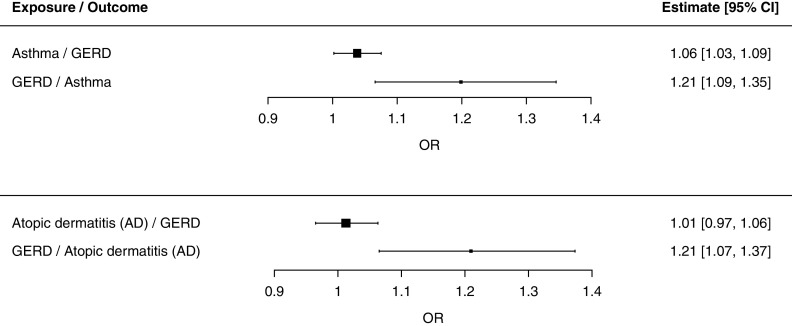
Rationale: Gastroesophageal reflux disease (GERD) is commonly associated with atopic disorders, but cause-effect relationships remain unclear. Objectives: We applied Mendelian randomization analysis to explore whether GERD is causally related to atopic disorders of the lung (asthma) and/or skin (atopic dermatitis [AD]). Methods: We conducted two-sample bidirectional Mendelian randomization to infer the magnitude and direction of causality between asthma and GERD, using summary statistics from the largest genome-wide association studies conducted on asthma (Ncases = 56,167) and GERD (Ncases = 71,522). In addition, we generated instrumental variables for AD from the latest population-level genome-wide association study meta-analysis (Ncases = 22,474) and assessed their fidelity and confidence of predicting the likely causal pathway(s) leading to asthma and/or GERD. Measurements and Main Results: Applying three different methods, each method revealed similar magnitude of causal estimates that were directionally consistent across the sensitivity analyses. Using an inverse variance-weighted method, the largest effect size was detected for asthma predisposition to AD (odds ratio [OR], 1.46; 95% confidence interval [CI], 1.34-1.59), followed by AD to asthma (OR, 1.34; 95% CI, 1.24-1.45). A significant association was detected for genetically determined asthma on risk of GERD (OR, 1.06; 95% CI, 1.03-1.09) but not genetically determined AD on GERD. In contrast, GERD equally increased risks of asthma (OR, 1.21; 95% CI, 1.09-1.35) and AD (OR, 1.21; 95% CI, 1.07-1.37). Conclusions: This study uncovers previously unrecognized causal pathways that have clinical implications in European-ancestry populations: 1) asthma is a causal risk for AD, and 2) the predisposition to AD, including asthma, can arise from specific pathogenic mechanisms manifested by GERD.
Keywords: causal pathways; epidemiological approach; human genetics; risk factors.
Figures


Comment in
-
Gastroesophageal Reflux, Atopic Dermatitis, and Asthma: Finally Evidence for Causal Links?Am J Respir Crit Care Med. 2023 Jan 15;207(2):117-118. doi: 10.1164/rccm.202210-1953ED. Am J Respir Crit Care Med. 2023. PMID: 36301927 Free PMC article. No abstract available.
References
-
- Vakil N, van Zanten SV, Kahrilas P, Dent J, Jones R, Global Consensus Group The Montreal definition and classification of gastroesophageal reflux disease: a global evidence-based consensus. Am J Gastroenterol . 2006;101:1900–1920. - PubMed
-
- Leggett JJ, Johnston BT, Mills M, Gamble J, Heaney LG. Prevalence of gastroesophageal reflux in difficult asthma: relationship to asthma outcome. Chest . 2005;127:1227–1231. - PubMed
-
- Harding SM, Guzzo MR, Richter JE. The prevalence of gastroesophageal reflux in asthma patients without reflux symptoms. Am J Respir Crit Care Med . 2000;162:34–39. - PubMed
-
- Mansfield LE, Stein MR. Gastroesophageal reflux and asthma: a possible reflex mechanism. Ann Allergy . 1978;41:224–226. - PubMed
