


The association of obesity with euploidy rates in women undergoing in vitro fertilization with preimplantation genetic testing
- PMID: 36214982
- PMCID: PMC9723054
- DOI: 10.1007/s10815-022-02624-8
The association of obesity with euploidy rates in women undergoing in vitro fertilization with preimplantation genetic testing
Abstract
Purpose: The purpose of this study was to determine the impact of body mass index (BMI) on euploidy rates for in vitro fertilization (IVF) cycles with preimplantation genetic testing (PGT) utilizing primarily next-generation sequencing (NGS).
Methods: This retrospective cohort study included women aged ≤ 45 years who underwent IVF/PGT between September 2013 and September 2020 at a single university-affiliated fertility center. The primary outcome was euploidy rate. Secondary outcomes included peak serum estradiol (E2), number of oocytes retrieved, oocyte maturation rate, high-quality blastulation rate, clinical loss rate (CLR), clinical pregnancy rate (CPR), and ongoing pregnancy/live birth rate (OPR/LBR).
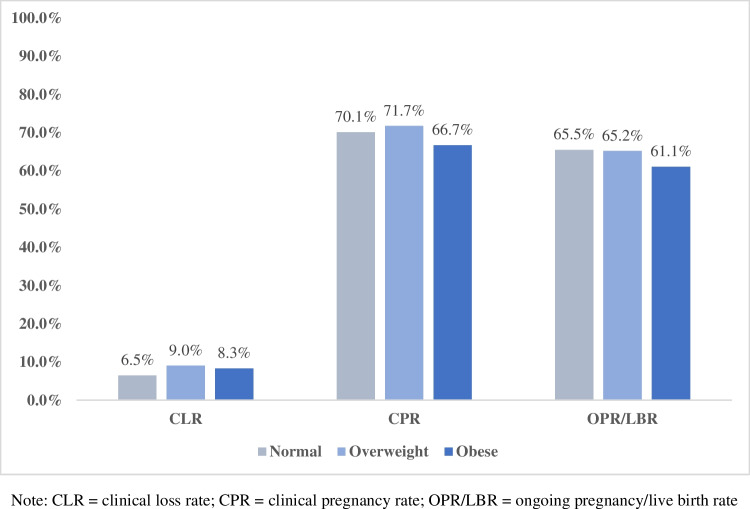
Results: The study included 1335 IVF cycles that were stratified according to BMI (normal, n = 648; overweight, n = 377; obese, n = 310). The obese group was significantly older with significantly lower baseline FSH, peak E2, high-quality blastulation rate, and number of embryos biopsied than the normal group. Overall euploidy rates were not significantly different between BMI groups (normal 36.4% ± 1.3; overweight 37.3% ± 1.8; obese 32.3% ± 1.8; p = 0.11), which persisted after controlling for covariates (p = 0.82) and after stratification of euploidy rate by age group and by number of oocytes retrieved per age group. There were no significant differences in CLR, CPR, and OPR/LBR across BMI groups.
Conclusions: Despite a lower high quality blastulation rate with obesity, there is not a significant difference in euploidy rates across BMI groups in women undergoing IVF/PGT.
Keywords: Body mass index; Euploidy rate; In vitro fertilization; Preimplantation genetic testing.
© 2022. The Author(s), under exclusive licence to Springer Science+Business Media, LLC, part of Springer Nature.
Conflict of interest statement
The authors declare no competing interests.
Figures
References
-
- National Institutes of Health. Overweight and obesity statistics. Available at: https://www.niddk.nih.gov/health-information/health-statistics/overweigh.... Accessed December 14, 2021.
-
- Watkins ML, Rasmussen SA, Honein MA, Botto LD, Moore CA. Maternal obesity and risk for birth defects. Pediatrics. 2003;111:1152–1158. - PubMed
-
- Weiss JL, Malone FD, Emig D, Ball RH, Nyberg DA, Comstock CH, et al. Obesity, obstetric complications and cesarean delivery rate — a population-based screening study. Am J Obstet Gynecol. 2004;190:1091–1097. - PubMed
MeSH terms
LinkOut - more resources
Full Text Sources
