


The impact of heating, ventilation and air conditioning (HVAC) design features on the transmission of viruses, including the 2019 novel coronavirus (COVID-19): A systematic review of humidity
- PMID: 36215321
- PMCID: PMC9550073
- DOI: 10.1371/journal.pone.0275654
The impact of heating, ventilation and air conditioning (HVAC) design features on the transmission of viruses, including the 2019 novel coronavirus (COVID-19): A systematic review of humidity
Abstract
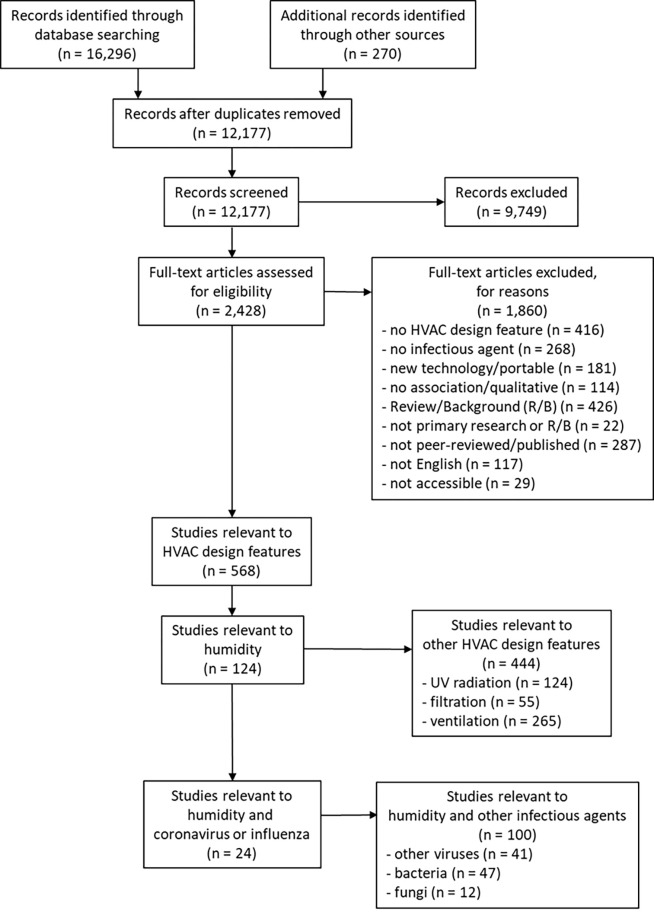
The aerosol route has been a pathway for transmission of many viruses. Similarly, recent evidence has determined aerosol transmission for SARS-CoV-2 to be significant. Consequently, public health officials and professionals have sought data regarding the role of Heating, Ventilation, and Air Conditioning (HVAC) features as a means to mitigate transmission of viruses, particularly coronaviruses. Using international standards, a systematic review was conducted to comprehensively identify and synthesize research examining the effect of humidity on transmission of coronaviruses and influenza. The results from 24 relevant studies showed that: increasing from mid (40-60%) to high (>60%) relative humidity (RH) for SARS-CoV-2 was associated with decreased virus survival; although SARS-CoV-2 results appear consistent, coronaviruses do not all behave the same; increasing from low (<40%) to mid RH for influenza was associated with decreased persistence, infectivity, viability, and survival, however effects of increased humidity from mid to high for influenza were not consistent; and medium, temperature, and exposure time were associated with inconsistency in results for both coronaviruses and influenza. Adapting humidity to mitigate virus transmission is complex. When controlling humidity as an HVAC feature, practitioners should take into account virus type and temperature. Future research should also consider the impact of exposure time, temperature, and medium when designing experiments, while also working towards more standardized testing procedures. Clinical trial registration: PROSPERO 2020 CRD42020193968.
Conflict of interest statement
The authors have declared that no competing interests exist.
Figures
References
-
- World Health Organization (WHO). WHO Director-General’s opening remarks at the media briefing on COVID-19–11 March 2020. https://www.who.int/director-general/speeches/detail/who-director-genera.... Accessed April 4, 2021.
-
- World Health Organization (WHO). Naming the coronavirus disease (COVID-19) and the virus that causes it. https://www.who.int/emergencies/diseases/novel-coronavirus-2019/technica.... Accessed April 15, 2021
Publication types
MeSH terms
Grants and funding
LinkOut - more resources
Full Text Sources
Medical
Miscellaneous
