


Comparison of Rapid Antigen Tests' Performance Between Delta and Omicron Variants of SARS-CoV-2 : A Secondary Analysis From a Serial Home Self-testing Study
- PMID: 36215709
- PMCID: PMC9578286
- DOI: 10.7326/M22-0760
Comparison of Rapid Antigen Tests' Performance Between Delta and Omicron Variants of SARS-CoV-2 : A Secondary Analysis From a Serial Home Self-testing Study
Abstract
Background: It is important to document the performance of rapid antigen tests (Ag-RDTs) in detecting SARS-CoV-2 variants.
Objective: To compare the performance of Ag-RDTs in detecting the Delta (B.1.617.2) and Omicron (B.1.1.529) variants of SARS-CoV-2.
Design: Secondary analysis of a prospective cohort study that enrolled participants between 18 October 2021 and 24 January 2022. Participants did Ag-RDTs and collected samples for reverse transcriptase polymerase chain reaction (RT-PCR) testing every 48 hours for 15 days.
Setting: The parent study enrolled participants throughout the mainland United States through a digital platform. All participants self-collected anterior nasal swabs for rapid antigen testing and RT-PCR testing. All Ag-RDTs were completed at home, whereas nasal swabs for RT-PCR were shipped to a central laboratory.
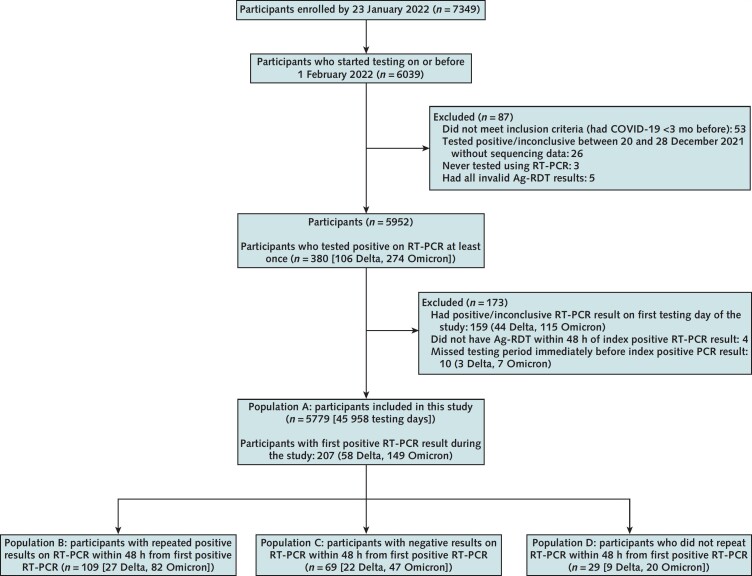
Participants: Of 7349 participants enrolled in the parent study, 5779 asymptomatic persons who tested negative for SARS-CoV-2 on day 1 of the study were eligible for this substudy.
Measurements: Sensitivity of Ag-RDTs on the same day as the first positive (index) RT-PCR result and 48 hours after the first positive RT-PCR result.
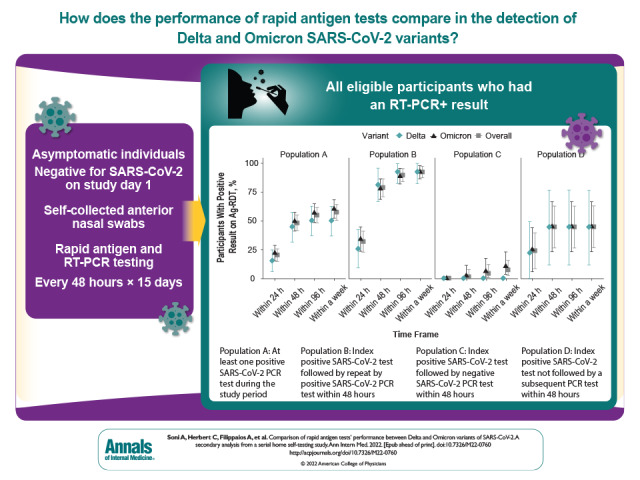
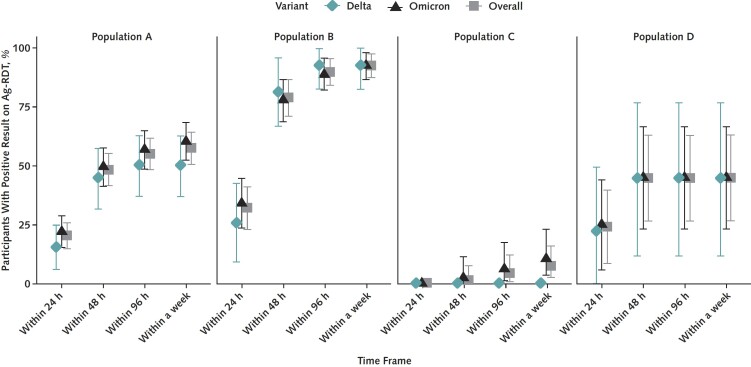
Results: A total of 207 participants were positive on RT-PCR (58 Delta, 149 Omicron). Differences in sensitivity between variants were not statistically significant (same day: Delta, 15.5% [95% CI, 6.2% to 24.8%] vs. Omicron, 22.1% [CI, 15.5% to 28.8%]; at 48 hours: Delta, 44.8% [CI, 32.0% to 57.6%] vs. Omicron, 49.7% [CI, 41.6% to 57.6%]). Among 109 participants who had RT-PCR-positive results for 48 hours, rapid antigen sensitivity did not differ significantly between Delta- and Omicron-infected participants (48-hour sensitivity: Delta, 81.5% [CI, 66.8% to 96.1%] vs. Omicron, 78.0% [CI, 69.1% to 87.0%]). Only 7.2% of the 69 participants with RT-PCR-positive results for shorter than 48 hours tested positive by Ag-RDT within 1 week; those with Delta infections remained consistently negative on Ag-RDTs.
Limitation: A testing frequency of 48 hours does not allow a finer temporal resolution of the analysis of test performance, and the results of Ag-RDTs are based on self-report.
Conclusion: The performance of Ag-RDTs in persons infected with the SARS-CoV-2 Omicron variant is not inferior to that in persons with Delta infections. Serial testing improved the sensitivity of Ag-RDTs for both variants. The performance of rapid antigen testing varies on the basis of duration of RT-PCR positivity.
Primary funding source: National Heart, Lung, and Blood Institute of the National Institutes of Health.
Conflict of interest statement
Figures
References
-
- The White House. Fact sheet: the Biden administration to begin distributing at-home, rapid COVID-19 tests to Americans for free. 14 January 2022. Accessed at www.whitehouse.gov/briefing-room/statements-releases/2022/01/14/fact-she... on 28 August 2022.
Publication types
MeSH terms
Supplementary concepts
Grants and funding
LinkOut - more resources
Full Text Sources
Medical
Miscellaneous
