Epidemiological and clinical characteristics of patients with monkeypox in the GeoSentinel Network: a cross-sectional study
- PMID: 36216018
- PMCID: PMC9546520
- DOI: 10.1016/S1473-3099(22)00651-X
Epidemiological and clinical characteristics of patients with monkeypox in the GeoSentinel Network: a cross-sectional study
Abstract
Background: The early epidemiology of the 2022 monkeypox epidemic in non-endemic countries differs substantially from the epidemiology previously reported from endemic countries. We aimed to describe the epidemiological and clinical characteristics among individuals with confirmed cases of monkeypox infection.
Methods: We descriptively analysed data for patients with confirmed monkeypox who were included in the GeoSentinel global clinical-care-based surveillance system between May 1 and July 1 2022, across 71 clinical sites in 29 countries. Data collected included demographics, travel history including mass gathering attendance, smallpox vaccination history, social history, sexual history, monkeypox exposure history, medical history, clinical presentation, physical examination, testing results, treatment, and outcomes. We did descriptive analyses of epidemiology and subanalyses of patients with and without HIV, patients with CD4 counts of less than 500 cells per mm3 or 500 cells per mm3 and higher, patients with one sexual partner or ten or more sexual partners, and patients with or without a previous smallpox vaccination.
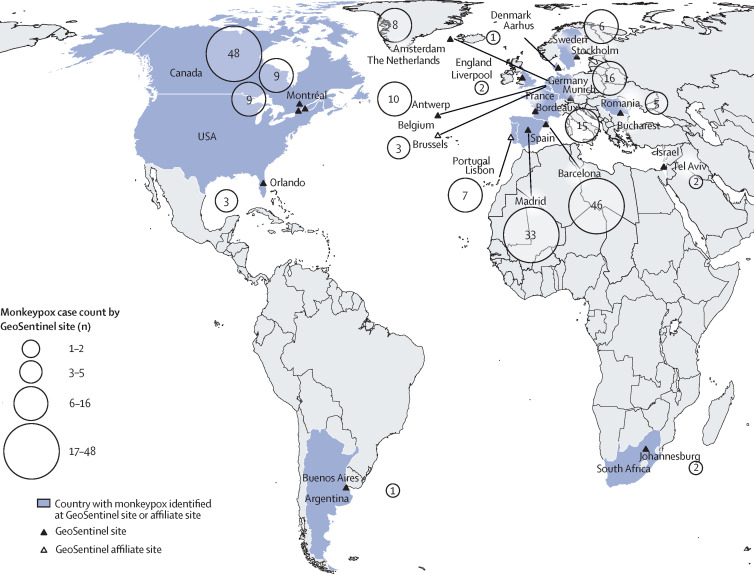
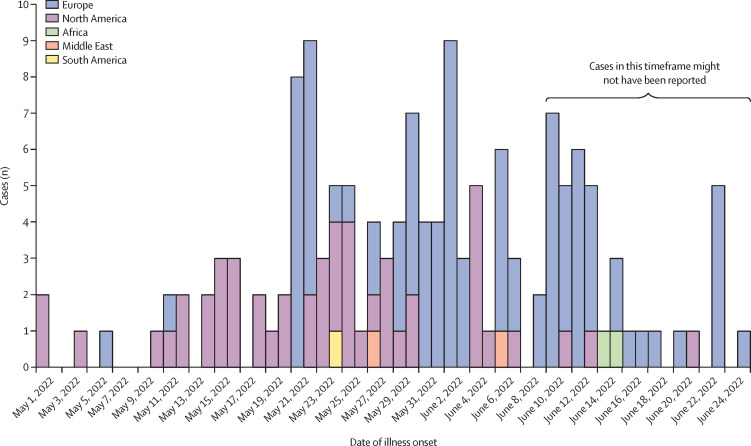
Findings: 226 cases were reported at 18 sites in 15 countries. Of 211 men for whom data were available, 208 (99%) were gay, bisexual, or men who have sex with men (MSM) with a median age of 37 years (range 18-68; IQR 32-43). Of 209 patients for whom HIV status was known, 92 (44%) men had HIV infection with a median CD4 count of 713 cells per mm3 (range 36-1659; IQR 500-885). Of 219 patients for whom data were available, 216 (99%) reported sexual or close intimate contact in the 21 days before symptom onset; MSM reported a median of three partners (IQR 1-8). Of 195 patients for whom data were available, 78 (40%) reported close contact with someone who had confirmed monkeypox. Overall, 30 (13%) of 226 patients were admitted to hospital; 16 (53%) of whom had severe illness, defined as hospital admission for clinical care rather than infection control. No deaths were reported. Compared with patients without HIV, patients with HIV were more likely to have diarrhoea (p=0·002), perianal rash or lesions (p=0·03), and a higher rash burden (median rash burden score 9 [IQR 6-21] for patients with HIV vs median rash burden score 6 [IQR 3-14] for patients without HIV; p<0·0001), but no differences were identified in the proportion of men who had severe illness by HIV status.
Interpretation: Clinical manifestations of monkeypox infection differed by HIV status. Recommendations should be expanded to include pre-exposure monkeypox vaccination of groups at high risk of infection who plan to engage in sexual or close intimate contact.
Funding: US Centers for Disease Control and Prevention, International Society of Travel Medicine.
Copyright © 2023 Elsevier Ltd. All rights reserved.
Conflict of interest statement
Declaration of interests HA reports an unpaid leadership role as a member of the executive board of the International Society of Travel Medicine (ISTM) as counsellor and is a member of the boards of the Swedish Society of Tropical Medicine and of the Swedish Society of Travel Medicine. MD-M has received speaker fees from Pfizer, Gilead, and MSD unrelated to this project. SF has received speaker fees for Pfizer and MSD and serves on the advisory boards for MSD, Pfizer, AstraZeneca, and Gilead. AG reports grants from the The Netherlands Organisation for Health Research and Development for the COBRA–KAI study on COVID-19 vaccine immunogenicity in haematological patients; and has received fees for participation on the data safety monitoring board of the IDSCOVA-study on intradermal administration of COVID-19 vaccine. CG reports a grant from Gilead sciences in 2021 for a COVID-19 project; has received payment for meetings by AbbVie to develop hepatitis C educational materials for practitioners; and is also a member of the Committee to Advise on Travel and Topical Medicine. DH receives salary support from funding for GeoSentinel (1 U01CK000632-01-00) from the CDC's Division of Global Migration and Quarantine, and he is also on the advisory board and collects speaking fees from Bavarian Nordic. RH and ML (principal investigator for GeoSentinel) receive salary support via the cooperative agreement between ISTM and the CDC for GeoSentinel (1 U01CK000632-01-00). MK reports consulting fees and institution grants from ViiV Healthcare, AbbVie, and Gilead for other unrelated projects. PK is vice president of the GeoSentinel Foundation (non-paid; voluntary). CP has received speaker fees from MSD and Pfizer; and is president of the Romanian Society for Travel Medicine and Infectious Diseases (unpaid). ES is a member of the executive board of the Asia-Pacific Travel Health Society; and is president of the Israeli Society of Parasitology and Tropical Medicine. JV reports travel expenses from the Flemish Research Foundation for participation in an international conference unrelated to this manuscript. All other authors declare no competing interests.
Figures
Comment in
-
The 2022 monkeypox outbreak: the need for clinical curiosity.Lancet Infect Dis. 2023 Feb;23(2):133-134. doi: 10.1016/S1473-3099(22)00669-7. Epub 2022 Oct 7. Lancet Infect Dis. 2023. PMID: 36216017 Free PMC article. No abstract available.
References
-
- US Centers for Disease Control and Prevention Monkeypox. Monkey signs and symptoms. 2022. https://www.cdc.gov/poxvirus/monkeypox/index.html
-
- WHO Monkeypox. Monkeypox. Geneva: World Health Organization. https://www.who.int/news-room/fact-sheets/detail/monkeypox
-
- Guarner J, Del Rio C, Malani PN. Monkeypox in 2022—what clinicians need to know. JAMA. 2022;328:139–140. - PubMed
-
- Centers for Disease Control and Prevention Update: multistate outbreak of monkeypox—Illinois, Indiana, Kansas, Missouri, Ohio, and Wisconsin, 2003. MMWR Morb Mortal Wkly Rep. 2003;52:642–646. - PubMed
Publication types
MeSH terms
Grants and funding
LinkOut - more resources
Full Text Sources
Medical
Research Materials