. 2022 Jul 12;7(10):2186-2195.
doi: 10.1016/j.ekir.2022.07.003. eCollection 2022 Oct.

Efficacy, Safety, and Tolerability of Oral Furosemide Among Patients Receiving Hemodialysis: A Pilot Study

Affiliations

Efficacy, Safety, and Tolerability of Oral Furosemide Among Patients Receiving Hemodialysis: A Pilot Study

Jennifer E Flythe et al. Kidney Int Rep. .

Abstract

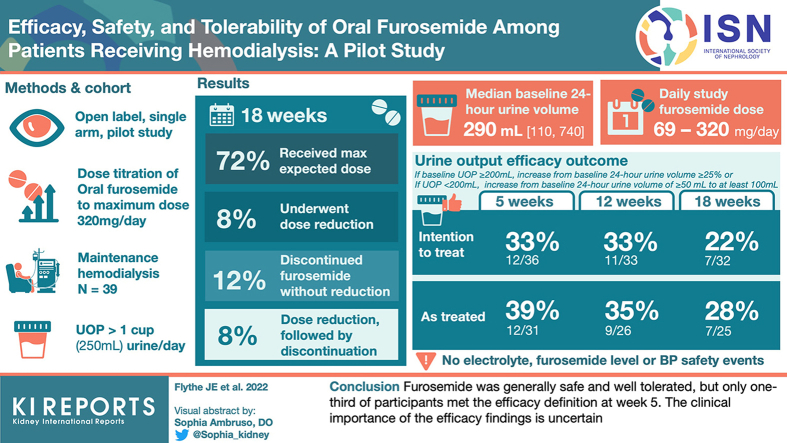
Introduction: Diuretic use may reduce volume-related complications in hemodialysis. We evaluated the efficacy, safety, and tolerability of furosemide in patients with hemodialysis-dependent kidney failure.

Methods: We conducted an open label, single-arm, 18-week, dose titration pilot study of oral furosemide (maximum dose 320 mg/day) among patients receiving maintenance hemodialysis who reported at least 1 cup of urine output per day. The primary efficacy outcome was an increase from baseline to a specified threshold of 24-hour urine volume, with the threshold based on baseline urine volume (<200 ml/day vs. ≥200 ml/day). Safety outcomes included hypokalemia and hypomagnesemia, and tolerability was assessed by prespecified patient-reported symptoms.

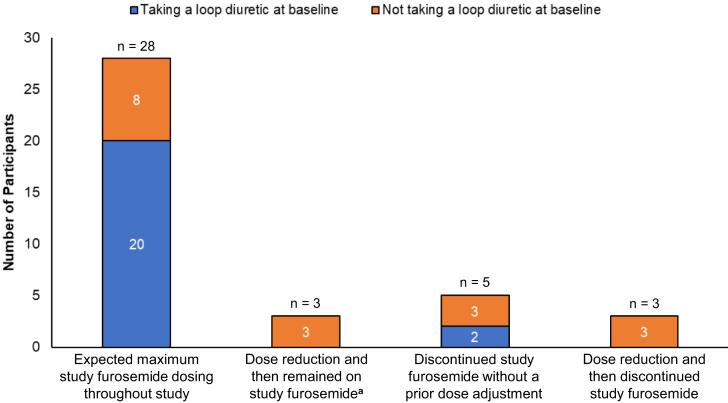
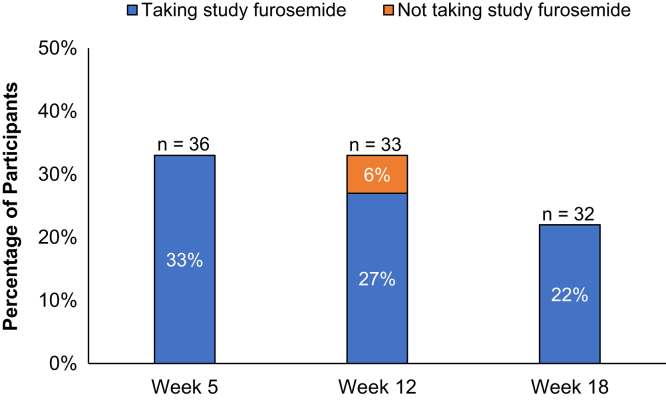
Results: Of the 39 participants, 28 (72%) received the expected furosemide dose, 3 (8%) underwent dose reduction, 5 (12%) discontinued furosemide without dose reduction, and 3 (8%) underwent dose reduction and subsequently discontinued furosemide. The median (quartile 1, quartile 3) baseline 24-hour urine volume was 290 ml (110, 740), and the maximum, average daily study furosemide dose ranged from 69 mg/day to 320 mg/d. The urine output efficacy outcome was met by 12 (33%), 11 (33%), and 7 (22%) participants at weeks 5, 12, and 18, respectively, in the intention-to-treat analysis, and by 12 (39%), 9 (35%), and 7 (28%) participants at weeks 5, 12, and 18, respectively, in the on-treatment analysis. There were no electrolyte, furosemide level, or patient-reported hearing change safety events.

Conclusion: Furosemide was generally safe and well tolerated, but only one-third of participants met the efficacy definition at week 5. The clinical importance of the efficacy findings is uncertain.

Keywords: diuretic; efficacy; furosemide; hemodialysis; hypervolemia; safety.


Figures

None
Graphical abstract
Figure 1
Figure 1
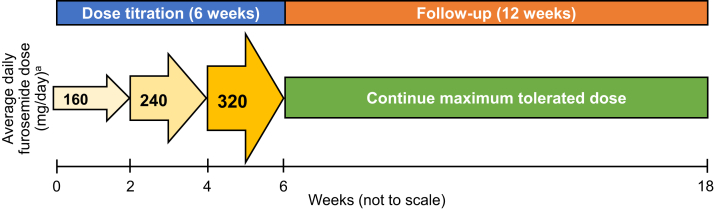
Study design. aDuring the 6-week dose titration period, participants who were not taking a loop diuretic at study entry received 80 mg furosemide twice a day for 14 days and then, if the dose was tolerated, they received 120 mg oral furosemide twice a day for 14 days and then, if the dose was tolerated, they received 160 mg oral furosemide twice a day for 14 days. During the 6-week dose titration period, participants who were taking a loop diuretic at study entry received their baseline furosemide dose (or furosemide-equivalent dose for those receiving nonfurosemide loop diuretics) for 14 days. If tolerated, the baseline furosemide dose was increased by 50% for 14 days, and then, if the dose was tolerated, the dose was increased by 50% for 14 days. The maximum dose for any participant was 320 mg/day. During the 12-week follow-up period, participants remained on their maximally tolerated dose from the dose titration period.
Figure 2
Figure 2
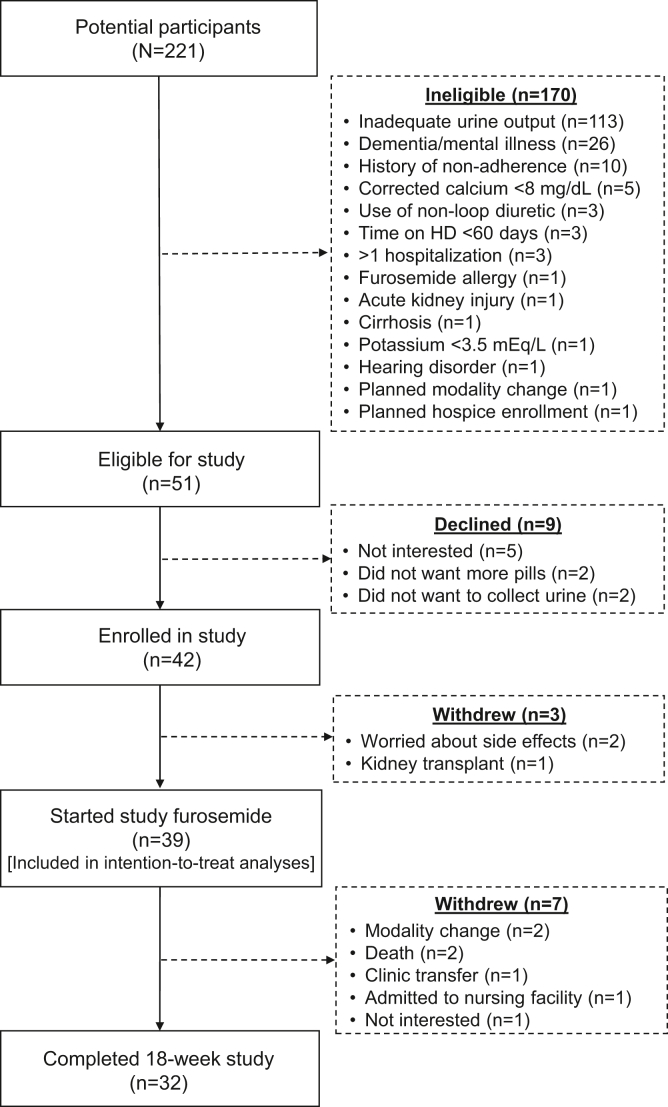
Participant enrollment and follow-up. HD, hemodialysis.
Figure 3
Figure 3
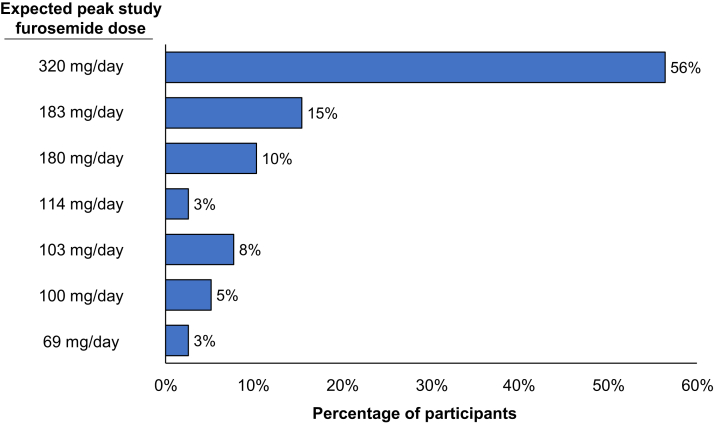
Expected maximum study furosemide dosing among study participants (N = 39).
Figure 4
Figure 4
Study furosemide dosing patterns stratified by use of a loop diuretic at baseline. aTwo participants reduced study furosemide dose and remained on the lower study furosemide dose for the remainder of the study, and one participant reduced study furosemide dose for one week and then returned to the higher study furosemide dose for the remainder of the study.
Figure 5
Figure 5
Percentage of participants meeting the urine output efficacy definition stratified by study furosemide status at the time of 24-hour urine collection (on vs. off study furosemide). aEfficacy for urine output was defined as (a) an increase from baseline 24-hour urine volume of ≥25% among participants with a baseline 24-hour urine volume ≥200 ml and (b) a ≥50 ml increase in 24-hour urine volume to a 24-hour urine volume of at least 100 ml among participants with a baseline 24-hour urine volume <200 ml.

References

    1. Weiner D.E., Brunelli S.M., Hunt A., et al. Improving clinical outcomes among hemodialysis patients: a proposal for a “volume first” approach from the chief medical officers of US dialysis providers. Am J Kidney Dis. 2014;64:685–695. doi: 10.1053/j.ajkd.2014.07.003. - DOI - PubMed
    1. Flythe J.E., Chang T.I., Gallagher M.P., et al. Blood pressure and volume management in dialysis: conclusions from a kidney disease: improving global outcomes (KDIGO) controversies conference. Kidney Int. 2020;97:861–876. doi: 10.1016/j.kint.2020.01.046. - DOI - PMC - PubMed
    1. Zoccali C., Moissl U., Chazot C., et al. Chronic fluid overload and mortality in ESRD. J Am Soc Nephrol. 2017;28:2491–2497. doi: 10.1681/ASN.2016121341. - DOI - PMC - PubMed
    1. Cabrera C., Brunelli S.M., Rosenbaum D., et al. A retrospective, longitudinal study estimating the association between interdialytic weight gain and cardiovascular events and death in hemodialysis patients. BMC Nephrol. 2015;16:113. doi: 10.1186/s12882-015-0110-9. - DOI - PMC - PubMed
    1. Assimon M.M., Wenger J.B., Wang L., Flythe J.E. Ultrafiltration rate and mortality in maintenance hemodialysis patients. Am J Kidney Dis. 2016;68:911–922. doi: 10.1053/j.ajkd.2016.06.020. - DOI - PMC - PubMed

LinkOut - more resources