Lessons from early life: understanding development to expand stem cells and treat cancers
- PMID: 36217963
- PMCID: PMC9724165
- DOI: 10.1242/dev.201070
Lessons from early life: understanding development to expand stem cells and treat cancers
Abstract
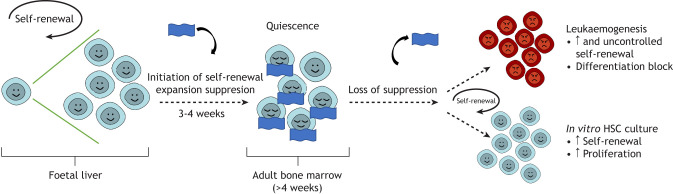
Haematopoietic stem cell (HSC) self-renewal is a process that is essential for the development and homeostasis of the blood system. Self-renewal expansion divisions, which create two daughter HSCs from a single parent HSC, can be harnessed to create large numbers of HSCs for a wide range of cell and gene therapies, but the same process is also a driver of the abnormal expansion of HSCs in diseases such as cancer. Although HSCs are first produced during early embryonic development, the key stage and location where they undergo maximal expansion is in the foetal liver, making this tissue a rich source of data for deciphering the molecules driving HSC self-renewal. Another equally interesting stage occurs post-birth, several weeks after HSCs have migrated to the bone marrow, when HSCs undergo a developmental switch and adopt a more dormant state. Characterising these transition points during development is key, both for understanding the evolution of haematological malignancies and for developing methods to promote HSC expansion. In this Spotlight article, we provide an overview of some of the key insights that studying HSC development have brought to the fields of HSC expansion and translational medicine, many of which set the stage for the next big breakthroughs in the field.
Keywords: HSC; Haematopoiesis; Stem cells.
© 2022. Published by The Company of Biologists Ltd.
Conflict of interest statement
Competing interests The authors declare no competing or financial interests.
Figures
References
-
- Azzoni, E., Frontera, V., Anselmi, G., Rode, C., James, C., Deltcheva, E. M., Demian, A. S., Brown, J., Barone, C., Patelli, A.et al. (2021). The onset of circulation triggers a metabolic switch required for endothelial to hematopoietic transition. Cell Rep. 37, 110103. 10.1016/j.celrep.2021.110103 - DOI - PMC - PubMed