Review
. 2022 Oct;255(4-5):385-405.
doi: 10.1007/s00232-022-00263-9. Epub 2022 Oct 11.

Cholesterol Stiffening of Lipid Membranes

Affiliations
Review

Cholesterol Stiffening of Lipid Membranes

Fathima T Doole et al. J Membr Biol. 2022 Oct.

Abstract

Biomembrane order, dynamics, and other essential physicochemical parameters are controlled by cholesterol, a major component of mammalian cell membranes. Although cholesterol is well known to exhibit a condensing effect on fluid lipid membranes, the extent of stiffening that occurs with different degrees of lipid acyl chain unsaturation remains an enigma. In this review, we show that cholesterol locally increases the bending rigidity of both unsaturated and saturated lipid membranes, suggesting there may be a length-scale dependence of the bending modulus. We review our published data that address the origin of the mechanical effects of cholesterol on unsaturated and polyunsaturated lipid membranes and their role in biomembrane functions. Through a combination of solid-state deuterium NMR spectroscopy and neutron spin-echo spectroscopy, we show that changes in molecular packing cause the universal effects of cholesterol on the membrane bending rigidity. Our findings have broad implications for the role of cholesterol in lipid-protein interactions as well as raft-like mixtures, drug delivery applications, and the effects of antimicrobial peptides on lipid membranes.

Keywords: Area per lipid; Cholesterol; Membrane elasticity; Neutron spin-echo; Rafts; Solid-state NMR spectroscopy.


Conflict of interest statement

The authors declare no competing interests.

The authors declare that they have no conflicts of interest.

Figures
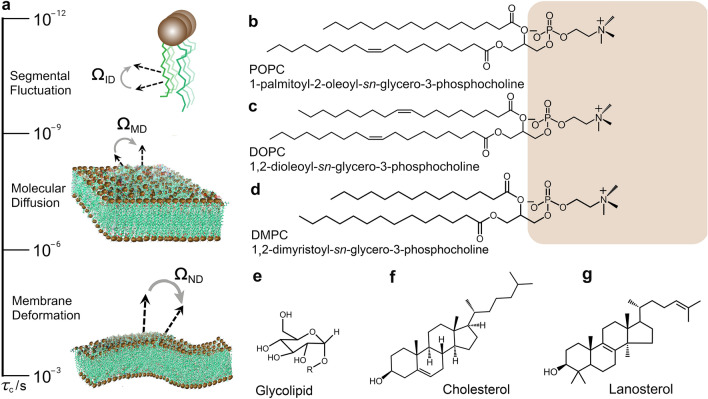
Fig. 1
Fig. 1
Energy landscapes and mobilities of phospholipids in membranes entail characteristic timescales. a Fluctuations of 13C–1H or C–2H bonds are given by ΩID Euler angles for internal segmental frame (I) with respect to the membrane director axis (D). Phospholipid molecular motions entail anisotropic reorientation of the molecule-fixed frame (M) with respect to the membrane director axis (D) as described by ΩMD Euler angles. The liquid-crystalline bilayer lends itself to propagation of thermally excited, quasi-periodic fluctuations due to motion of the local membrane normal (N) relative to the average director axis (D) characterized by ΩND Euler angles. Examples are shown respectively for glycerophospholipids, b POPC, c DOPC, and d DMPC where the lipid headgroups are highlighted in brown; e glycolipids where R denotes the rest of the lipid molecule; f cholesterol which is the sterol component of animal biomembranes; and g lanosterol which is a precursor in the sterol biosynthesis pathway
Fig. 2
Fig. 2
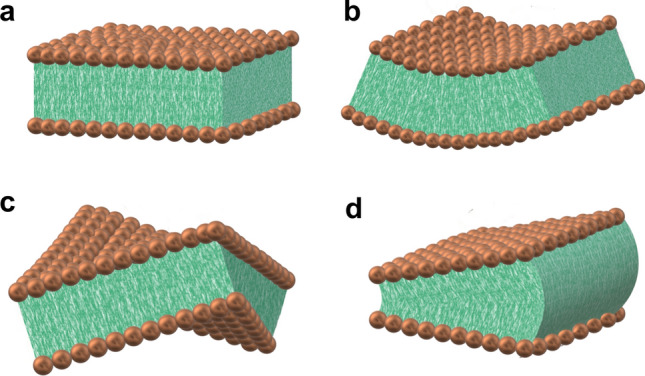
Excitations of a fluid lipid bilayer are described within the continuum elastic approximation. a Planar bilayer, b splay, c twist, and d bend deformations, together with axial rotations about the local director
Fig. 3
Fig. 3
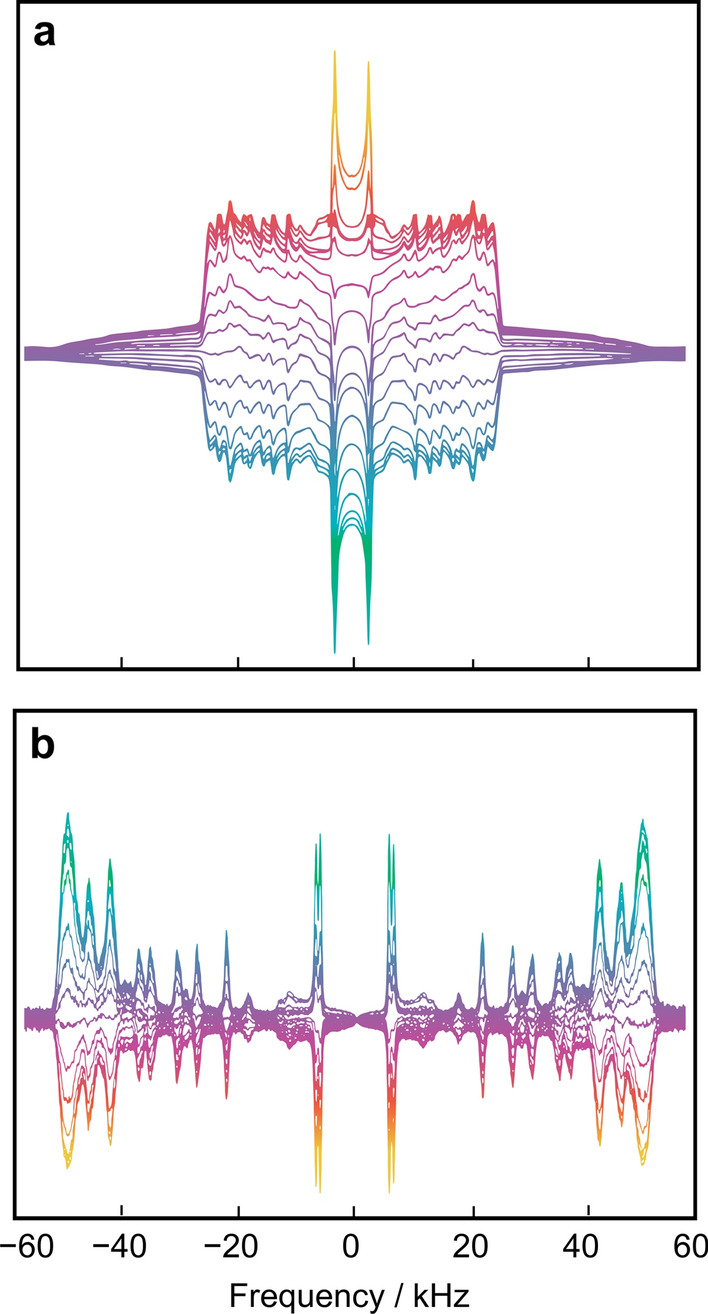
Solid-state 2H NMR spectroscopy of membrane lipids provides both lineshape data and relaxation times yielding information about structure and dynamics. a Inversion recovery of 2H nuclear magnetization for random DMPC-d54/cholesterol (1:1) multilamellar dispersion in the liquid-ordered phase at T = 44 °C showing partially relaxed 2H NMR spectra. b Deconvolved (de-Paked) 2H NMR spectra corresponding to bilayer normal parallel to magnetic field (θ = 0°). The sample contained 20 mM Tris buffer at pH 7.3 (50 wt% H2O). Data were acquired at 76.8 MHz using a phase-cycled, inversion-recovery quadrupolar-echo pulse sequence, π − t1 − (π /2)x − τ − (π/2)y − t2 (acquire), where t1 is a variable delay ranging from 5 ms (bottom) to 3 s (top). Adapted from Ref. (Martinez et al. 2002b)
Fig. 4
Fig. 4
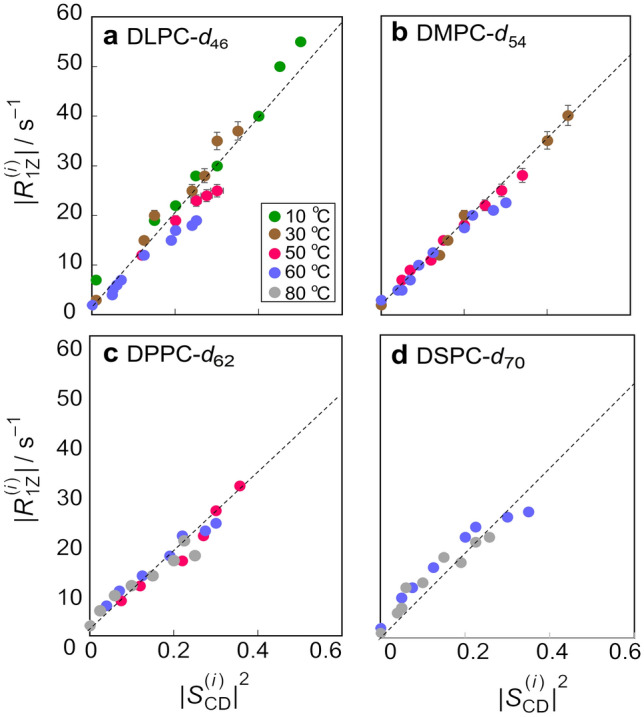
Functional dependence of relaxation times and order parameters from solid-state 2H NMR spectroscopy reveal dynamical bending rigidity of lipid membranes. Data are for unoriented lipid dispersions at 55.4 MHz and various temperatures (T ≥ Tm + 6 °C): a DLPC-d46, b DMPC-d54, c DPPC-d62, and d DSPC-d70, with acyl lengths of n = 12, 14, 16, and 18 carbons, respectively. Square-law functional relation of spin–lattice relaxation rates R1Z and order parameters |SCD| along the acyl chains (index i) for a homologous series of PCs in the Lα phase characterizes the influence of the acyl length (bilayer thickness). Adapted from Ref. (Brown et al. 2001)
Fig. 5
Fig. 5
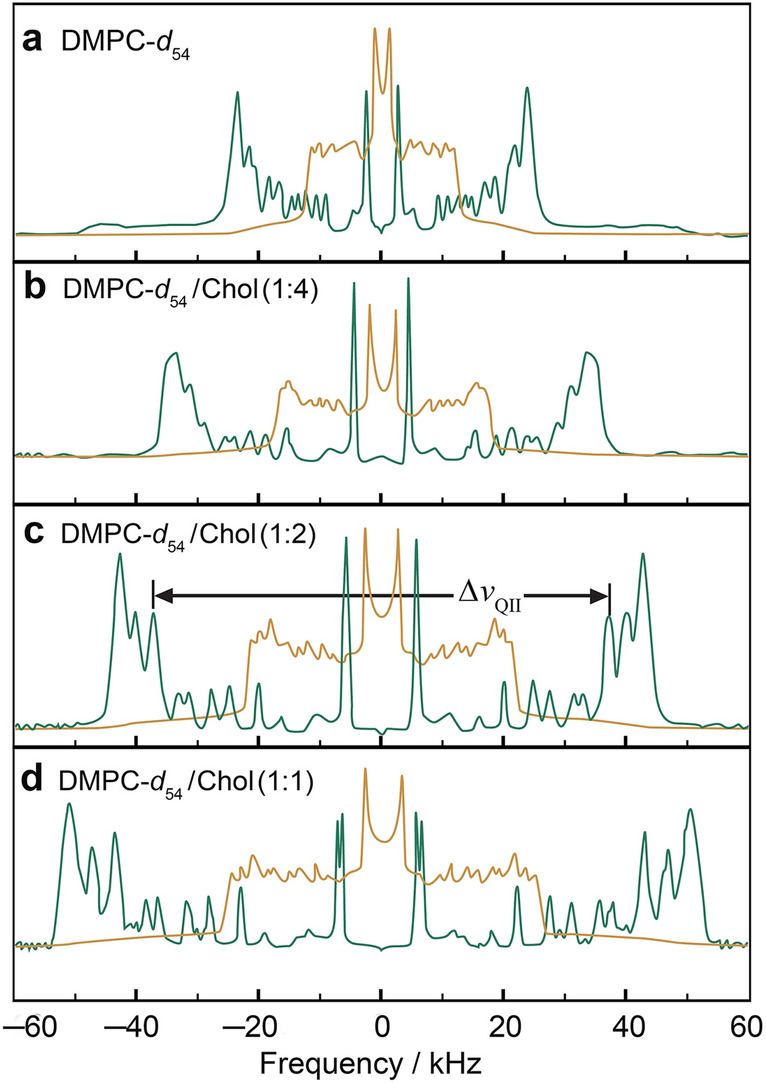
Cholesterol reduces the conformational degrees of freedom for lipid acyl chain segments yielding closer molecular packing. a DMPC-d54 in the liquid-disordered (ld) phase, and bd DMPC-d54 containing various mole fractions of cholesterol (Chol) in the liquid-ordered (lo) phase. Powder type spectra (brown) of randomly oriented multilamellar dispersions were numerically inverted (de-Paked) to yield subspectra corresponding to the θ = 0° orientation (green). Note that a distribution of residual quadrupolar couplings (RQCs) corresponds to the various C2H2 and C2H3 groups with a progressive increase due to cholesterol. Adapted from Ref. (Martinez et al. 2004)
Fig. 6
Fig. 6
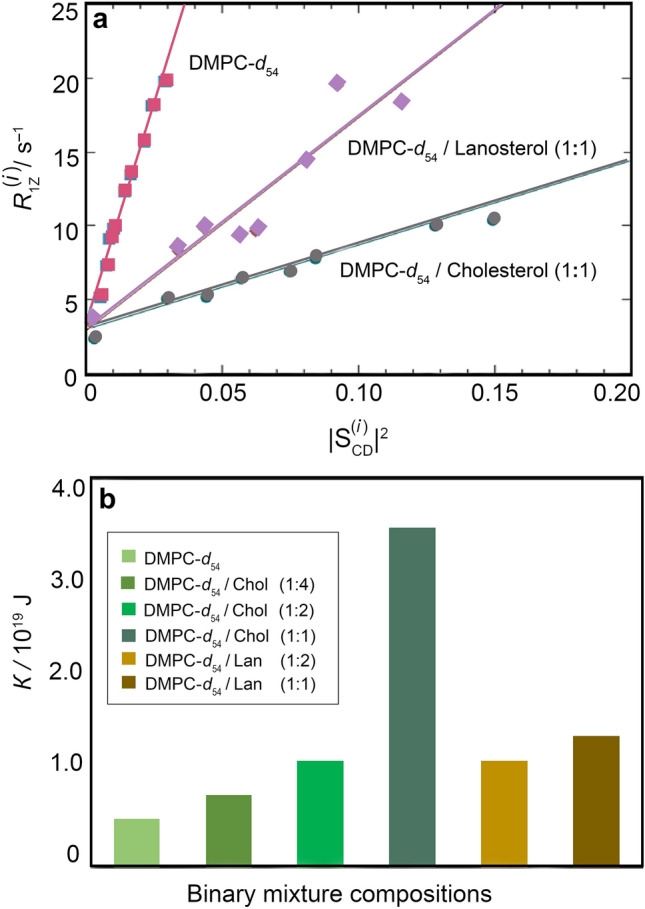
Square-law relations of NMR relaxation times and order parameters indicate bilayer stiffening by cholesterol and lanosterol. a Dependence of spin–lattice relaxation rates R1Z(i) on squared order parameters |SCD(i)| for resolved 2H NMR splittings of DMPC-d54. Data were obtained at T = 44 °C and at 76.8 MHz (11.8 T). b Bending rigidity values calculated for DMPC-d54/cholesterol (DMPC-d54/Chol) and DMPC-d54/lanosterol (DMPC-d54/Lan) systems. Adapted from Ref. (Martinez et al. 2004)
Fig. 7
Fig. 7
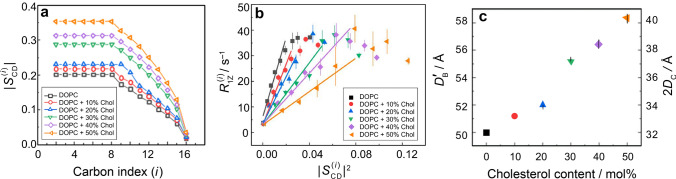
Results from solid-state 2H NMR spectroscopy shows cholesterol increases acyl chain ordering and bending stiffness of lipid membranes due to closer molecular packing in the bilayer. a Segmental order parameter versus acyl position for POPC-d31 probe lipid in DOPC/cholesterol membranes with different mol% cholesterol at T = 25 °C. b Dependence of spin–lattice relaxation rate R1Z(i) on squared order parameters |SCD(i)| indicating a decrease in square-law slopes due to bilayer stiffening by cholesterol. c Structural parameters, i.e., steric thickness (DB) and bilayer hydrocarbon thickness (2DC), obtained from 2H NMR lineshapes using the first-order mean-torque model. Adapted from Ref. (Chakraborty et al. 2020)
Fig. 8
Fig. 8
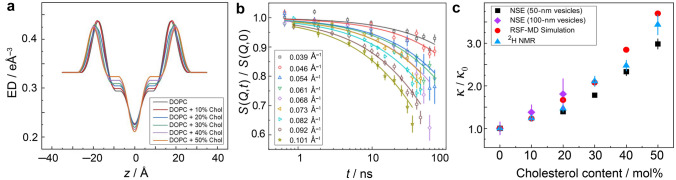
Neutron spin-echo (NSE) spectroscopy and solid-state 2H NMR relaxometry show nearly identical increases in bending modulus of unsaturated lipid membranes with cholesterol mole fraction. a Electron density (ED) profiles along the membrane normal (z-axis) obtained from SAXS data for DOPC/cholesterol membranes, such that z = 0 denotes the center of the membrane. b NSE-measured intermediate scattering functions on 50-nm vesicles of protiated DOPC membranes with 20 mol% cholesterol. Error bars represent ± 1 standard deviation. The lines are fits to the data using a stretched exponential function. c Relative bending rigidity moduli (κ/κ0) calculated from nanoscale bending fluctuations sampled by NSE spectroscopy, solid-state 2H NMR relaxometry, and analysis of MD simulations. Adapted from Ref. (Chakraborty et al. 2020)

References

    1. Allen TM, Cullis PR. Liposomal drug delivery systems: from concept to clinical applications. Adv Drug Deliv Rev. 2013;65:36–48. doi: 10.1016/j.addr.2012.09.037. - DOI - PubMed
    1. Allender DW, Sodt AJ, Schick M. Cholesterol-dependent bending energy is important in cholesterol distribution of the plasma membrane. Biophys J. 2019;116:2356–2366. doi: 10.1016/j.bpj.2019.03.028. - DOI - PMC - PubMed
    1. Arfken G. Mathematical methods for physicsts. New York: Academic Press; 1970.
    1. Arriaga LR, López-Montero I, Monroy F, Orts-Gil G, Hellweg T. Stiffening effect of cholesterol on disordered lipid phases: a combined neutron spin echo + dynamic light scattering analysis of the bending elasticity of large unilamellar vesicles. Biophys J. 2009;96:3629–3637. doi: 10.1016/j.bpj.2009.01.045. - DOI - PMC - PubMed
    1. Arriaga LR, López-Montero I, Orts-Gil G, Farago B, Hellweg T, Monroy F. Fluctuation dynamics of spherical vesicles: frustration of regular bulk dissipation into subdiffusive relaxation. Phys Rev E. 2009;80:031908. doi: 10.1103/PhysRevE.80.031908. - DOI - PubMed

Publication types