. 2023 Jan 1;72(1):135-148.
doi: 10.2337/db22-0252.

Genetic Mapping of Multiple Traits Identifies Novel Genes for Adiposity, Lipids, and Insulin Secretory Capacity in Outbred Rats

Affiliations

Genetic Mapping of Multiple Traits Identifies Novel Genes for Adiposity, Lipids, and Insulin Secretory Capacity in Outbred Rats

Thu Hong-Le et al. Diabetes. .

Abstract

Despite the successes of human genome-wide association studies, the causal genes underlying most metabolic traits remain unclear. We used outbred heterogeneous stock (HS) rats, coupled with expression data and mediation analysis, to identify quantitative trait loci (QTLs) and candidate gene mediators for adiposity, glucose tolerance, serum lipids, and other metabolic traits. Physiological traits were measured in 1,519 male HS rats, with liver and adipose transcriptomes measured in >410 rats. Genotypes were imputed from low-coverage whole-genome sequencing. Linear mixed models were used to detect physiological and expression QTLs (pQTLs and eQTLs, respectively), using both single nucleotide polymorphism (SNP)- and haplotype-based models for pQTL mapping. Genes with cis-eQTLs that overlapped pQTLs were assessed as causal candidates through mediation analysis. We identified 14 SNP-based pQTLs and 19 haplotype-based pQTLs, of which 10 were in common. Using mediation, we identified the following genes as candidate mediators of pQTLs: Grk5 for fat pad weight and serum triglyceride pQTLs on Chr1, Krtcap3 for fat pad weight and serum triglyceride pQTLs on Chr6, Ilrun for a fat pad weight pQTL on Chr20, and Rfx6 for a whole pancreatic insulin content pQTL on Chr20. Furthermore, we verified Grk5 and Ktrcap3 using gene knockdown/out models, thereby shedding light on novel regulators of obesity.


Figures

Figure 1
Figure 1
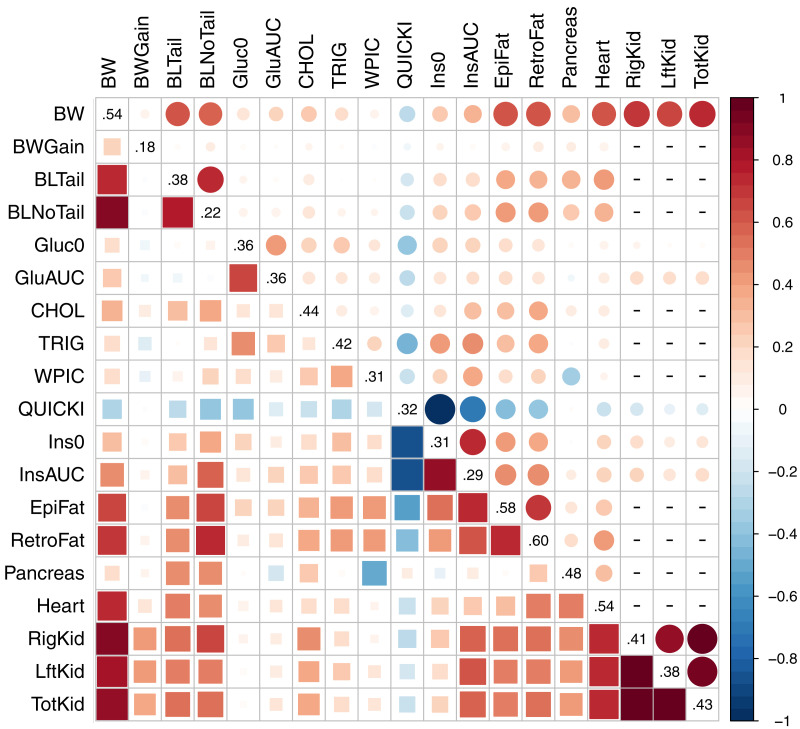
Heritabilities and genetic and phenotypic correlations for physiological traits in up to 1,519 male HS rats. The main diagonal contains the heritabilities, the upper triangle the phenotypic correlations, and the lower triangle the genetic correlations. Dashes indicate missing data for phenotypic correlations, where traits were measured on different animals.
Figure 2
Figure 2
Porcupine plot of pQTLs detected as genome-wide significant using haplotype-based (A) or SNP-based (B) mixed models. The x-axis shows genomic position and y-axis the significance as −log10 of the P value of the test of association. Traits are color-coded, as indicated in the legend. Thresholds are shown as horizontal lines and indicate the genome-wide 10% thresholds, as determined by permutation in haplotype and bootstraps in SNP-based mapping. Haplotype association thresholds vary between traits, whereas those for SNPs are almost the same for all traits. Two pQTLs for Heart weight indicated by diamonds are likely the same locus, likely due to a misassembly in Rn6.0.
Figure 3
Figure 3
Adipose expression of Grk5 is a full mediator for RetroFat/BW (A) and EpiFat/BW (B) and a partial mediator for TRIG (C) at the Chr1 QTL. Panels AC show mediation analysis for the phenotypes RetroFat/BW, EpiFat/BW, and TRIG, respectively. Within each row, left to right, are shown (i) box-whisker plots of the estimated founder haplotype effects with uncertainties at the peak SNP for the phenotype; (ii) the scan across Chr1 for SNP-based mixed model for the trait; and (iii) the corresponding scan after including the expression of Grk5 as a covariate. Dash horizontal lines represent maximum −log(P value) in physiological mapping of the traits. D shows the haplotype effects and expression QTL analysis for Grk5, in which the rightmost panel is a scatter plot of RetroFat/BW vs. Grk5 expression in adipose tissue across 415 rats, color-coded by genotype at the peak SNP of the pQTL for RetroFat/BW, showing the BUF and WKY allele. E shows that knockdown (KD) of Grk5 in a 3T3L1 preadipocyte cell line (left) decreases total TRIG accumulation in a mature adipocytes (right). The white bar represents the KD and the black bar is the control. D0, day 0; D7, day 7.
Figure 4
Figure 4
Liver expression of Krtcap3 is a full mediator for RetroFat/BW (A) and partial mediator for TRIG (B) at the Chr6 QTL. Within each row, left to right, are shown (i) box-whisker plots of the estimated founder haplotype effects with uncertainties at the peak SNP for the phenotype; (ii) the genome scan across Chr6 for SNP-based mixed model for the traits; and (iii) the corresponding scan after including the expression of Krtcap3 as a covariate. Horizontal dashed lines represent maximum −log(P value) in physiological mapping of the traits. C shows the haplotype effects and expression QTL analysis for Krtcap3, in which the rightmost panel is a scatter plot of RetroFat/BW vs. Krtcap3 expression in liver tissue across 430 rats, color-coded by genotype at the peak SNP of the pQTL for RetroFat/BW, which is private to the founder WKY. D shows body weight at 6 weeks of age in WT (black circle) and Krtcap3 knockout rats (KO) (gray square). Both KO male and KO female rats were significantly heavier than WT control. *P < 0.05.
Figure 5
Figure 5
Liver expression of Rfx6 is full mediator for WPIC. The top row shows, from left to right, box-whisker plots of the estimated founder haplotype effects with uncertainties at the peak SNP for WPIC; the genome scan across Chr20 for the SNP-based mixed model; and the corresponding scan after including the expression of Rfx6 as a covariate. Horizontal dashed line represents maximum WPIC −log(P value). The bottom row shows the haplotype effects and expression QTL analysis for liver Rfx6, in which the rightmost panel is a scatter plot of WPIC vs. Rfx6 expression in liver tissue across 430 rats, color-coded by genotype at the peak SNP of the pQTL for WPIC.
Figure 6
Figure 6
Liver expression of Ilrun is full mediator for EpiFat/BW. The top row shows, from left to right, box-whisker plots of the estimated founder haplotype effects with uncertainties at the peak SNP for EpiFat/BW; the genome scan across Chr20 for SNP-based mixed model; and the corresponding scan after including the expression of Ilrun as a covariate. Horizontal dashed line represents maximum WPIC −log(P value). The bottom row shows the haplotype effects and expression QTL analysis for liver Ilrun, in which the rightmost panel is a scatter plot of EpiFat/BW vs. Ilrun expression in liver tissue across 430 rats, color-coded by genotype at the peak SNP of the pQTL for EpiFat/BW, which is private to the founder WKY.

References

    1. GBD 2015 Obesity Collaborators . Health effects of overweight and obesity in 195 countries over 25 years. N Engl J Med 2017;377:13–27 - PMC - PubMed
    1. Maes HH, Neale MC, Eaves LJ. Genetic and environmental factors in relative body weight and human adiposity. Behav Genet 1997;27:325–351 - PubMed
    1. Klarin D, Damrauer SM, Cho K, et al. .; Global Lipids Genetics Consortium; Myocardial Infarction Genetics (MIGen) Consortium; Geisinger-Regeneron DiscovEHR Collaboration; VA Million Veteran Program . Genetics of blood lipids among ∼300,000 multi-ethnic participants of the Million Veteran Program. Nat Genet 2018;50:1514–1523 - PMC - PubMed
    1. Chen J, Spracklen CN, Marenne G, et al. .; Lifelines Cohort Study; Meta-Analysis of Glucose and Insulin-related Traits Consortium (MAGIC) . The trans-ancestral genomic architecture of glycemic traits. Nat Genet 2021;53:840–860 - PMC - PubMed
    1. Horikoshi M, Mägi R, van de Bunt M, et al. .; ENGAGE Consortium . Discovery and fine-mapping of glycaemic and obesity-related trait loci using high-density imputation. PLoS Genet 2015;11:e1005230. - PMC - PubMed

Publication types