


Roles of biomarkers in anti-MDA5-positive dermatomyositis, associated interstitial lung disease, and rapidly progressive interstitial lung disease
- PMID: 36221983
- PMCID: PMC9701872
- DOI: 10.1002/jcla.24726
Roles of biomarkers in anti-MDA5-positive dermatomyositis, associated interstitial lung disease, and rapidly progressive interstitial lung disease
Abstract
Background: Anti-melanoma differentiation-associated gene 5 (MDA5)-positive dermatomyositis (MDA5+ DM) is significantly associated with interstitial lung disease (ILD), especially rapidly progressive ILD (RPILD) due to poor prognosis, resulting in high mortality rates. However, the pathogenic mechanism of MDA5+ DM-RPILD is unclear. Although some MDA5+ DM patients have a chronic course of ILD, many do not develop RPILD. Therefore, the related biomarkers for the early diagnosis, disease activity monitoring, and prediction of the outcome of RPILD in MDA5+ DM patients should be identified. Blood-based biomarkers are minimally invasive and can be easily detected.
Methods: Recent relative studies related to blood biomarkers in PubMed were reviewed.
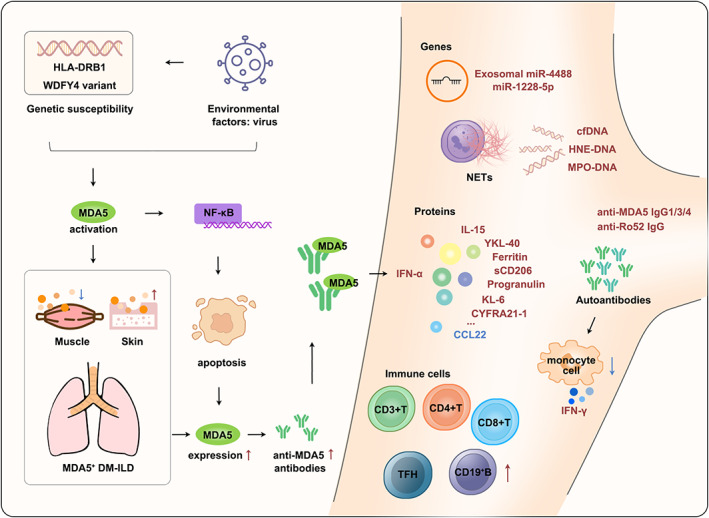
Results: An increasing number of studies have demonstrated that dysregulated expression of blood biomarkers related to ILD such as ferritin, Krebs von den Lungen-6 (KL-6), surfactant protein-D (SP-D), and cytokines, and some tumor markers in MDA5+ DM may provide information in disease presence, activity, treatment response, and prognosis. These studies have highlighted the great potentials of blood biomarker values for MDA5+ DM-ILD and MDA5+ DM-RPILD. This review provides an overview of recent studies related to blood biomarkers, besides highlighted protein biomarkers, including antibody (anti-MDA5 IgG subclasses and anti-Ro52 antibody), genetic (exosomal microRNAs and neutrophil extracellular traps related to cell-free DNA), and immune cellular biomarkers in MDA5+ DM, MDA5+ DM-ILD, and MDA5+ DM-RPILD patients, hopefully elucidating the pathogenesis of MDA5+ DM-ILD and providing information on the early diagnosis, disease activity monitoring, and prediction of the outcome of the ILD, especially RPILD.
Conclusions: Therefore, this review may provide insight to guide treatment decisions for MDA5+ DM-RPILD patients and improve outcomes.
Keywords: MDA5; biomarker; dermatomyositis; interstitial lung disease; rapidly progressive interstitial lung disease.
© 2022 The Authors. Journal of Clinical Laboratory Analysis published by Wiley Periodicals LLC.
Conflict of interest statement
The authors have declared no conflicts of interest.
Figures
References
-
- Lundberg IE, Fujimoto M, Vencovsky J, et al. Idiopathic inflammatory myopathies. Nat Rev Dis Primers. 2021;7:86 (In eng). - PubMed
-
- Sun KY, Fan Y, Wang YX, Zhong YJ, Wang GF. Prevalence of interstitial lung disease in polymyositis and dermatomyositis: a meta‐analysis from 2000 to 2020. Semin Arthritis Rheum. 2021;51:175‐191. (In eng). - PubMed
-
- McPherson M, Economidou S, Liampas A, Zis P, Parperis K. Management of mda‐5 antibody positive clinically amyopathic dermatomyositis associated interstitial lung disease: a systematic review. Semin Arthritis Rheum. 2022;53:151959 (In eng). - PubMed
Publication types
MeSH terms
Substances
Grants and funding
LinkOut - more resources
Full Text Sources
Medical
Research Materials
