


Nonsuicidal self-injury, sleep quality, and shame response to a laboratory stress task
- PMID: 36223526
- PMCID: PMC9925399
- DOI: 10.1002/jclp.23450
Nonsuicidal self-injury, sleep quality, and shame response to a laboratory stress task
Abstract
Objective: Nonsuicidal self-injury (NSSI) frequently functions to regulate shame-based emotions and cognitions in the context of interpersonal stress. The present study sought to examine how sleep quality (SQ) may influence this process in a laboratory setting.
Methods: Participants included 72 adults (Mage = 24.28; 36 with a lifetime history of NSSI) who completed a self-report measure of prior month SQ and engaged in a modified Trier social stress task (TSST). State shame ratings were collected immediately before and following the TSST, as well as 5 min post-TSST, to allow for the measurement of shame reactivity and recovery.
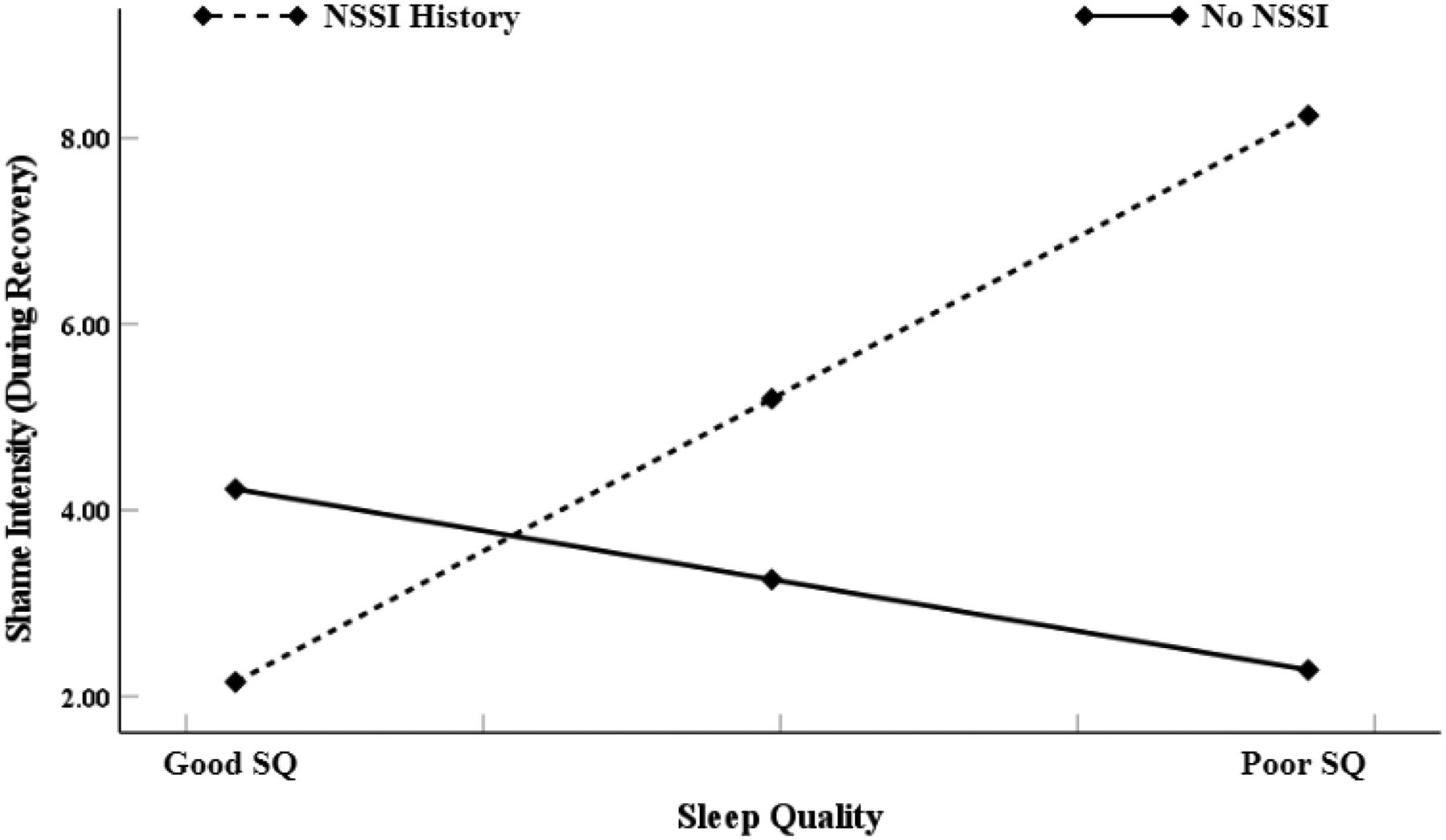
Results: No significant results emerged for NSSI history and SQ as statistical predictors of shame reactivity. However, NSSI history was significantly associated with heightened shame intensity during the recovery period of the task, and this was moderated by SQ. Simple slopes analyses revealed a conditional effect whereby poorer SQ (1SD above the mean) was associated with greater intensity of shame during recovery, but only for those with a history of NSSI.
Conclusion: Poor SQ may contribute to worrisome emotional responses to daytime stressors in those at risk for NSSI.
Keywords: emotion regulation; insomnia; nonsuicidal self-injury; self-harm; shame; sleep.
© 2022 Wiley Periodicals LLC.
Conflict of interest statement
Disclosure statement
None of the authors report a conflict of interest. The views expressed in this article are those of the authors and do not necessarily reflect the position or policy of the Department of Veterans Affairs or any of its academic affiliates.
Figures
References
-
- Akhavan Abiri F, & Shairi MR (2020). Validity and reliability of symptom checklist-90-revised (SCL-90-R) and brief symptom inventory-53 (BSI-53). Clinical Psychology and Personality, 17, 169–195.
-
- Allen KJ, & Hooley JM (2019). Negative Emotional Action Termination (NEAT): Support for a cognitive mechanism underlying negative urgency in nonsuicidal self-injury. Behavior Therapy, 50, 924–937. - PubMed
-
- Ammerman BA, Jacobucci R, Turner BJ, Dixon-Gordon KL, & McCloskey MS (2020). Quantifying the importance of lifetime frequency versus number of methods in conceptualizing nonsuicidal self-injury severity. Psychology of Violence, 10, 442.
-
- Anderson C, & Platten CR (2011). Sleep deprivation lowers inhibition and enhances impulsivity to negative stimuli. Behavioural Brain Research, 217, 463–466. - PubMed
-
- Bentley KH, Cassiello-Robbins CF, Vittorio L, Sauer-Zavala S, & Barlow DH (2015). The association between nonsuicidal self-injury and the emotional disorders: A meta-analytic review. Clinical Psychology Review, 37, 72–88. - PubMed
Publication types
MeSH terms
Grants and funding
LinkOut - more resources
Full Text Sources
Medical
