


Translating the hierarchical taxonomy of psychopathology (HiTOP) from potential to practice: Ten research questions
- PMID: 36227328
- PMCID: PMC10097839
- DOI: 10.1037/amp0001046
Translating the hierarchical taxonomy of psychopathology (HiTOP) from potential to practice: Ten research questions
Abstract
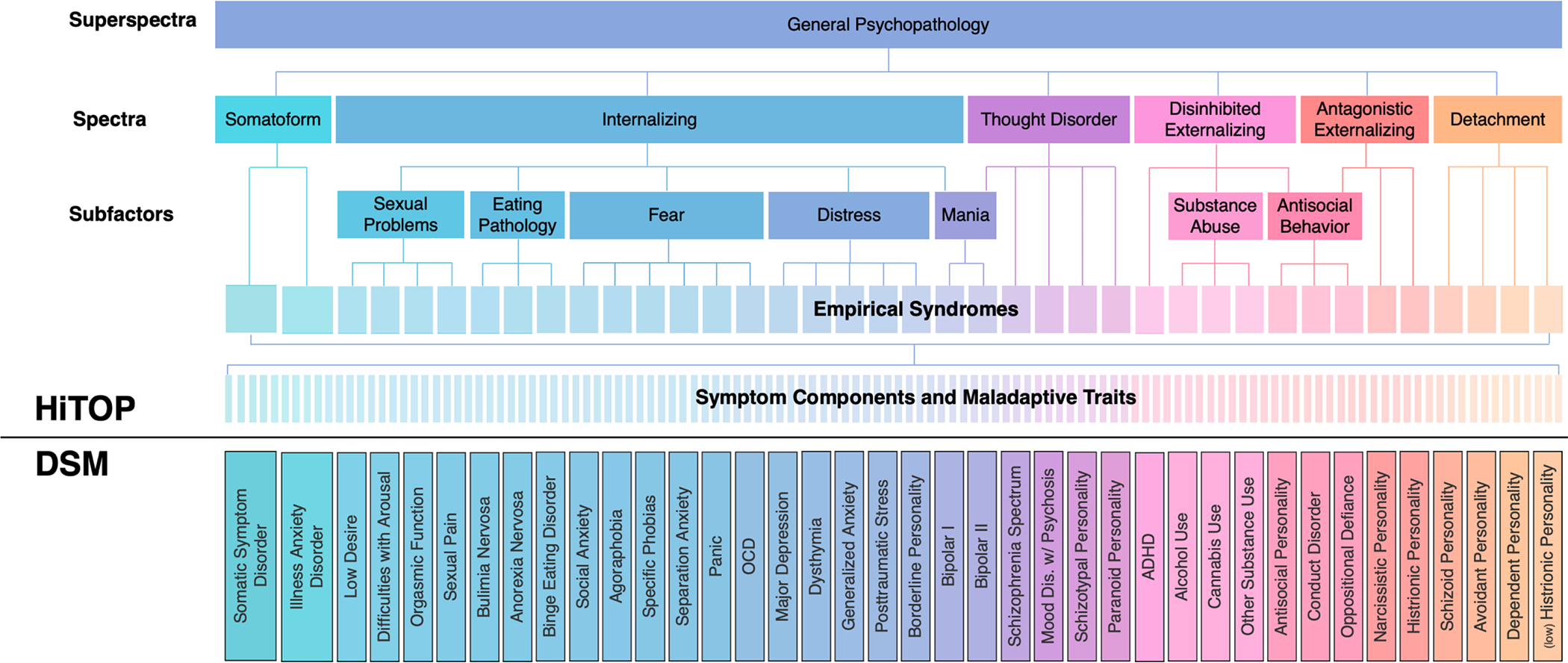
The Hierarchical Taxonomy of Psychopathology (HiTOP) is a novel diagnostic system grounded in empirical research into the architecture of mental illness. Its basic units are continuous dimensions-as opposed to categories-that are organized into a hierarchy according to patterns of symptom co-occurrence observed in quantitative studies. Previous HiTOP discussions have focused on existing evidence regarding the model's structure and ability to account for neurobiological, social, cultural, and clinical variation. The present article looks ahead to the next decade of applied research and clinical practice using the HiTOP rubric. We highlight 10 topics where HiTOP has the potential to make significant breakthroughs. Research areas include genetic influences, environmental contributions, neural mechanisms, real-time dynamics, and lifespan development of psychopathology. We also discuss development of novel assessments, forecasting methods, and treatments. Finally, we consider implications for clinicians and educators. For each of these domains, we propose directions for future research and venture hypotheses as to what HiTOP will reveal about psychopathology. (PsycInfo Database Record (c) 2023 APA, all rights reserved).
Figures
References
-
- Barlow DH (2000). Unraveling the mysteries of anxiety and its disorders from the perspective of emotion theory. American Psychologist, 55(11), 1247–1263. - PubMed
-
- Barlow DH, Sauer-Zavala S, Carl JR, Bullis JR, & Ellard KK (2014). The nature, diagnosis, and treatment of neuroticism: Back to the future. Clinical Psychological Science, 2(3), 344–365.
-
- Ben-Porath YS, & Tellegen A (2020). Minnesota Multiphasic Personality Inventory-3 (MMPI-3): Technical manual. University of Minnesota Press.
MeSH terms
Grants and funding
LinkOut - more resources
Full Text Sources
Medical