


Racial and ethnic differences in cervical cancer screening barriers and intentions: The My Body My Test-3 HPV self-collection trial among under-screened, low-income women
- PMID: 36227948
- PMCID: PMC9562154
- DOI: 10.1371/journal.pone.0274974
Racial and ethnic differences in cervical cancer screening barriers and intentions: The My Body My Test-3 HPV self-collection trial among under-screened, low-income women
Abstract
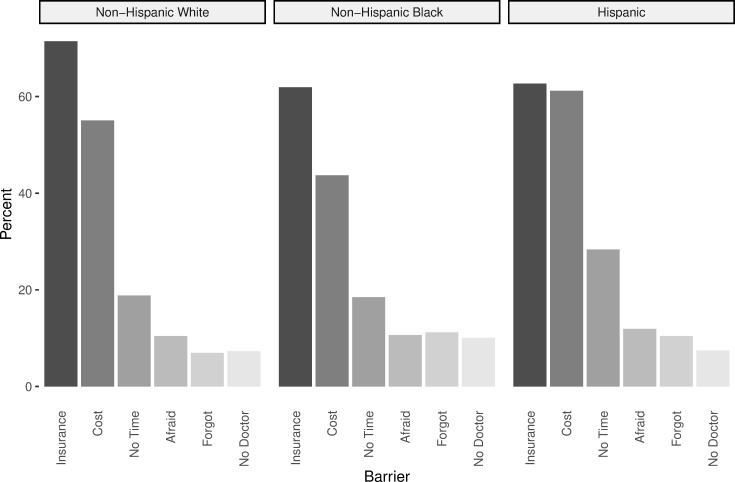
Under-screened women are more likely to be diagnosed with invasive cervical cancer at later stages and have worse survival outcomes. Under- or un-insured women, low-income women, and minoritized groups face barriers to screening. Intention to screen is an indicator of future screening behavior, yet is understudied among low-income, under-screened women. Participants were 710 low-income, uninsured or publicly insured women ages 25-64 years in North Carolina who were not up to date on cervical cancer screening according to national guidelines. Participants were asked about barriers to screening and intention to screen. We estimated reported barriers to cervical cancer screening stratified by race and ethnicity (categorized as White, Black, and Hispanic) and assessed predictors of intention to screen. Sixty-one percent of all participants reported 5 or more barriers to screening. The most commonly reported reasons for not getting screened were lack of insurance (White: 71%, Black: 62%, Hispanic/Latina: 63%) and cost (White: 55%, Black: 44%, Hispanic/Latina: 61%). Women were more likely to have an intention to screen if they reported "it was not hard to get screening" (OR: 1.47 (1.00, 2.15)). Older women reported being less likely to intend to screen. Black women reported being more likely to intend to screen than White women. Lack of health insurance and cost were frequently reported barriers to cervical cancer screening. Increasing knowledge of affordable clinics and expanding access to Medicaid may reduce barriers and increase cervical cancer screening uptake.
Conflict of interest statement
Dr. Jennifer S. Smith has received research grants and consultancies from Hologic and Becton Dickinson in the past five years. Dr. Andrea C. Des Marais has had some conference travel expenses covered by Hologic in the last 5 years. This does not alter our adherence to PLOS ONE policies on sharing data and materials. The remaining authors have no conflicts to disclose.
Figures
References
-
- American Cancer Society. Can Cervical Cancer Be Prevented? 2020 [cited 31 May 2020]. Available: https://www.cancer.org/cancer/cervical-cancer/causes-risks-prevention/pr...
-
- American Cancer Society. Key Facts for Cervical Cancer. 2016 [cited 20 May 2020]. Available: https://www.cancer.org/cancer/cervical-cancer/about/key-statistics.html
-
- American Cancer Society. Survival Rates for Cervical Cancer. 2020 [cited 3 Jun 2020]. Available: https://www.cancer.org/cancer/cervical-cancer/detection-diagnosis-stagin...
