


Effects of short-term quetiapine and lithium therapy for acute manic or mixed episodes on the limbic system and emotion regulation circuitry in youth with bipolar disorder
- PMID: 36229596
- PMCID: PMC9938175
- DOI: 10.1038/s41386-022-01463-6
Effects of short-term quetiapine and lithium therapy for acute manic or mixed episodes on the limbic system and emotion regulation circuitry in youth with bipolar disorder
Abstract
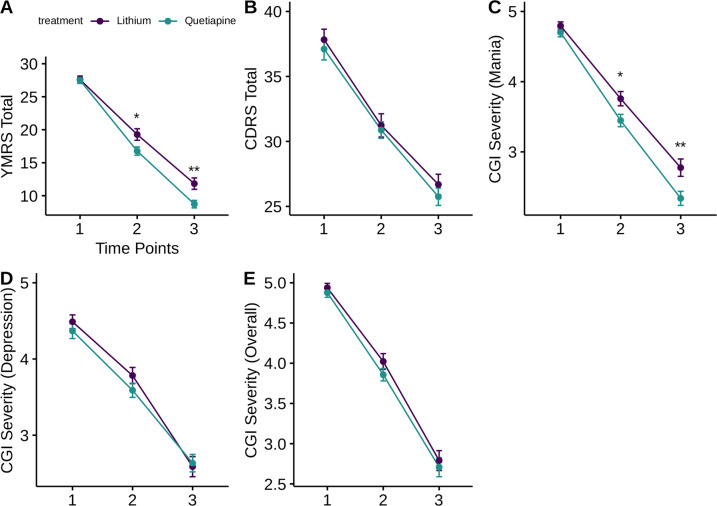
Disruptions in the limbic system, and in emotion regulation circuitry that supports affect modulation, have been reported during acute manic episodes of bipolar disorder (BD). The impact of pharmacological treatment on these deficits, especially in youth, remains poorly characterized. 107 youths with acute manic or mixed episodes of bipolar I disorder and 60 group-matched healthy controls were recruited. Youth with bipolar disorder were randomized to double-blind treatment with quetiapine or lithium and assessed weekly. Task-based fMRI studies were performed using an identical pairs continuous performance task (CPT-IP) at pre-treatment baseline and post-treatment weeks one and six. Region of interest analyses focused on the limbic system and ventral PFC - basal ganglia - thalamocortical loop structures known to be involved in emotion regulation. Changes in regional activation were compared between the two treatment groups, and pretreatment regional activation was used to predict treatment outcome. Mania treatment scores improved more rapidly in the quetiapine than lithium treated group, as did significant normalization of neural activation toward that of healthy individuals in left amygdala (p = 0.007), right putamen (p < 0.001), and right globus pallidus (p = 0.003). Activation changes in the right putamen were correlated with reduction of mania symptoms. The limbic and emotion regulation system activation at baseline and week one predicted treatment outcome in youth with bipolar disorder with significant accuracy (up to 87.5%). Our findings document more rapid functional brain changes associated with quetiapine than lithium treatment in youth with bipolar disorder, with most notable changes in the limbic system and emotion regulation circuitry. Pretreatment alterations in these regions predicted treatment response. These findings advance understanding of regional brain alterations in youth with bipolar disorder, and show that fMRI data can predict treatment outcome before it can be determined clinically, highlighting the potential utility of fMRI biomarkers for early prediction of treatment outcomes in bipolar disorder.Clinical Trials Registration: Name: Multimodal Neuroimaging of Treatment Effects in Adolescent Mania. URL: https://clinicaltrials.gov/ . Registration number: NCT00893581.
© 2022. The Author(s), under exclusive licence to American College of Neuropsychopharmacology.
Conflict of interest statement
JRS has received research support from the National Institutes of Health (NIMH/NIEHS/NICHD) as well as Allergan, Neuronetics and Otsuka. He has received material support from and provided consultation to Myriad Genetics and receives royalties from the publication of two texts (Springer) and serves as an author for UpToDate and an Associate Editor for Current Psychiatry. He has spoken in CME presentations for Neuroscience Education Institute and CMEology. JRS also has provided consultation to the FDA and Intracellular Therapeutics. JAS consults to VeriSci. LRP and MPD have received research support from NIMH, PCORI, Acadia, Alkermes, Allergan, Janssen, Johnson and Johnson, Lundbeck, Myriad, Otsuka, Pfizer, Sunovion and Shire. MPD has provided consultation or advisory board services for Alkermes, Allergan, CMEology, Janssen, Johnson and Johnson, Lundbeck, Medscape, Myriad, Pfizer, Sage, and Sunovion. All other authors declare that they have no competing interests.
Figures


References
Publication types
MeSH terms
Substances
Associated data
Grants and funding
LinkOut - more resources
Full Text Sources
Medical
Miscellaneous
