. 2023 Mar;41(3):378-386.
doi: 10.1038/s41587-022-01486-w. Epub 2022 Oct 13.

Precision mitochondrial DNA editing with high-fidelity DddA-derived base editors

Affiliations

Precision mitochondrial DNA editing with high-fidelity DddA-derived base editors

Seonghyun Lee et al. Nat Biotechnol. 2023 Mar.

Abstract

Bacterial toxin DddA-derived cytosine base editors (DdCBEs)-composed of split DddAtox (a cytosine deaminase specific to double-stranded DNA), custom-designed TALE (transcription activator-like effector) DNA-binding proteins, and a uracil glycosylase inhibitor-enable mitochondrial DNA (mtDNA) editing in human cells, which may pave the way for therapeutic correction of pathogenic mtDNA mutations in patients. The utility of DdCBEs has been limited by off-target activity, which is probably caused by spontaneous assembly of the split DddAtox deaminase enzyme, independent of DNA-binding interactions. We engineered high-fidelity DddA-derived cytosine base editors (HiFi-DdCBEs) with minimal off-target activity by substituting alanine for amino acid residues at the interface between the split DddAtox halves. The resulting domains cannot form a functional deaminase without binding of their linked TALE proteins at adjacent sites on DNA. Whole mitochondrial genome sequencing shows that, unlike conventional DdCBEs, which induce hundreds of unwanted off-target C-to-T conversions in human mtDNA, HiFi-DdCBEs are highly efficient and precise, avoiding collateral off-target mutations, and as such, they will probably be desirable for therapeutic applications.


Conflict of interest statement

J.-S.K. is a co-founder of and holds stock in ToolGen. S.L. and J.-S.K. have filed patent applications related to this work. The other authors declare no competing interests.

Figures

Fig. 1
Fig. 1. Interface engineering of two split DddAtox proteins.
a, Schematic of DdCBE engineering. b,c, Crystal structures of the DddAtox deaminases. Residues at the interfaces of the split dimers are represented as sticks. In b, 1397N and 1397C are shown in magenta and cyan, respectively. In c, 1333N and 1333C are shown in orange and green, respectively. d,e, Interface mutations in 1397N and 1397C (d) and in 1333N and 1333C (e) are shown in red.
Fig. 2
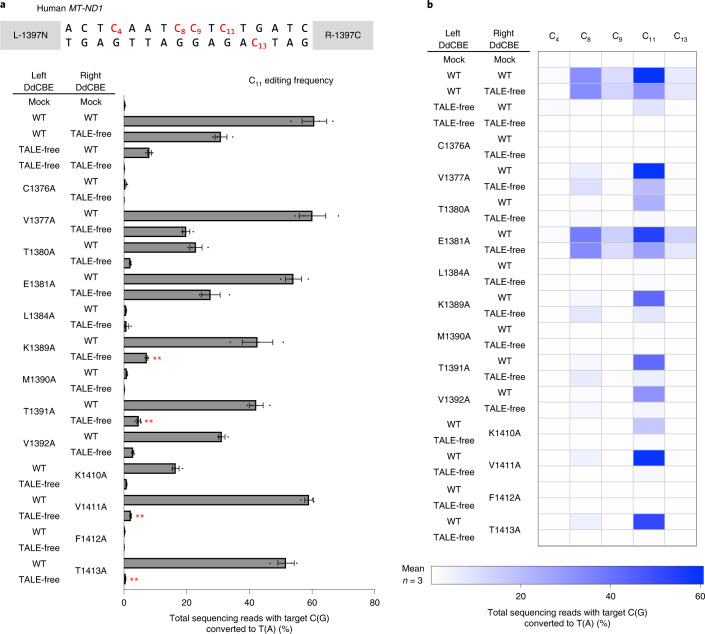
Fig. 2. Cytosine base editing induced by G1397-split DdCBE and various mutants in human mtDNA.
a, Base editing frequencies induced by G1397-split DddAtox interface mutants. The editing window and target cytosine bases are shown at the top. Plasmids encoding the mutant and wild-type (WT) or TALE-free DddAtox proteins were co-transfected as indicated in the left column. All of the TALE-fused and TALE-free constructs contain UGI. b, Heat map showing target C-to-T (G-to-A) editing efficiencies induced by DdCBE and the various mutants. Error bars are s.e.m. for n = 3 biologically independent samples. P = 0.0045, P = 0.0032, P = 0.0070 and P = 0.0066 for K1389A, T1391A, V1411A and T1413A, compared to wild-type and TALE-free pair, respectively. **P < 0.01, Student’s two-tailed t-test. Source data
Fig. 3
Fig. 3. Target C-to-T conversions using G1333-split DdCBE and interface mutants in the MT-ND1 gene.
a, Base editing frequencies induced by G1333-split DddAtox interface mutants. The editing window and target cytosine bases are shown at the top. Plasmids encoding the mutant and wild-type (WT) TALE-free DddAtox proteins were co-transfected as indicated in the left column. The TALE-free DddAtox proteins used for the left and right DdCBEs were 1333N and 1333C, respectively. b, Heat map showing target C-to-T (G-to-A) editing efficiencies induced by DdCBE and the various mutants. Error bars are s.e.m. for n = 3 biologically independent samples. P = 0.0036, P = 0.0042 and P = 0.0034 for K1389A, T1391A and V1393A, compared to the wild-type and TALE-free pair, respectively. **P < 0.01, Student’s two-tailed t-test. Source data
Fig. 4
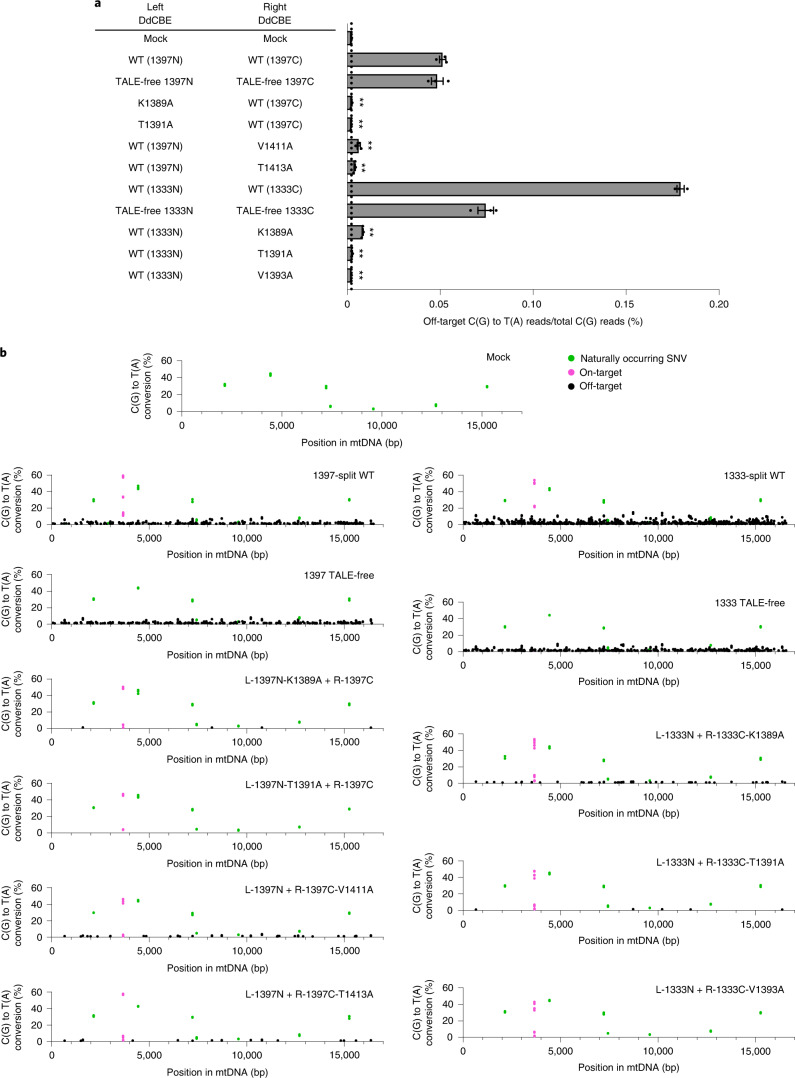
Fig. 4. Mitochondrial genome-wide off-target editing induced by DdCBEs specific to the MT-ND1 site.
a, The average frequencies of mitochondrial genome-wide off-target editing induced by wild-type DdCBE, TALE-free constructs, and interface-engineered DddAtox pairs. Error bars are s.e.m. for n = 3 biologically independent samples. P = 0.0010, P = 0.0011, P = 0.0002, P = 0.0009, P = 0.0001, P = 0.0001 and P = 0.0001 for L-1397N-K1389A, L-1397N-T1391A, R-1397C-V1411A, R-1397C-T1413A, R-1333C-K1389A, R-1333C-T1391A and R-1333C-V1393A compared to the wild-type pairs, respectively. **P < 0.01, Student’s two-tailed t-test. b, Mitochondrial genome-wide plots for C-to-T point mutations with frequencies ≥1%. Naturally occurring SNVs, on-target edits (including bystander edits in the editing window) and off-target edits are shown in green, magenta and black, respectively. All data points from n = 3 biologically independent experiments are shown. Source data
Fig. 5
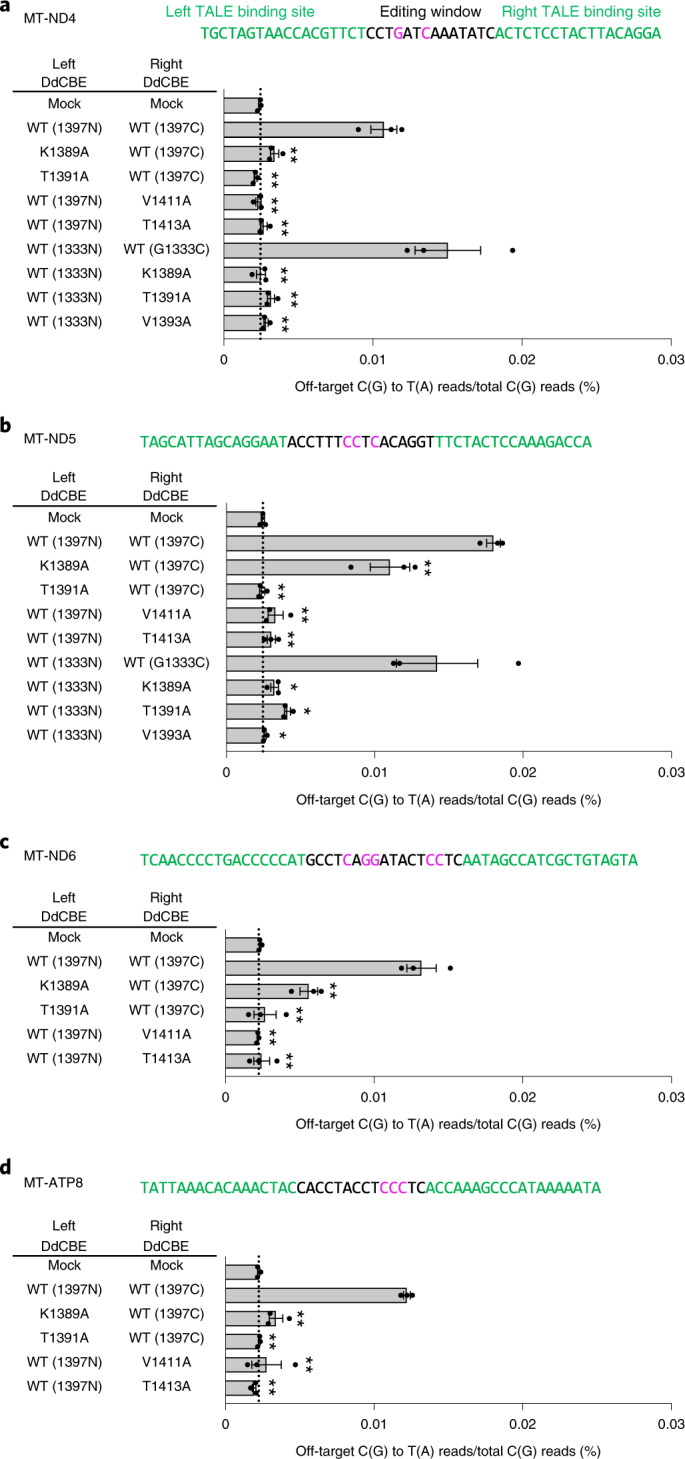
Fig. 5. Mitochondrial genome-wide off-target analysis for DdCBEs specific to four different human mtDNA sites.
ad,The MT-ND4 (a), MT-ND5 (b), MT-ND6 (c) and MT-ATP8 (d) sites targeted by DdCBE and interface-engineered variants. The bar graphs indicate the average frequencies of mitochondrial genome-wide off-target editing by wild-type and engineered DddAtox pairs. Error bars are s.e.m. for n = 3 biologically independent samples. *P < 0.05 and **P < 0.01, Student’s two-tailed t-test. Exact P values are provided in the source data. Source data
Fig. 6
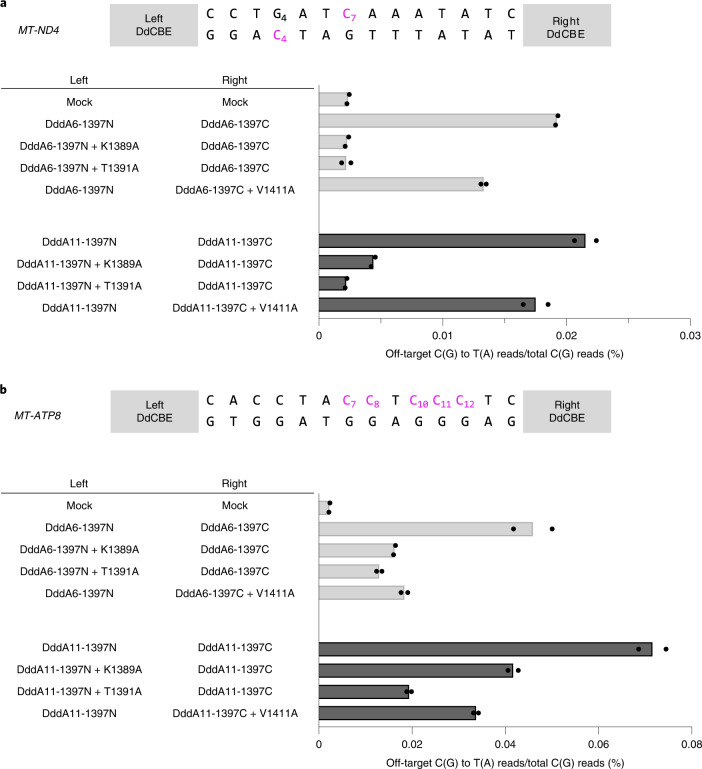
Fig. 6. Mitochondrial genome-wide off-target analysis for DddA6, and DddA11 and their HiFi variants.
a,b, The average frequencies of mitochondrial genome-wide off-target editing induced by DddA6/DddA11 and interface-engineered variants targeting MT-ND4 (a) and MT-ATP8 (b) sites for n = 2 biologically independent samples. The editing windows are shown at the top and target cytosine bases are in magenta. Source data

References

    1. Mok BY, et al. A bacterial cytidine deaminase toxin enables CRISPR-free mitochondrial base editing. Nature. 2020;583:631–637. doi: 10.1038/s41586-020-2477-4. - DOI - PMC - PubMed
    1. Lim K, Cho S-I, Kim J-S. Nuclear and mitochondrial DNA editing in human cells with zinc finger deaminases. Nat. Commun. 2022;13:1–10. doi: 10.1038/s41467-022-27962-0. - DOI - PMC - PubMed
    1. Lee H, et al. Mitochondrial DNA editing in mice with DddA-TALE fusion deaminases. Nat. Commun. 2021;12:1190. doi: 10.1038/s41467-021-21464-1. - DOI - PMC - PubMed
    1. Silva-Pinheiro P, et al. In vivo mitochondrial base editing via adeno-associated viral delivery to mouse post-mitotic tissue. Nat. Commun. 2022;13:1–9. doi: 10.1038/s41467-022-28358-w. - DOI - PMC - PubMed
    1. Guo J, et al. DdCBE mediates efficient and inheritable modifications in mouse mitochondrial genome. Mol Ther Nucleic Acids. 2022;27:73–80. doi: 10.1016/j.omtn.2021.11.016. - DOI - PMC - PubMed

Publication types