


Melanoma Management: From Epidemiology to Treatment and Latest Advances
- PMID: 36230575
- PMCID: PMC9562203
- DOI: 10.3390/cancers14194652
Melanoma Management: From Epidemiology to Treatment and Latest Advances
Abstract
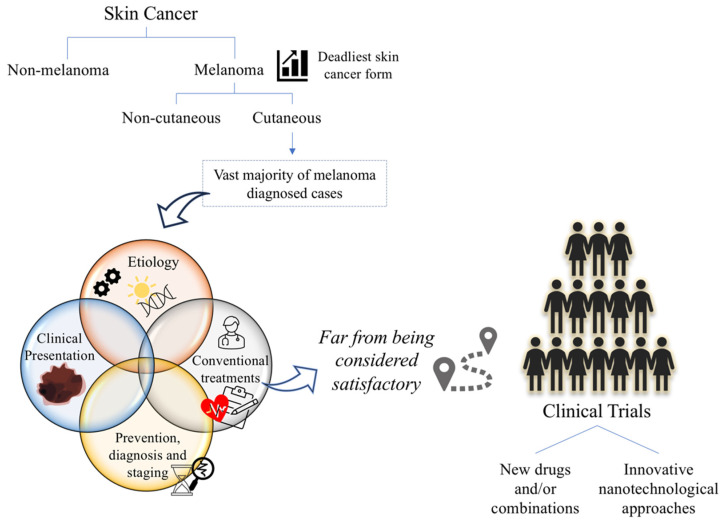
Melanoma is the deadliest skin cancer, whose morbidity and mortality indicators show an increasing trend worldwide. In addition to its great heterogeneity, melanoma has a high metastatic potential, resulting in very limited response to therapies currently available, which were restricted to surgery, radiotherapy and chemotherapy for many years. Advances in knowledge about the pathophysiological mechanisms of the disease have allowed the development of new therapeutic classes, such as immune checkpoint and small molecule kinase inhibitors. However, despite the incontestable progress in the quality of life and survival rates of the patients, effectiveness is still far from desired. Some adverse side effects and resistance mechanisms are the main barriers. Thus, the search for better options has resulted in many clinical trials that are now investigating new drugs and/or combinations. The low water solubility of drugs, low stability and rapid metabolism limit the clinical potential and therapeutic use of some compounds. Thus, the research of nanotechnology-based strategies is being explored as the basis for the broad application of different types of nanosystems in the treatment of melanoma. Future development focus on challenges understanding the mechanisms that make these nanosystems more effective.
Keywords: clinical trials; diagnosis; epidemiology; etiology; melanoma; nanotechnology; treatment.
Conflict of interest statement
The authors declare no conflict of interest.
Figures
References
-
- Gilaberte Y., Prieto-Torres L., Pastushenko I., Juarranz Á. Anatomy and Function of the Skin. In: Hamblin M.R., Avci P., Prow T.W., editors. Nanoscience in Dermatology. Elsevier; Amsterdam, The Netherlands: 2016. pp. 1–14.
-
- Thakur R., Batheja P., Kaushik D., Michniak B. Structural and Biochemical Changes in Aging Skin and Their Impact on Skin Permeability Barrier. In: Dayan N., editor. Skin Aging Handbook. Elsevier; Amsterdam, The Netherlands: 2009. pp. 55–90.
Publication types
Grants and funding
LinkOut - more resources
Full Text Sources
