


Magnetic Resonance Imaging-Based Predictive Models for Clinically Significant Prostate Cancer: A Systematic Review
- PMID: 36230670
- PMCID: PMC9562712
- DOI: 10.3390/cancers14194747
Magnetic Resonance Imaging-Based Predictive Models for Clinically Significant Prostate Cancer: A Systematic Review
Abstract
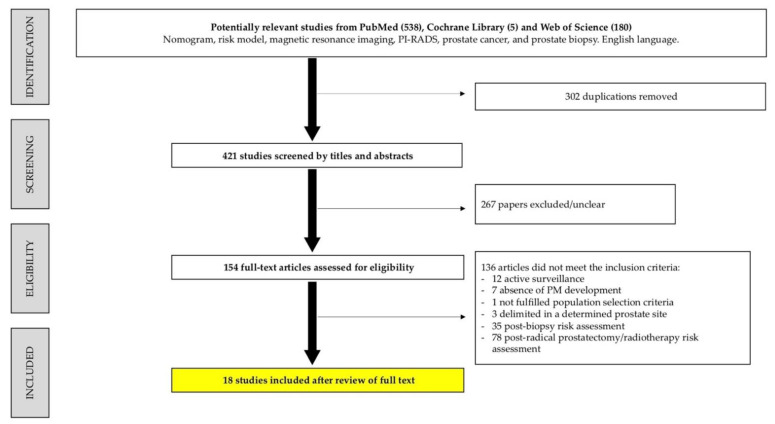
MRI can identify suspicious lesions, providing the semi-quantitative risk of csPCa through the Prostate Imaging-Report and Data System (PI-RADS). Predictive models of clinical variables that individualise the risk of csPCa have been developed by adding PI-RADS score (MRI-PMs). Our objective is to analyse the current developed MRI-PMs and define their clinical usefulness. A systematic review was performed after a literature search performed by two independent investigators in PubMed, Cochrane, and Web of Science databases, with the Medical Subjects Headings (MESH): predictive model, nomogram, risk model, magnetic resonance imaging, PI-RADS, prostate cancer, and prostate biopsy. This review was made following the Preferred Reporting Items for Systematic Reviews and Meta-analyses (PRISMA) criteria and studied eligibility based on the Participants, Intervention, Comparator, and Outcomes (PICO) strategy. Among 723 initial identified registers, 18 studies were finally selected. Warp analysis of selected studies was performed with the Quality Assessment of Diagnostic Accuracy Studies (QUADAS-2) tool. Clinical predictors in addition to the PI-RADS score in developed MRI-PMs were age, PCa family history, digital rectal examination, biopsy status (initial vs. repeat), ethnicity, serum PSA, prostate volume measured by MRI, or calculated PSA density. All MRI-PMs improved the prediction of csPCa made by clinical predictors or imaging alone and achieved most areas under the curve between 0.78 and 0.92. Among 18 developed MRI-PMs, 7 had any external validation, and two RCs were available. The updated PI-RADS version 2 was exclusively used in 11 MRI-PMs. The performance of MRI-PMs according to PI-RADS was only analysed in a single study. We conclude that MRI-PMs improve the selection of candidates for prostate biopsy beyond the PI-RADS category. However, few developed MRI-PMs meet the appropriate requirements in routine clinical practice.
Keywords: magnetic resonance imaging; predictive model; prostate cancer; risk calculator.
Conflict of interest statement
The authors declare no conflict of interest.
Figures

References
-
- Mottet N., van den Bergh R.C.N., Briers E., Van den Broeck T., Cumberbatch M.G., De Santis M., Fanti S., Fossati N., Gandaglia G., Gillessen S., et al. EAU-EANM-ESTRO-ESUR-SIOG Guidelines on Prostate Cancer—2020 Update. Part 1: Screening, Diagnosis, and Local Treatment with Curative Intent. Eur. Urol. 2021;79:243–262. doi: 10.1016/j.eururo.2020.09.042. - DOI - PubMed
-
- Epstein J.I., Egevad L., Amin M.B., Delahunt B., Srigley J.R., Humphrey P.A. The 2014 International Society of Urological Pathology (ISUP) Consensus Conference on Gleason Grading of Prostatic Carcinoma Definition of Grading Patterns and Proposal for a New Grading System. Am. J. Surg. Pathol. 2016;40:244–252. doi: 10.1097/PAS.0000000000000530. - DOI - PubMed
Publication types
Grants and funding
LinkOut - more resources
Full Text Sources
Research Materials
Miscellaneous
