


Very Low-Volume, High-Intensity Interval Training Mitigates Negative Health Impacts of COVID-19 Pandemic-Induced Physical Inactivity
- PMID: 36231609
- PMCID: PMC9565952
- DOI: 10.3390/ijerph191912308
Very Low-Volume, High-Intensity Interval Training Mitigates Negative Health Impacts of COVID-19 Pandemic-Induced Physical Inactivity
Abstract
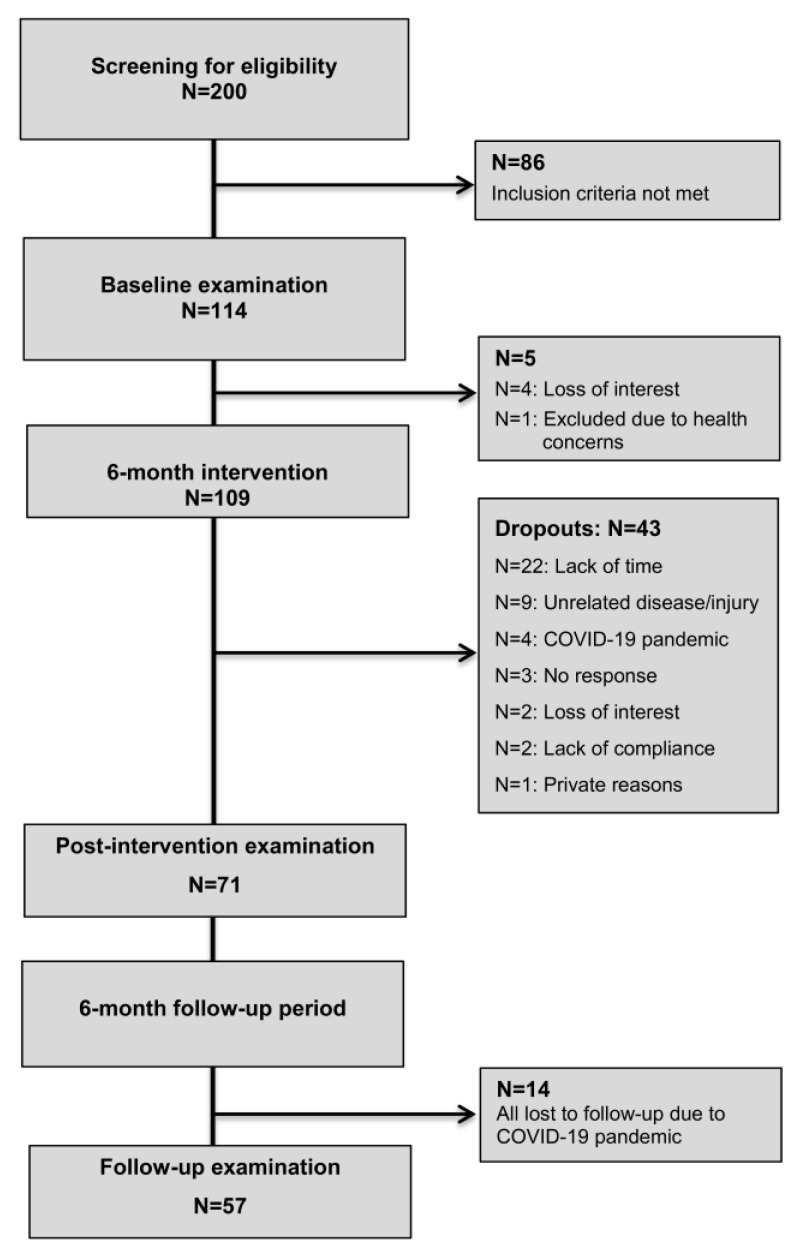
Initially, we aimed to investigate the impact of a one-year worksite low-volume, high-intensity interval training (LOW-HIIT) on cardiometabolic health in 114 sedentary office workers. Due to the COVID-19 pandemic outbreak, LOW-HIIT was discontinued after 6 months and participants were followed up for 6 months to analyze physical activity/exercise behavior and outcome changes during lockdown. Health examinations, including cardiopulmonary exercise testing and the assessment of cardiometabolic markers were performed baseline (T-1), after 6 months (T-2, termination of worksite LOW-HIIT) and 12 months (T-3, follow-up). Cycle ergometer LOW-HIIT (5 × 1 min at 85-95% HRmax) was performed 2×/week. For follow-up analyses, participants were classified into three groups: HIIT-group (continued home-based LOW-HIIT), EX-group (continued other home-based exercises), and NO-EX-group (discontinued LOW-HIIT/exercise). At T-2, VO2max (+1.5 mL/kg/min, p = 0.002), mean arterial blood pressure (MAB, -4 mmHg, p < 0.001), HbA1c (-0.2%, p = 0.005) and self-reported quality of life (QoL, +5 points, p < 0.001) were improved. At T-3, HIIT-group maintained VO2max and QoL and further improved MAB. EX-group maintained MAB and QoL but experienced a VO2max decrease. In NON-EX, VO2max, MAB and QoL deteriorated. We conclude that LOW-HIIT can be considered a promising option to improve cardiometabolic health in real-life conditions and to mitigate physical inactivity-related negative health impacts during lockdowns.
Keywords: cardiometabolic health; exercise; health promotion; lockdown; occupational health management; physical activity.
Conflict of interest statement
The authors declare no conflict of interest.
References
-
- Lear S.A., Hu W., Rangarajan S., Gasevic D., Leong D., Iqbal R., Casanova A., Swaminathan S., Anjana R.M., Kumar R., et al. The effect of physical activity on mortality and cardiovascular disease in 130,000 people from 17 high-income, middle-income, and low-income countries: The PURE study. Lancet. 2017;390:2643–2654. doi: 10.1016/S0140-6736(17)31634-3. - DOI - PubMed
-
- Lee I.M., Shiroma E.J., Lobelo F., Puska P., Blair S.N., Katzmarzyk P.T., Lancet Physical Activity Series Working Group Effect of physical inactivity on major non-communicable diseases worldwide: An analysis of burden of disease and life expectancy. Lancet. 2012;380:219–229. doi: 10.1016/S0140-6736(12)61031-9. - DOI - PMC - PubMed
-
- Wen C.P., Wai J.P.M., Tsai M.K., Yang Y.C., Cheng T.Y.D., Lee M.-C., Chan H.T., Tsao C.K., Tsai S.P., Wu X. Minimum amount of physical activity for reduced mortality and extended life expectancy: A prospective cohort study. Lancet. 2011;378:1244–1253. doi: 10.1016/S0140-6736(11)60749-6. - DOI - PubMed
-
- Myers J., McAuley P., Lavie C.J., Despres J.P., Arena R., Kokkinos P. Physical activity and cardiorespiratory fitness as major markers of cardiovascular risk: Their independent and interwoven importance to health status. Prog. Cardiovasc. Dis. 2015;57:306–314. doi: 10.1016/j.pcad.2014.09.011. - DOI - PubMed
Publication types
MeSH terms
LinkOut - more resources
Full Text Sources
Medical
Miscellaneous
