


Comparison of Concordance of Peptic Ulcer Disease, Non-Adenomatous Intestinal Polyp, and Gallstone Disease in Korean Monozygotic and Dizygotic Twins: A Cross-Sectional Study
- PMID: 36232007
- PMCID: PMC9566074
- DOI: 10.3390/ijerph191912708
Comparison of Concordance of Peptic Ulcer Disease, Non-Adenomatous Intestinal Polyp, and Gallstone Disease in Korean Monozygotic and Dizygotic Twins: A Cross-Sectional Study
Abstract
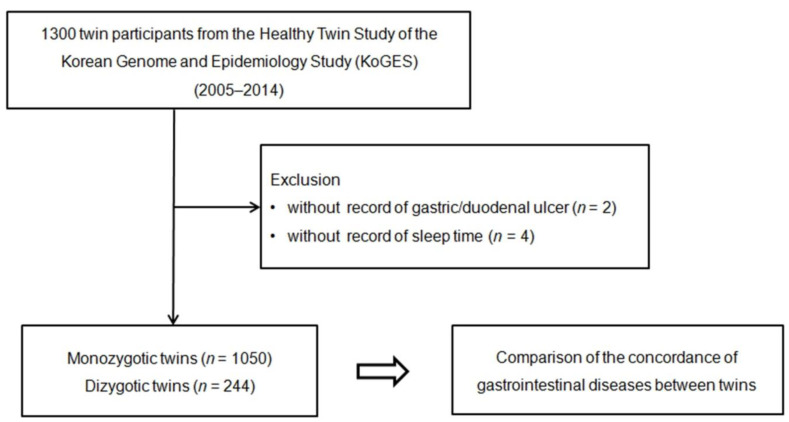
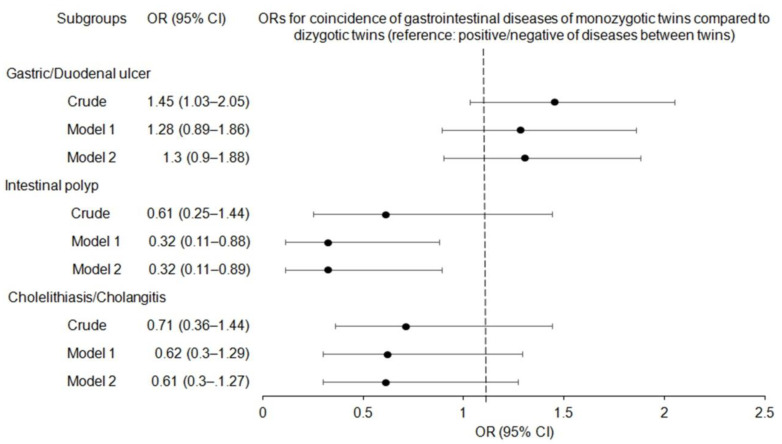
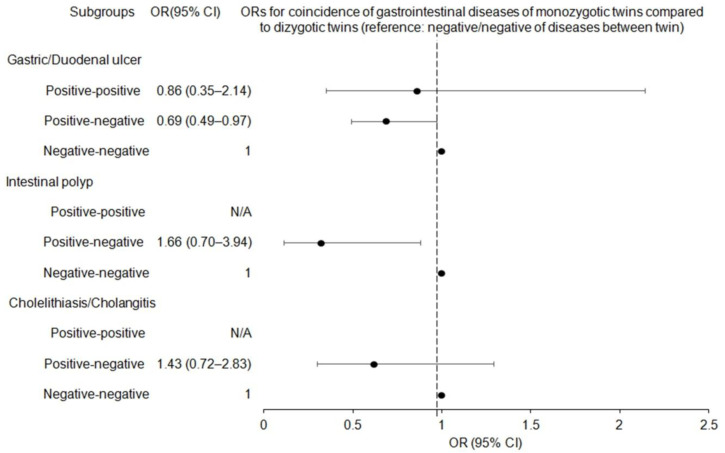
Epidemiological studies have suggested the role of multiple genetic and environmental factors in the development of non-neoplastic gastrointestinal (GI) diseases; however, little information is available on these factors in the Korean population. Therefore, this cross-sectional study explored the effect of these factors by analyzing the concordance of several benign GI disorders in 525 monozygotic twins compared to that in 122 dizygotic twins aged >20 years from the Healthy Twin Study data of the Korean Genome and Epidemiology Study (2005-2014). Chi-square test, Wilcoxon rank-sum, and binomial and multinomial logistic regression models were used for statistical analysis. There was lack of concordance of gastric/duodenal ulcers and cholelithiasis/cholangitis between monozygotic twins compared to that in dizygotic twins, suggesting that environmental factors may mediate those concordant disease expressions in monozygotic twins. The concordance of intestinal polyps in monozygotic twins was 32% lower than that in dizygotic twins (p = 0.028), indicating that the effect of genetic factors on the risk for intestinal polyp development may be low. In conclusion, the lack or low concordance of several benign GI diseases between monozygotic and dizygotic twin groups suggests the relative importance of environmental factors, indicating that these are preventable diseases.
Keywords: cholangitis; cholelithiasis; dizygotic twins; duodenal ulcer; environmental factor; gastric ulcer; genetic influence; intestinal polyp; monozygotic twins.
Conflict of interest statement
The authors declare no conflict of interest.
Figures
References
-
- Choi H.G., Kang H.S., Lim H., Kim J.H., Kim J.H., Cho S.J., Nam E.S., Min K.W., Park H.Y., Kim N.Y., et al. Changes in the Incidence Rates of Gastrointestinal Diseases Due to the COVID-19 Pandemic in South Korea: A Long-Term Perspective. J. Pers. Med. 2022;12:1144. doi: 10.3390/jpm12071144. - DOI - PMC - PubMed
Publication types
MeSH terms
LinkOut - more resources
Full Text Sources
Medical
