. 2022 Sep 29;23(19):11536.
doi: 10.3390/ijms231911536.

Rho/SRF Inhibitor Modulates Mitochondrial Functions

Affiliations

Rho/SRF Inhibitor Modulates Mitochondrial Functions

Pankaj Patyal et al. Int J Mol Sci. .

Abstract

CCG-1423 is a Rho A pathway inhibitor that has been reported to inhibit Rho/SRF-mediated transcriptional regulation. Serum response factor and its cofactors, which include ternary complex factors and myocardin-related transcription factors, regulate various cellular functions. In this study, we observed that CCG-1423 modulates the mitochondrial functions. The effect of this small molecule drug was determined by measuring mitochondrial function using an XFe96 Analyzer and an Oxygraph 2k (O2k) high-resolution respirometer. CCG-1423 treatment significantly reduced oxidative phosphorylation in a dose-dependent manner. However, CCG-1423 increased the glycolytic rate. We also observed that histone 4 at lysine-16 underwent hyperacetylation with the treatment of this drug. Immunolabeling with F-actin and MitoTracker revealed the alteration in the actin cytoskeleton and mitochondria. Taken together, our findings highlight a critical role of CCG-1423 in inhibiting the transcription of SRF/p49 and PGC-1α, β, resulting in the downregulation of mitochondrial genes, leading to the repression of mitochondrial oxidative phosphorylation and overall ATP reduction. This study provides a better understanding of the effects of CCG-1423 on mitochondria, which may be useful for the assessment of the potential clinical application of CCG-1423 and its derivatives.

Keywords: CCG-1423; acetylation; mitochondrial function; serum response factor.


Conflict of interest statement

The authors declare no conflict of interest in regard to this manuscript.

Figures
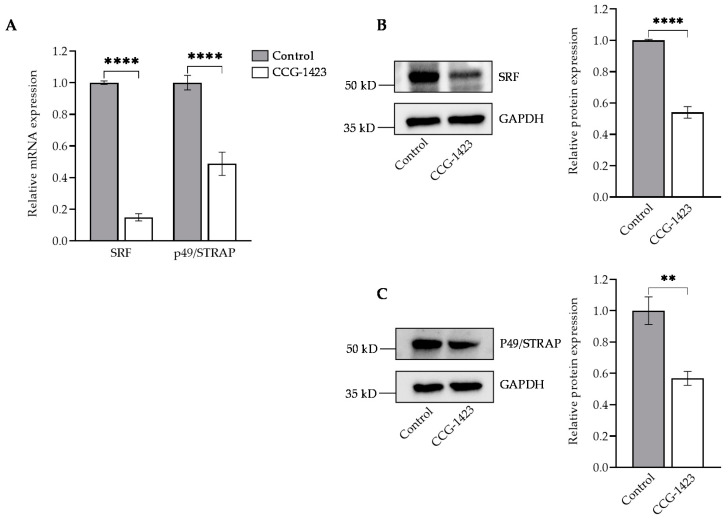
Figure 1
Figure 1
CCG-1423 represses SRF and p49/STRAP. (AC) C2C12 cells were treated with a 10 µM dosage for 24 h. (A) The mRNA expression of SRF and p49/STRAP was evaluated in qPCR. DMSO was used as control. Immunoblotting was used to evaluate the protein levels of (B) SRF and (C) p49/STRAP. GAPDH was used as the total protein loading control and relative protein expression was quantified in (B,C). ** p < 0.01, **** p < 0.0001 (n = 3).
Figure 2
Figure 2
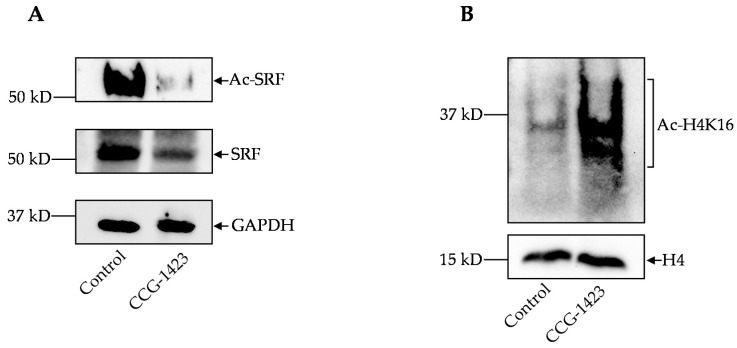
Immunoprecipitation of SRF acetylated lysine and H4K16 protein. (A) CCG-1423 represses the SRF acetylated-lysine (Ac-SRF), representative western blot of acetylated-lysine SRF and SRF in lysates from CCG-1423 treated and non-treated C2C12 cells. GAPDH was used as a loading control. (B) H4K16 was hyperacetylated on the CCG-1423 treatment, representative western blot image of H4K16 and total histone H4 protein was used as a loading control (n = 3).
Figure 3
Figure 3
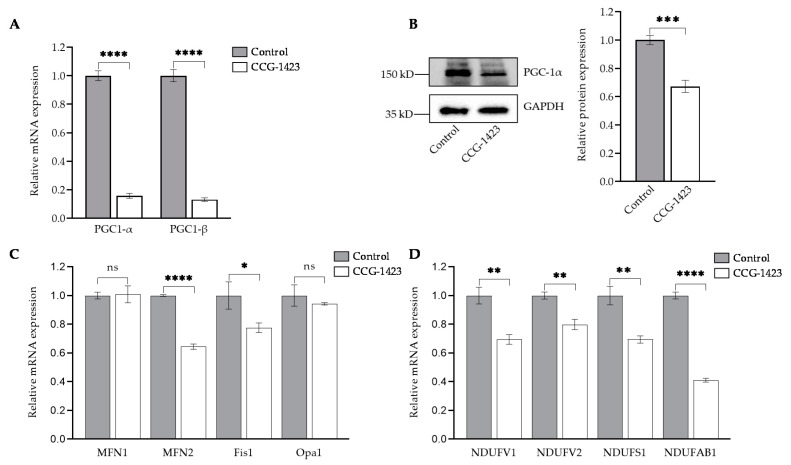
Repression of mitochondrial genes involved in biogenesis and function. (A) RT-qPCR analysis demonstrated the inhibition of PGC-1α and -1β gene expression following the treatment of CCG-1423. (B) Protein levels of PGC-1α were analyzed by Western blot and GAPDH was used as a loading control. Densitometric analysis shows inhibition of PGC-1α. (C) MFN2 and Fis1 gene expression levels reduced whereas MFN1 and Opa1 were unaffected. (D) Downregulation of mitochondrial genes involved in complex-I. * p < 0.05, ** p < 0.01, *** p < 0.001, **** p < 0.0001, ns: p > 0.05 (n = 3).
Figure 4
Figure 4
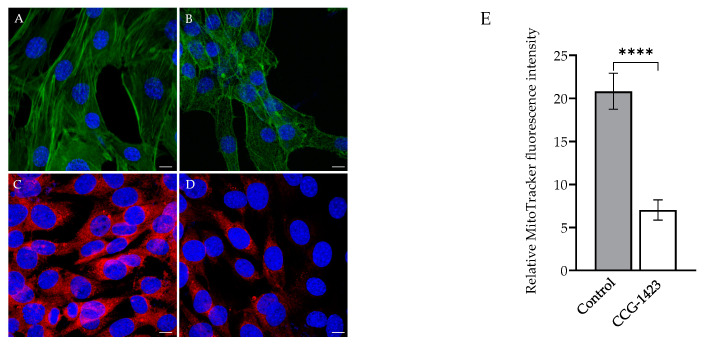
Immunolabeling of Actin and MitoTracker. C2C12 cells at 24 h post-treatment, cells incubated with phalloidin (green) and MitoTracker (red) conjugated dyes. DAPI (blue) was used for nuclear counterstaining. (A,C) Vehicle (DMSO) (B,D) CCG-1423 treated cells, at 10 μM dosage. 63× oil objective is used; scale bars indicate 10 μm. (E) MitoTracker stained cells are randomly selected microscopic fields in four individual repetitions where the fluorescence intensity was quantified using ImageJ. **** p < 0.0001 (n = 4).
Figure 5
Figure 5
Mitochondria functional analysis of oxygen consumption rate, extracellular acidification rate, and total ATP production. (A) OCR and basal respiration, maximum respiration, and spare respiratory capacity in CCG-1423 treated cells with different dosages. OCR was repressed in a dose dependent manner upon the treatment of CCG-1423 in C2C12 cells. (B) CCG-1423 upregulated the ECAR in a dose dependent manner. (C) Total ATP production was decreased in both mechanisms of oxidative phosphorylation (mitochondrial-ATP) and glycolysis (glycolysis-ATP). * p < 0.05, *** p < 0.001, **** p < 0.0001, ns: p > 0.05 (n = 4).
Figure 6
Figure 6
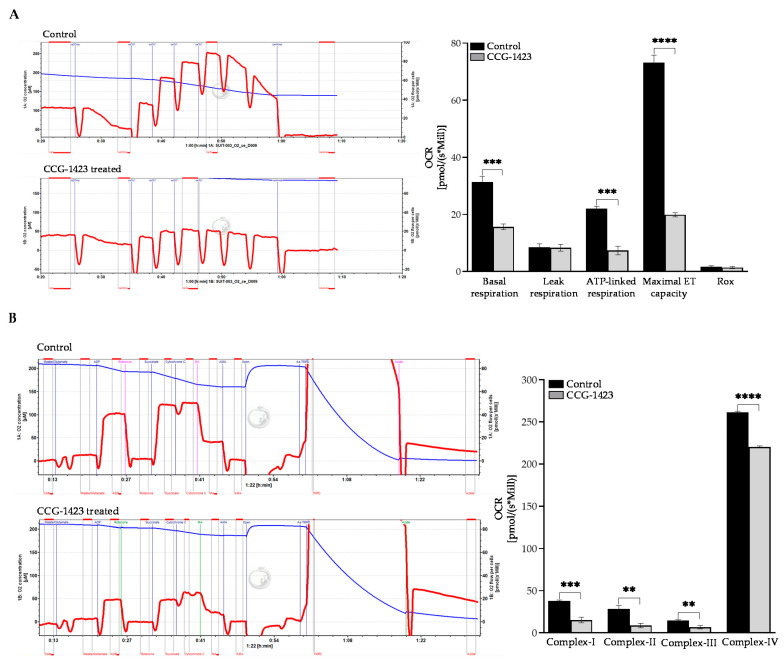
High-resolution respiratory analysis of oxidative phosphorylation. (A) OCR and basal respiration, leak respiration, ATP-linked respiration, Maximum ET capacity was analyzed using an Oroboros O2K instrument. Intact C2C12 cells were pre-treated with CCG-1423 with 10 µM for 24 h treatment. OCR and other functional aspects indicated above in the figure were repressed. (B) C2C12 cells were permeabilized and were used to determine OCR levels at complexes of ETC. OCR at complex I–IV of ETC were repressed on the treatment of CCG-1423. ** p < 0.01, *** p < 0.001, **** p < 0.0001 (n = 3).
Figure 7
Figure 7
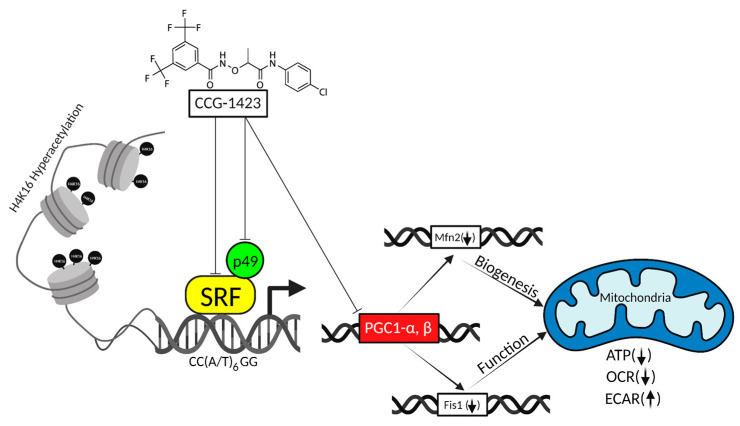
Schematic demonstrating the effects of CCG-1423 on mitochondria function. CCG-1423 inhibits SRF, p49/STRAP and PGC1-α, β, and causes H4K16 hyperacetylation, which modulates the functional activity of oxidative phosphorylation, glycolysis, and total ATP. Arrows indicate: = increase, ↓ = decrease, and formula image = inhibition.

References

    1. McDonald O.G., Wamhoff B.R., Hoofnagle M.H., Owens G.K. Control of SRF binding to CArG box chromatin regulates smooth muscle gene expression in vivo. J. Clin. Investig. 2006;116:36–48. doi: 10.1172/JCI26505. - DOI - PMC - PubMed
    1. Miano J.M. Serum response factor: Toggling between disparate programs of gene expression. J. Mol. Cell Cardiol. 2003;35:577–593. doi: 10.1016/S0022-2828(03)00110-X. - DOI - PubMed
    1. Xie L. MKL1/2 and ELK4 co-regulate distinct serum response factor (SRF) transcription programs in macrophages. BMC Genom. 2014;15:301. doi: 10.1186/1471-2164-15-301. - DOI - PMC - PubMed
    1. Esnault C., Stewart A., Gualdrini F., East P., Horswell S., Matthews N., Treisman R. Rho-actin signaling to the MRTF coactivators dominates the immediate transcriptional response to serum in fibroblasts. Genes Dev. 2014;28:943–958. doi: 10.1101/gad.239327.114. - DOI - PMC - PubMed
    1. Miano J.M., Long X., Fujiwara K. Serum response factor: Master regulator of the actin cytoskeleton and contractile apparatus. Am. J. Physiol. Cell Physiol. 2007;292:C70–C81. doi: 10.1152/ajpcell.00386.2006. - DOI - PubMed

LinkOut - more resources