


Intravenous Magnesium Sulfate Reduces the Need for Antiarrhythmics during Acute-Onset Atrial Fibrillation in Emergency and Critical Care
- PMID: 36233391
- PMCID: PMC9570780
- DOI: 10.3390/jcm11195527
Intravenous Magnesium Sulfate Reduces the Need for Antiarrhythmics during Acute-Onset Atrial Fibrillation in Emergency and Critical Care
Abstract
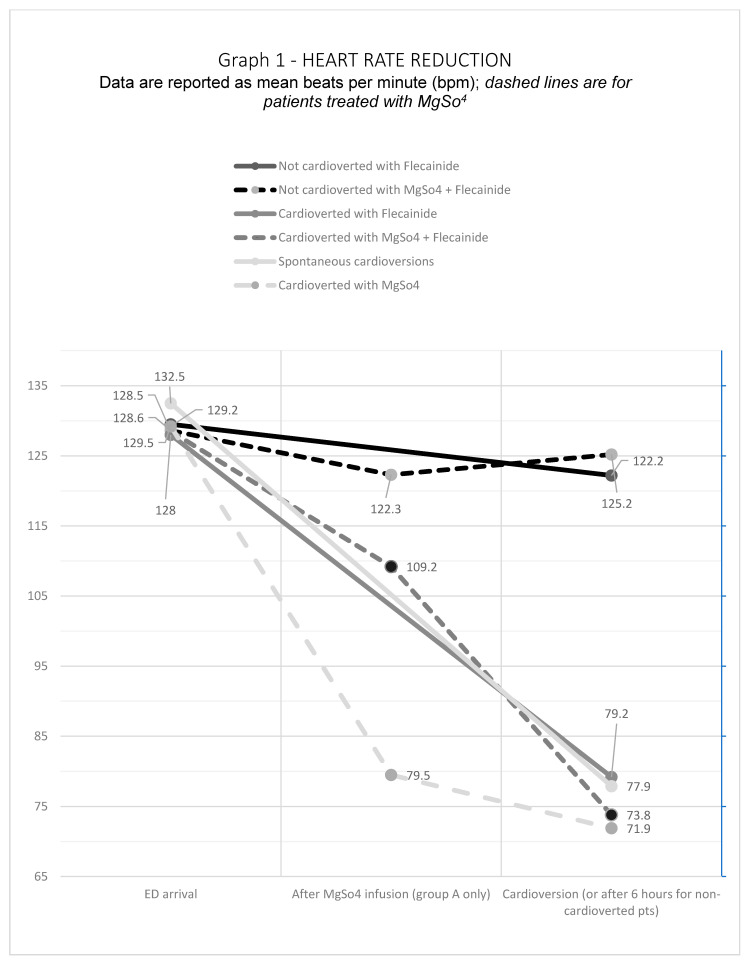
Several studies have suggested the potential role of Magnesium Sulfate (MgSO4) for the treatment of Atrial Fibrillation (AF) but, in clinical practice, the use of magnesium is not standardized although it is largely used for the treatment of supraventricular arrhythmias. Objectives. We evaluated the role of MgSO4 infusion in association with flecainide in cardioversion of patients presenting in ED with symptomatic AF started less than 48 h before. We retrospectively searched for all patients presented in ED from 1 January 2019 to 31 December 2019 requiring pharmacological cardioversion with flecainide 2 mg/kg. Ninety-seven patients met these criteria, 46 received the administration of intravenous MgSO4 2 gr (Group A), and 51 did not (Group B). Among the 97 patients, the overall cardioversion rate was 85.6%, 91.3% in Group A and 80.4% in Group B. In 27 patients out of 97, the Flecainide was not administered because of spontaneous restoration of sinus rhythm of 9 pts (Group B) and 18 pts (Group A). We also found a statistical significance in the HR at the time of cardioversion between Group A (77.8 ± 19.1 bpm) and Group B (87 ± 21.7 bpm). No complications emerged. The association between MgSO4 and Flecainide has not yielded statistically significant results. However, in consideration of its high safety profile, MgSO4 administration may play a role in ED cardioversion of acute onset AF, reducing the need for antiarrhythmic medications and electrical cardioversion procedures, relieving symptoms reducing heart rate, and reducing the length of stay in the ED.
Keywords: Flecainide; atrial fibrillation; magnesium sulfate; rate control; rhythm control.
Conflict of interest statement
The authors declare that they have no competing interest.
References
-
- Zwillinger L. Über die Magnesiumwirkung auf das Herz. Klin. Wochenschr. 1935;14:1429–1433. doi: 10.1007/BF01778848. - DOI
LinkOut - more resources
Full Text Sources
Miscellaneous
