


A New Treatment Protocol of Combined High-Dose Levothyroxine and Repetitive Transcranial Magnetic Stimulation for the Treatment of Rapid-Cycling Bipolar Spectrum Disorders: A Cohort Evaluation of 55 Patients
- PMID: 36233698
- PMCID: PMC9572106
- DOI: 10.3390/jcm11195830
A New Treatment Protocol of Combined High-Dose Levothyroxine and Repetitive Transcranial Magnetic Stimulation for the Treatment of Rapid-Cycling Bipolar Spectrum Disorders: A Cohort Evaluation of 55 Patients
Abstract
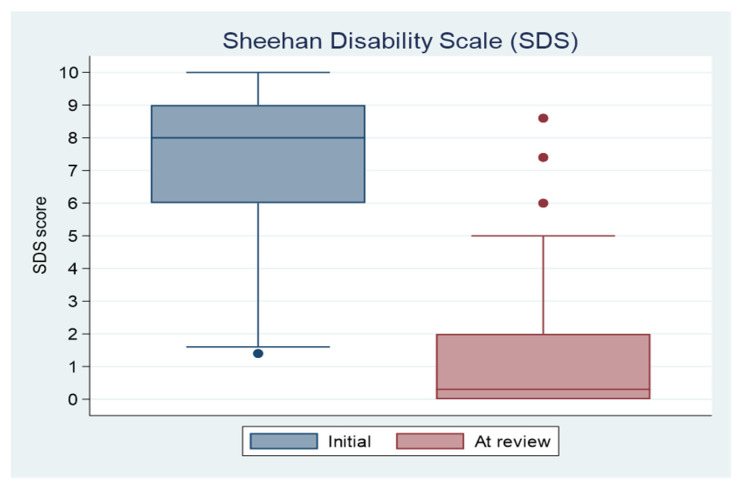
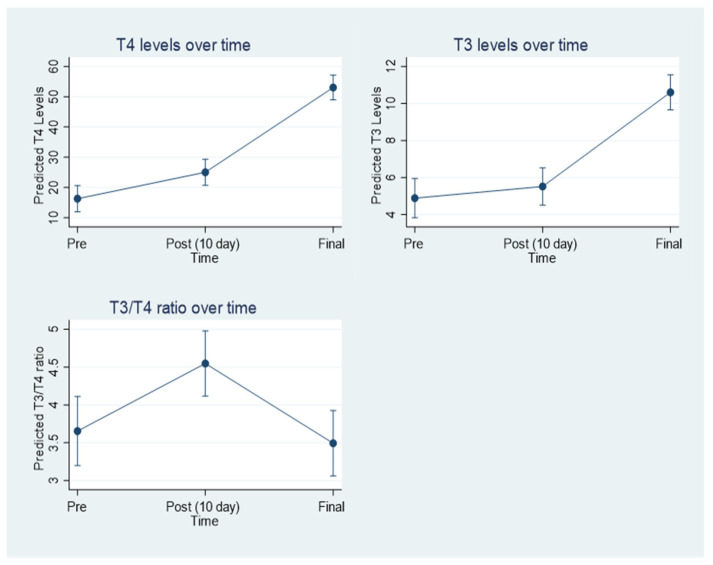
Background: Bipolar spectrum disorders (BSD) are highly disabling, with rapid cycling being treatment resistant. High-dose levothyroxine (HDT) has been reported to be effective. Diagnosis is associated with mutations in thyroid-activating enzymes and cerebral transporter protein carrier. Repetitive transcranial magnetic stimulation (rTMS) has neuroplastic effects. Methods: We report data on 55 severely symptomatic patients with rapid-cycling BSD treated with a combination protocol of HDT and rTMS. Of the patients, 31 patients (56.4%) were female and 40 (72.7%) had at least one additional diagnosis. Results: Patients were evaluated at three monthly intervals after acute treatment. Remission was measured using the Sheehan Disability Scale (SDS). The average number of medications prescribed was 1.8, with 32 patients (58.2%) needing only levothyroxine. The average dose of levothyroxine was 303.7 mcg (50 mcg−1000 mcg). A total of 53 patients were in remission (96.4%), with an average duration of 2.0 years. The SDS scores decreased significantly (Cohen’s d = 2.61 (95% C.I. 1.81 to 2.83, p < 0.001). One patient had reversible side effects. A total of 52 (94.3%) patients had Deiodinase 1 and 2 (DiO1/DiO2) or SLCO1C1 protein carrier gene mutations. Conclusion: The data support the safety and acceptability of combined HDT/rTMS. Patients achieved long remissions with substantial improvements in quality of life.
Keywords: bipolar disorder; levothyroxine; repetitive transcranial magnetic stimulation (rTMS); thyroid test; treatment.
Conflict of interest statement
The London Psychiatry Centre has pending patents for the treatment protocol in Europe and the US, with Zamar being the invento.
Figures
References
-
- Merikangas K.R., Jin R., He J.-P., Kessler R.C., Lee S., Sampson N.A., Viana M.C., Andrade L.H., Hu C., Karam E.G., et al. Prevalence and Correlates of Bipolar Spectrum Disorder in the World Mental Health Survey Initiative. Arch. Gen. Psychiatry. 2011;68:241–251. doi: 10.1001/archgenpsychiatry.2011.12. - DOI - PMC - PubMed
-
- Westman J., Hällgren J., Wahlbeck K., Erlinge D., Alfredsson L., Osby U. Cardiovascular mortality in bipolar disorder: A population-based cohort study in Sweden. [(accessed on 15 July 2022)];BMJ Open. 2013 3 doi: 10.1136/bmjopen-2012-002373. Available online: https://bmjopen.bmj.com/content/3/4/e002373. - DOI - PMC - PubMed
-
- Merikangas K.R., Akiskal H.S., Angst J., Greenberg P.E., Hirschfeld R.M., Petukhova M., Kessler R.C. Lifetime and 12-month prevalence of bipolar spectrum disorder in the National Comorbidity Survey replication. Arch. Gen. Psychiatry. 2007;64:543–552. doi: 10.1001/archpsyc.64.5.543. - DOI - PMC - PubMed
LinkOut - more resources
Full Text Sources
